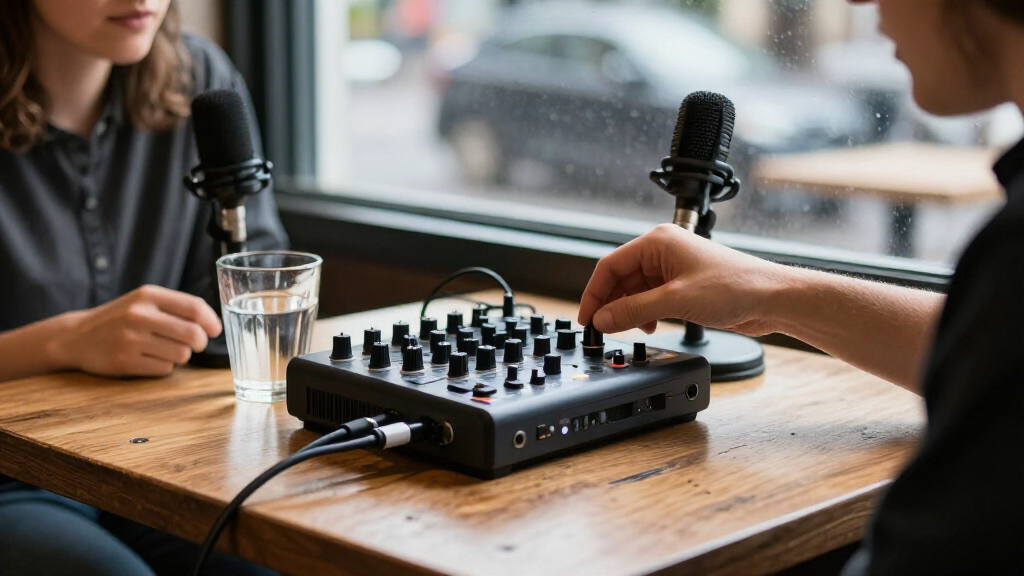
Portable podcast mixers range from compact recorders for field interviews to full production studios for multi-person shows. I rank the Zoom LiveTrak L-8 as the best overall for its battery operation, mixer controls, and onboard recording flexibility. The Zoom PodTrak P4 is a simpler choice for portable, multi-mic recording, while the RØDE RØDECaster Pro II suits creators who want advanced production features in a more powerful studio-style unit. The main tradeoff is portability and simplicity versus more inputs, controls, and production options. Read on for how the full lineup compares and which mixer fits your recording setup.

Get everyday essentials delivered free with Prime
- Fast, free delivery on millions of items
- Prime Video, Amazon Music and more included
- Member-only deals all year
Key Takeaways
- The Zoom LiveTrak L-8 leads for self-contained portability: its battery-powered design and recording features make it a stronger fit for recording away from a desk than most studio-oriented mixers here.
- Portable recorders and production studios solve different problems: the Zoom PodTrak P4 prioritizes straightforward podcast recording, while the RØDECaster Pro II offers a broader set of production controls.
- Bundles trade flexibility for a ready-to-start setup: packages from Also GO, G10, MAONO, PUPGSIS, and others can include microphones and accessories, but buyers should check whether their included components suit the intended show.
- Four-person shows need a channel plan, not just a bundle label: the 4-Person Podcast Equipment Bundle and Zoom L-8 are more relevant starting points for multiple speakers than compact two-person-style setups.
- More features can mean more setup work: a mixer with extra routing, sound effects, or controls may be useful for live production, but a simple recorder can be a better match for hosts who want to start recording quickly.
| RØDE RØDECaster Pro II All-in-One Audio Production Studio |  | Best Overall for Standalone Production | Channels: 9 | Microphone inputs: 4 combo inputs | SMART pads: 8 programmable | VIEW LATEST PRICE | See Our Full Breakdown |
| MAONO E2 Gen2 Podcast Audio Interface and Mixer |  | Best Battery-Powered Compact Pick | Inputs: 2 XLR combo inputs | Channels: 10 | Maximum preamp gain: 60 dB | VIEW LATEST PRICE | See Our Full Breakdown |
| Also GO Podcast Equipment Bundle with F998 Audio Mixer and BM800 Microphone | 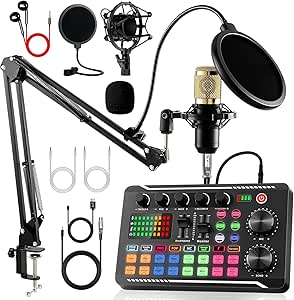 | Best Complete Starter Bundle | Mixer model: F998 | Microphone model: BM800 | Sound effects: 16 | VIEW LATEST PRICE | See Our Full Breakdown |
| G10 Podcast Equipment Bundle with Audio Mixer, Microphone, and Boom Arm |  | Best for Built-In Voice Effects | Channels: 2 | Connectivity: 3.5 mm, 6.35 mm, XLR/48V, Bluetooth, USB-C | Power source: Battery powered | VIEW LATEST PRICE | See Our Full Breakdown |
| Zoom LiveTrak L-8 Battery-Powered Mixer and Recorder |  | Best for Multitrack Field Recording | Channels: 8 | Simultaneous recording: 12 tracks | Recording quality: 24-bit/96 kHz | VIEW LATEST PRICE | See Our Full Breakdown |
| MAONO Podcast Equipment Bundle with Audio Mixer and 3.5 mm Microphone |  | Best All-in-One Starter Bundle | Mixer model: Maonocaster Lite AM200 | Channels: 9 | Connectivity: USB Type-C, 3.5 mm, auxiliary, Bluetooth | VIEW LATEST PRICE | See Our Full Breakdown |
| Zoom PodTrak P4 Portable Podcast Recorder |  | Best for Multi-Mic Portable Recording | Microphone inputs: 4 XLR inputs with phantom power | Headphone outputs: 4, with individual volume controls | Sound pads: 4 programmable | VIEW LATEST PRICE | See Our Full Breakdown |
| PUPGSIS Podcast Mixer Bundle with Dynamic Microphone |  | Best for Gaming and Casual Streaming | Model: T12S-Bundle-B | Channels: 4 | Connectivity: Bluetooth, USB | VIEW LATEST PRICE | See Our Full Breakdown |
| Pyle PMXU63BT 6-Channel Audio Mixer with Bluetooth, USB, MP3 Player, 3-Band EQ, and 48V Phantom Power |  | Best for Flexible Wired Inputs | Channels: 6 | Inputs: 4 XLR/1/4-inch combo inputs; 1/4-inch mono and stereo inputs | Connectivity: Bluetooth 4.0, USB | VIEW LATEST PRICE | See Our Full Breakdown |
| Podcast Recording Bundle with Microphones, Audio Interface, and Voice Changer |  | Best for Two-Mic Voice-Effect Setups | Channels: 2 | Connectivity: USB | Power source: Battery powered | VIEW LATEST PRICE | See Our Full Breakdown |
| Zoom PodTrak P4next Podcast Recorder with AI Noise Reduction |  | Best for Portable Four-Person Recording | Microphone inputs: 4 XLR inputs | Maximum gain: +70 dB | Headphone outputs: 4, each with separate volume control | VIEW LATEST PRICE | See Our Full Breakdown |
| 4-Person Podcast Equipment Bundle with M100 Audio Mixer and Dynamic Microphones |  | Best Complete Battery-Powered Starter Bundle | Microphones: 4 dynamic microphones | Mixer channels: 4 | Connectivity: Bluetooth, USB, and XLR | VIEW LATEST PRICE | See Our Full Breakdown |
| portable podcast mixer | Connectivity | Channels | Weight | Dimensions |
|---|---|---|---|---|
| RØDE RØDECaster Pro II All-in- | Bluetooth, USB, Wi-Fi | 9 | 2 kg | 12.01 x 10.63 x 2.36 in |
| MAONO E2 Gen2 Podcast Audio In | AUX, Bluetooth, USB-C | 10 | 0.89 kg | 9.64 × 6.18 × 2.16 in |
| Also GO Podcast Equipment Bund | Wired and Bluetooth | — | — | — |
| G10 Podcast Equipment Bundle w | 3.5 mm, 6.35 mm, XLR/48V, Bluetooth, USB-C | 2 | 4.6 lb | 11.73 x 5.51 x 8.58 in |
| Zoom LiveTrak L-8 Battery-Powe | — | 8 | 1500 g | — |
| MAONO Podcast Equipment Bundle | USB Type-C, 3.5 mm, auxiliary, Bluetooth | 9 | 1.3 kg | 9.44 × 5.11 × 1.65 in (listed; description also gives 9.45 × 5.51 × 1.65 in) |
| Zoom PodTrak P4 Portable Podca | — | — | 130 g | 6.1 × 4.41 × 1.85 in |
| PUPGSIS Podcast Mixer Bundle w | Bluetooth, USB | 4 | — | — |
| Pyle PMXU63BT 6-Channel Audio | Bluetooth 4.0, USB | 6 | — | — |
| Podcast Recording Bundle with | USB | 2 | 1.48 kg | — |
| Zoom PodTrak P4next Podcast Re | Phone input and USB audio interface | — | 10.56 ounces | — |
| 4-Person Podcast Equipment Bun | Bluetooth, USB, and XLR | — | — | 3 x 5 x 6 inches |
More Details on Our Top Picks
RØDE RØDECaster Pro II All-in-One Audio Production Studio
The RØDECaster Pro II earns the lead for podcasters who want mixing, processing, sound triggers, and recording in one portable console. Its four combo inputs and Revolution preamps support a multi-mic table, while APHEX processing and eight programmable SMART pads put voice shaping and live cues at hand. Unlike the MAONO E2 Gen2, it can record to a microSD card or USB drive and operate standalone, so a computer is not required for recording. That broader production setup comes with a larger footprint and more controls to learn than the MAONO. It weighs 2 kg, and microphones are not included; the listed details also leave recording formats and storage capacity unspecified. I’d choose it for a flexible, self-contained podcast rig, not a minimal grab-and-go setup.
Pros:- Four combo inputs with Revolution preamps suit multi-microphone recording
- APHEX processing and programmable SMART pads combine voice shaping with live sound cues
- Records to a computer, microSD card, or USB drive and can work standalone
- Bluetooth, USB, and Wi-Fi offer several connection options
Cons:- At 2 kg, it is less convenient to carry than the MAONO E2 Gen2
- Microphones are not included, adding equipment to source separately
- Recording formats and supported storage capacity are not specified in the provided details
Best for: Podcasters who record multi-person shows and want standalone recording, processing, and live sound cues in one console
Not ideal for: Solo creators seeking the lightest battery-powered setup, or buyers who need microphones included
- Channels:9
- Microphone inputs:4 combo inputs
- SMART pads:8 programmable
- Connectivity:Bluetooth, USB, Wi-Fi
- Recording options:Computer, microSD, USB drive
- Dimensions:12.01 x 10.63 x 2.36 in
- Weight:2 kg
- Warranty:2 years
Our verdict“Choose the RØDECaster Pro II if you want a versatile standalone production console and can accept its larger setup and separate microphone costs.”
MAONO E2 Gen2 Podcast Audio Interface and Mixer
The MAONO E2 Gen2 is the more travel-friendly choice for creators who need a mixer that can run away from a desk. Its built-in battery offers up to 8 hours, and two combo inputs with up to 60 dB of preamp gain cover a straightforward two-mic show. Bluetooth, USB-C, and 3.5 mm connections let it work with computers and mobile devices; loopback, monitoring, voice effects, and sound-effect buttons add useful streaming tools. Compared with the RØDECaster Pro II, it is smaller and battery-powered, but it lacks the RØDE’s standalone recording to removable media. Its battery also has a defined runtime, and it cannot charge a connected phone or provide power delivery. I’d pick it for mobile streaming and compact podcast setups, rather than as a self-contained recorder.
Pros:- Built-in battery supports up to 8 hours of use
- Two combo inputs provide up to 60 dB of preamp gain
- Loopback, monitoring, voice effects, and sound-effect buttons support streaming workflows
- Works with computers, smartphones, and tablets
Cons:- Battery runtime is limited to up to 8 hours
- Does not support phone charging or power delivery
- Unlike the RØDECaster Pro II, it does not list recording to microSD or USB storage
Best for: Two-person podcasters and mobile streamers who want a battery-powered interface for a phone, tablet, or computer
Not ideal for: Creators who need standalone recording to removable media, phone charging, or a battery-free long-session setup
- Inputs:2 XLR combo inputs
- Channels:10
- Maximum preamp gain:60 dB
- Maximum sample rate:48 kHz
- Connectivity:AUX, Bluetooth, USB-C
- Battery life:Up to 8 hours
- Dimensions:9.64 × 6.18 × 2.16 in
- Weight:0.89 kg
Our verdict“Pick the MAONO E2 Gen2 for a compact, battery-powered two-input setup, but choose another model if you need standalone recording or phone charging.”
Also GO Podcast Equipment Bundle with F998 Audio Mixer and BM800 Microphone
The Also GO F998 bundle takes a different route from the standalone mixers here: it includes the mixer, BM800 microphone, boom arm, headphones, and supporting accessories, giving a new podcaster a ready-made starting kit. The F998 adds 16 sound effects, seven recording modes, and four voice-changing modes, plus wired and Bluetooth connections for compatible devices. That makes it more immediately outfitted than the RØDECaster Pro II, which offers deeper production features but does not include a microphone. The tradeoff is that the bundle’s appeal rests on having many components and effects together; the supplied details do not specify preamp gain, recording resolution, or standalone recording to removable media. The instructions also recommend a full charge before first use or after long storage. I’d favor this kit for a first setup, not for buyers seeking clearly documented recording specifications.
Pros:- Includes a BM800 microphone, headphones, boom arm, and several recording accessories
- Offers 16 sound effects, seven recording modes, and four voice-changing modes
- Supports wired and Bluetooth connections
- Compatible with Windows, Mac OS, iOS, and Android
Cons:- The supplied details do not specify preamp gain or recording resolution
- Instructions recommend fully charging the mixer before first use or after extended storage
- Bluetooth is suggested for phones and tablets, while a wired connection may be more straightforward for computers
Best for: First-time podcasters who want a microphone, mixer, headphones, boom arm, and basic accessories in one kit
Not ideal for: Experienced producers who need specified recording resolution, preamp performance, or standalone multitrack recording
- Mixer model:F998
- Microphone model:BM800
- Sound effects:16
- Recording modes:7
- Voice changer modes:4
- Connectivity:Wired and Bluetooth
- Compatible systems:Windows, Mac OS, iOS, Android
- Included accessories:Boom arm, headphones, shock mount, pop filter, foam windscreen, XLR cables, USB cable, 3.5 mm audio cables
Our verdict“Choose the Also GO bundle if you want an all-in-one starter kit with a microphone and accessories, rather than a mixer with extensively specified recording capabilities.”
G10 Podcast Equipment Bundle with Audio Mixer, Microphone, and Boom Arm
The G10 bundle is aimed at creators who want live voice shaping and a starter microphone setup without buying each component separately. Its mixer includes noise reduction, EQ, reverb, voice changing, and built-in sound effects, while Bluetooth and USB-C help connect it to mobile devices or computers. It also supplies a 3.5 mm condenser microphone and boom arm. Compared with the Also GO F998 bundle, the G10 lists a broader range of audio input and output connector types, including XLR/48V, but the included microphone itself uses a 3.5 mm connection. That mismatch may limit how neatly the supplied mic fits a later upgrade path. The listing gives no warranty details, and its two-channel specification is a narrower fit than the Zoom LiveTrak L-8’s eight-channel recording setup. I’d choose it for effects-led streaming, not larger panel shows.
Pros:- Includes a 3.5 mm condenser microphone and boom arm
- Mixer combines noise reduction, EQ, voice changing, sound effects, and reverb
- Supports Bluetooth, USB-C, and multiple listed audio connector types
- Designed for PC, Mac, and mobile-device use
Cons:- The included microphone uses 3.5 mm while the mixer also lists other input types
- Two channels make it less suited to larger podcast panels than the Zoom LiveTrak L-8
- Warranty details are not specified in the provided information
Best for: New streamers who want a supplied microphone and boom arm, plus voice effects, EQ, and reverb controls
Not ideal for: Multi-person podcast teams needing more than two channels or buyers who want clear warranty information
- Channels:2
- Connectivity:3.5 mm, 6.35 mm, XLR/48V, Bluetooth, USB-C
- Power source:Battery powered
- Output connectors:TRS, USB-C, XLR
- Audio input:XLR, TRS, 3.5 mm
- Microphone type:3.5 mm condenser
- Dimensions:11.73 x 5.51 x 8.58 in
- Weight:4.6 lb
Our verdict“The G10 is a fit for a solo streamer who values built-in effects and included gear, but not for a growing multi-mic podcast.”
Zoom LiveTrak L-8 Battery-Powered Mixer and Recorder
The Zoom LiveTrak L-8 is the strongest fit here for podcasters who prioritize separate tracks and monitoring over a compact, effects-focused interface. It records up to 12 tracks at 24-bit/96 kHz to an SD card and can record to the card and a computer at the same time. Four headphone outputs and three independent monitor mixes let guests and hosts hear tailored feeds, an advantage over the two-input MAONO E2 Gen2 for a more involved recording session. Its eight channels include six combo inputs and two stereo inputs, but only six preamps are specified, so the channel count does not mean eight mic preamps. It is also larger than the MAONO and less focused on built-in voice effects than the RØDECaster Pro II. I’d choose it for multitrack capture and guest monitoring, not minimal travel.
Pros:- Records up to 12 tracks at 24-bit/96 kHz to an SD card
- Can record to an SD card and computer simultaneously over USB
- Four headphone outputs and three independent monitor mixes support guest sessions
- Battery-powered design supports portable recording
Cons:- Only six preamps are specified for its eight channels
- Larger than compact options such as the MAONO E2 Gen2
- Software update support date is listed as unknown
Best for: Podcast teams recording several sources who need SD-card multitrack capture and separate headphone mixes
Not ideal for: Solo mobile creators seeking a compact interface with extensive built-in voice effects and sound pads
- Channels:8
- Simultaneous recording:12 tracks
- Recording quality:24-bit/96 kHz
- Recording media:SD card
- Preamps:6
- Headphone outputs:4
- Independent monitor mixes:3
- Power source:Battery powered
- Weight:1500 g
Our verdict“Choose the LiveTrak L-8 when separate-track capture and guest monitoring matter more than a smaller, effects-led mixer.”
MAONO Podcast Equipment Bundle with Audio Mixer and 3.5 mm Microphone
The Maonocaster Lite AM200 suits new podcasters who want a mixer, microphone, and basic recording accessories in one package. Its effects, reverb, tone controls, and noise reduction give casual streams more on-the-fly shaping than the more recording-focused Zoom PodTrak P4. It can also route a show to as many as four devices or platforms, which is useful for a small two-person setup.
The tradeoff is its 3.5 mm microphone input: it does not support phantom power, so this bundle is not a flexible base for upgrading to many studio condenser microphones. At 1.3 kg, it is also heavier than the notably compact PodTrak P4. I’d pick it for an effects-led, ready-to-start setup, not for a mic-heavy show that may grow.
Pros:- Includes a mixer, condenser microphone, tripod, windscreen, and connection cables.
- Built-in and recordable effects, reverb, tone controls, and noise reduction support live audio shaping.
- Supports recording and streaming from compatible computers and mobile devices.
- Can stream to as many as four devices and platforms simultaneously.
Cons:- The 3.5 mm microphone input does not support phantom power, limiting microphone choices.
- At 1.3 kg, it is less convenient to carry than the Zoom PodTrak P4.
- Some phone connections need an unincluded OTG adapter, and the computer may require manual input and output selection.
Best for: First-time solo or two-person podcasters who want an included microphone, simple effects, and computer or compatible phone streaming.
Not ideal for: Creators planning to use phantom-powered condenser microphones or expand to a larger multi-microphone recording setup.
- Mixer model:Maonocaster Lite AM200
- Channels:9
- Connectivity:USB Type-C, 3.5 mm, auxiliary, Bluetooth
- Microphone input:3.5 mm; phantom power not supported
- Power:Battery powered; 5 V
- Dimensions:9.44 × 5.11 × 1.65 in (listed; description also gives 9.45 × 5.51 × 1.65 in)
- Weight:1.3 kg
- Included items:Condenser microphone, tripod, windscreen, mixer, charging cable, two 3.5 mm TRRS cables, microphone cable, manual
- Streaming support:Up to 2 people, 4 devices, and 4 platforms simultaneously
Our verdict“Choose the MAONO bundle for a ready-to-start, effects-rich two-person show, but skip it if phantom-powered microphones or lighter travel gear are priorities.”
Zoom PodTrak P4 Portable Podcast Recorder
The Zoom PodTrak P4 is the strongest fit here for a small, mic-based podcast that needs to record away from a desk. Four XLR inputs with phantom power let a group use compatible studio microphones, while four individually controlled headphone outputs give each speaker a listening level of their own. Unlike the MAONO Maonocaster Lite AM200, it is built around multitrack recording and microphone connections rather than a bundled mic and a broad set of voice effects.
For remote guests, the P4 adds a phone connection and automatic mix-minus, which helps prevent callers from hearing their own delayed voice. Its compact, 130 g body is easy to pack, though two AA batteries provide up to 3.5 hours of operation. I’d choose it for portable interviews, but its two-in/two-out USB interface is limited for more elaborate computer routing.
Pros:- Four XLR inputs with phantom power support a range of microphones and group sizes.
- Four headphone outputs have individual volume controls for on-location monitoring.
- Multitrack WAV recording and programmable sound pads suit interview and show workflows.
- Automatic mix-minus and phone and USB connections support remote guests.
Cons:- Battery life is listed as up to 3.5 hours, which may be restrictive for longer sessions.
- Requires two AA batteries rather than offering longer-lasting battery capacity.
- The USB audio-interface mode is limited to two inputs and two outputs.
Best for: Mobile podcast teams of up to four people who need XLR microphones, separate headphone controls, and multitrack recording.
Not ideal for: Streamers seeking a bundled microphone, extensive voice effects, or a USB interface with more than two input channels.
- Microphone inputs:4 XLR inputs with phantom power
- Headphone outputs:4, with individual volume controls
- Sound pads:4 programmable
- Recording:Multitrack WAV
- Remote interview features:Automatic Mix-Minus; TRRS phone jack and USB
- USB audio interface:2-in/2-out
- Power and battery life:2 AA batteries; up to 3.5 hours
- Dimensions:6.1 × 4.41 × 1.85 in
- Weight:130 g
Our verdict“Pick the PodTrak P4 for portable four-microphone recording and remote interviews, provided its battery runtime and basic USB routing fit your sessions.”
PUPGSIS Podcast Mixer Bundle with Dynamic Microphone
The PUPGSIS T12S-Bundle-B is aimed at creators who want a straightforward mixer-and-microphone kit for gaming, streaming, or an entry-level podcast. Its four-channel mixer combines Bluetooth, noise reduction, voice effects, and four customizable sound pads, each able to hold up to 25 seconds of audio. That gives it a more compact, stream-oriented feature set than the Zoom PodTrak P4, which puts more emphasis on XLR microphones, multitrack recording, and remote interviews.
The included dynamic microphone, headphones, and cables make setup feel approachable, but the headphones are described as being for sound-card testing rather than as a clear long-term monitoring upgrade. The stated microphone connection is 1/4-inch, and some device pairings may need checking before purchase. I’d choose it for casual live content, not a growing production that needs dependable multitrack capture.
Pros:- Bundle includes a dynamic microphone, mixer, headphones, and connection cables.
- Four customizable sound pads can each store up to 25 seconds of audio.
- Bluetooth, noise reduction, and voice effects cater to live streaming and gaming.
- Plug-and-play controls include muting, monitoring, and volume adjustment.
Cons:- The product information does not specify multitrack recording, unlike the Zoom PodTrak P4.
- Included headphones are described as being for testing the sound card, so buyers may want separate monitoring headphones.
- Compatibility can depend on the device and connection setup.
Best for: New gaming streamers and casual podcasters who want a bundled dynamic microphone, simple controls, and sound effects for live content.
Not ideal for: Podcast teams needing multitrack recording, several XLR microphone inputs, or clearly documented compatibility across complex setups.
- Model:T12S-Bundle-B
- Channels:4
- Connectivity:Bluetooth, USB
- Sound pads:4; up to 25 seconds of recording each
- Microphone:Dynamic; 1/4-inch (6.35 mm)
- Outputs:TRS, XLR
- Voltage:5 V
- Package contents:Dynamic microphone, mixer, XLR-to-6.35 mm TRRS cable, OTG cable, wired headphones, manual
- Warranty:One year
Our verdict“Choose the PUPGSIS bundle for casual gaming streams and effect-led live content, but look to the Zoom PodTrak P4 for a more clearly specified podcast recording workflow.”
Pyle PMXU63BT 6-Channel Audio Mixer with Bluetooth, USB, MP3 Player, 3-Band EQ, and 48V Phantom Power
The Pyle PMXU63BT is the most conventional live-sound mixer in this group. Its four XLR/1/4-inch combo inputs, additional 1/4-inch inputs, and six-channel layout offer more ways to connect microphones and other audio sources than the PUPGSIS four-channel streamer bundle. Bluetooth and USB playback can also bring in music without adding another playback device, while 3-band EQ gives the host basic tone shaping.
That flexibility comes with a portability caveat: this mixer needs a DC adapter, rather than running on batteries like the Zoom PodTrak P4, so it is better for a venue or a travel kit with reliable power than for recording outdoors. It also lacks the P4’s specified multitrack recorder and remote-interview tools. I’d select it for a powered mobile rig with varied inputs, not for a self-contained field podcast setup.
Pros:- Six channels and four XLR/1/4-inch combo inputs accommodate varied wired sources.
- Bluetooth, USB, and MP3 playback provide several ways to add audio.
- 3-band EQ and 16-bit DSP effects offer basic sound shaping.
- Provides +48 V phantom power for compatible microphones.
Cons:- Requires a DC adapter, unlike the battery-powered Zoom PodTrak P4.
- The listed specifications contain inconsistencies, including an 80 kHz frequency entry.
- Bluetooth range is listed as 15+ feet, which may constrain placement.
Best for: Podcasters and small event hosts who need several wired input types, Bluetooth or USB playback, and phantom power near an outlet.
Not ideal for: Field recording teams who need battery operation, onboard multitrack recording, or a compact recorder for interviews away from mains power.
- Channels:6
- Inputs:4 XLR/1/4-inch combo inputs; 1/4-inch mono and stereo inputs
- Connectivity:Bluetooth 4.0, USB
- Bluetooth range:15+ ft.
- Main outputs:2 × 1/4-inch (L/R)
- Phantom power:+48 V
- Equalizer and DSP:3-band EQ; 16-bit DSP
- Power supply:100–240 V; ±15 V DC adapter
- Dimensions and weight:9.3 × 9.7 × 2.6 in.; 3.8 lb.
Our verdict“Choose the Pyle for a powered setup that needs flexible inputs and playback, but choose the PodTrak P4 for battery-powered field podcast recording.”
Podcast Recording Bundle with Microphones, Audio Interface, and Voice Changer
This bundle is a practical match for a host and co-host who want two microphones and voice effects without assembling a separate kit. It includes two condenser microphones and suspension arms, plus an interface with noise reduction, DSP processing, and four voice variations. Compared with the MAONO Maonocaster Lite AM200, this package makes two microphones central to the setup; the MAONO, by contrast, lists sound effects and simultaneous streaming to multiple devices as key strengths.
The supplied details describe a two-channel, USB-connected unit with XLR audio input, but do not spell out a multitrack recording workflow or a broad range of mixer connections. That makes it less clearly suited to expanding beyond a simple pair. The bundle supports many operating systems and devices, though its battery should be charged before first use or after long storage, and driver installation may require customer-support help.
Pros:- Includes two condenser microphones and suspension arms for a paired-host setup.
- DSP processing and noise reduction offer sound shaping without separate processing hardware.
- Four voice variations and ten sound effects support character-led or gaming content.
- Lists compatibility across Windows, macOS, Android, iOS, Chrome OS, PS5, and Xbox.
Cons:- The two-channel specification may limit expansion beyond the included two-microphone setup.
- Driver installation may require help from customer support.
- The battery should be fully charged before first use or after extended storage.
Best for: Two-person podcast hosts or gaming creators who want a paired microphone kit, basic DSP, and voice effects for compatible devices.
Not ideal for: Mobile interview crews needing several XLR inputs, standalone multitrack recording, or a clearly documented portable recorder workflow.
- Channels:2
- Connectivity:USB
- Power source:Battery powered
- Output connector:USB Type-C
- Audio input:XLR
- Included microphones:2 condenser microphones
- Voice variations and sound effects:4 voice variations; 10 sound effects
- Compatibility:Windows, macOS, Android, iOS, Chrome OS, PC, smartphones, PS5, Xbox
- Weight:1.48 kg
Our verdict“Choose this bundle for a two-person setup with included microphones and voice effects, but not for a growing show that needs field-ready multitrack recording.”
Zoom PodTrak P4next Podcast Recorder with AI Noise Reduction
The Zoom PodTrak P4next is the clearest fit here for recording a four-person conversation away from a desk: it combines four XLR mic inputs, four separately controlled headphone outputs, and multitrack SD recording in a battery-powered unit. Compared with the larger Zoom LiveTrak L-8, it prioritizes a lighter, simpler podcast setup over a broader mixer workflow. AI noise reduction, Tone Enhancement, and compression offer ways to manage rough recording conditions, while phone connectivity can bring a remote caller into a session or support audio capture alongside video. The tradeoff is that it runs on two AA batteries, and the listed 510-minute recording time may not suit extended sessions without a power plan. Choose it for portable spoken-word recording, not for a full production desk.
Pros:- Four XLR inputs and multitrack recording support a four-person session.
- Four headphone outputs have separate volume controls for personalized monitoring.
- AI noise reduction, Tone Enhancement, and compression provide onboard audio tools.
- Phone input and USB audio interface mode support flexible recording setups.
Cons:- Requires two AA batteries, adding a power-planning step for mobile sessions.
- The listed recording time is 510 minutes, which may constrain unusually long recordings.
Best for: Mobile interviewers and small podcast teams who need four XLR microphones, individual headphone levels, and multitrack SD recording in a compact recorder.
Not ideal for: Hosts who routinely record sessions longer than the listed 510 minutes or want a larger mixer with more room for hands-on control, such as the Zoom LiveTrak L-8.
- Microphone inputs:4 XLR inputs
- Maximum gain:+70 dB
- Headphone outputs:4, each with separate volume control
- Recording format:WAV
- Storage:SD card; listed capacity 2 TB
- Power:2 AA batteries
- Weight:10.56 ounces
- Connectivity:Phone input and USB audio interface
Our verdict“Choose the P4next for portable, four-mic podcast sessions with independent headphone control; skip it if you need longer listed recording time or a more expansive mixer layout.”
4-Person Podcast Equipment Bundle with M100 Audio Mixer and Dynamic Microphones
This M100 bundle suits a group that needs microphones and basic accessories along with its mixer, rather than a recorder-first setup. Four dynamic mics, stands, earphones, and cables are included, so it offers a more ready-to-assemble four-person kit than the Zoom PodTrak P4next, which centers on recording features and expects microphones to be supplied separately. The M100 adds independent channel controls, noise reduction, effects, Bluetooth playback, and loopback, with USB plug-and-play compatibility claimed for Windows, iOS, and Android. Its rechargeable battery and compact listed dimensions support portable use, but the bundle’s battery runtime is unspecified. The product description also gives no specific device models or platform requirements, so buyers with a particular phone or tablet should verify compatibility before relying on it for a session.
Pros:- Includes four dynamic microphones, desktop stands, earphones, cables, and related accessories.
- Independent channel volume and mute controls help manage multiple speakers.
- Rechargeable 4000 mAh battery supports use away from a fixed power source.
- Bluetooth playback, audio effects, noise reduction, and loopback add flexible session options.
Cons:- Battery runtime is not specified, making it difficult to plan untethered recording sessions.
- Compatibility claims do not identify specific device models or platform requirements.
- The description does not specify multitrack recording or SD-card recording.
Best for: New four-person podcast or livestream teams who want a mixer, four dynamic microphones, and basic monitoring accessories in one portable bundle.
Not ideal for: Podcasters who need a clearly documented battery runtime, verified compatibility with a specific mobile device, or dedicated multitrack SD recording like the Zoom PodTrak P4next.
- Microphones:4 dynamic microphones
- Mixer channels:4
- Connectivity:Bluetooth, USB, and XLR
- Battery:4000 mAh rechargeable lithium-ion
- Compatible devices:Voice recorder, laptop, PC, smartphone, and tablet
- Operating systems:Windows, iOS, and Android
- Dimensions:3 x 5 x 6 inches
- Included accessories:Desktop mic stands, monitor earphones, cables, shock mounts, foam mic covers, and earphone splitters
Our verdict“Pick this bundle if you want a portable, ready-to-start four-person setup with included microphones, but choose the P4next if standalone multitrack recording is your priority.”
How We Picked
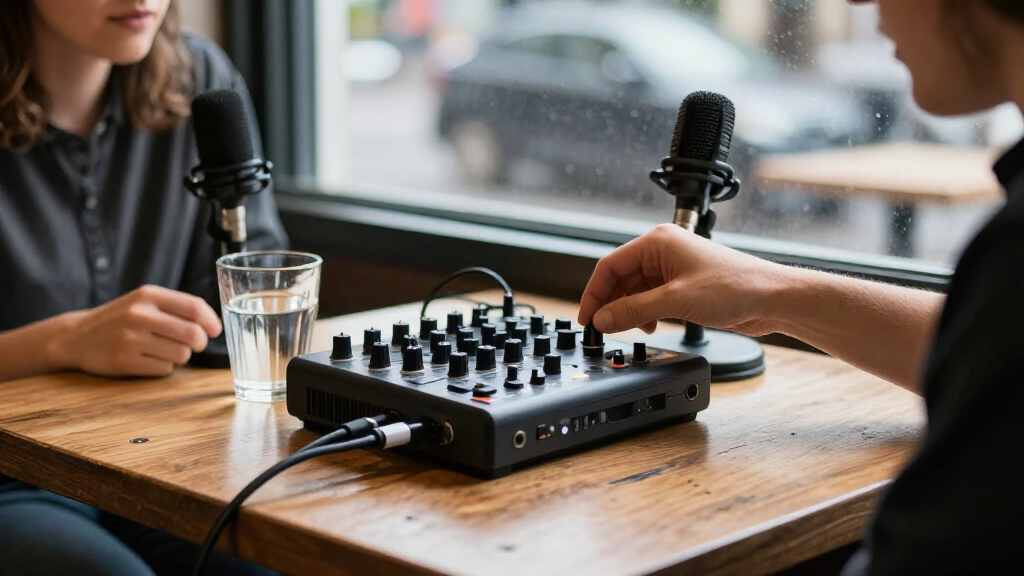
I compared these portable podcast mixers by how well they serve real recording situations: solo and remote interviews, multi-host conversations, mobile sessions, and shows that need live production controls. I looked at portability, power options, recording and computer-connectivity needs, microphone inputs, ease of setup, and whether a product is a standalone mixer or a bundle that depends on its included accessories. I also weighed the usefulness of the feature set against the additional setup and gear a buyer may need.
The ranking favors products that combine practical mobility with clear podcast use, rather than sheer feature count. The LiveTrak L-8 ranks first for bringing battery operation, mixing, and recording together; the PodTrak P4 follows for a more focused portable recording workflow. The RØDECaster Pro II ranks highly for creators who value production control over the smallest travel setup. Bundles and general-purpose mixers rank lower when their fit depends more heavily on included microphones, computer use, or extra equipment. Product names and feature descriptions reflect the supplied product information; buyers should confirm current compatibility and package contents before purchase.
Factors to Consider When Choosing Portable Podcast Mixers
Before choosing among these portable podcast mixers, decide where your audio will be captured and how much of the session you want the mixer to manage. A unit that works well beside a computer may be awkward for an interview recorded outdoors, while a compact recorder may feel limiting for a live show with multiple sources. These broader checks can help narrow the field before you compare individual models.
Decide What Portable Means for Your Show
Portability can mean a small footprint, battery operation, or a recorder you can use without a laptop; those are not the same thing. If you record in locations without reliable power, check whether the mixer itself can run on batteries rather than assuming a compact size makes it field-ready. For travel between rooms in a home or studio, power access may matter less than quick setup and easy cable storage. Think through the full carry kit, including microphones, headphones, stands, cables, and any computer you need. A mixer that travels well but requires several extra pieces may be less convenient than its dimensions suggest. Match portability to your actual recording routine, not occasional trips you may never make.
Count Microphone Inputs for the Whole Session
Count every person who may speak at once, then leave room for a guest or co-host you have not planned for. A product described as a multi-person bundle does not automatically tell you how many separate microphone channels are available or how each source can be controlled. Check whether each speaker gets an independent input and level control, since sharing a channel can make balancing voices harder. Also account for remote callers, phones, instruments, or playback audio if those are part of your format. Extra inputs can add size and setup complexity, so do not buy far more capacity than your show needs without a reason. A little headroom is useful; a channel count based only on the current guest list can lead to an early replacement.
Choose Between Standalone Recording and Computer-Based Work
Some creators want the mixer to record a session directly, while others prefer to capture audio through a computer and recording application. Direct recording can reduce reliance on a laptop during mobile sessions and may simplify a basic interview workflow. Computer-based setups can offer a familiar editing path, but they add software configuration and another device to pack. Before buying, confirm the connection type your computer supports and whether the mixer fits your preferred recording software. Do not assume that USB connectivity means every routing or multitrack function will work the same way on every system. Choose the workflow you will use consistently, rather than paying for capabilities that do not fit your editing habits.
Check Power, Storage, and Backup Plans
Mobile recording depends on more than the mixer: power, storage, and a way to protect the session all affect reliability. If you are recording away from an outlet, check the supported power method and plan for the length of your sessions. For onboard recording, confirm the required media type and capacity rather than discovering a compatibility issue on recording day. Long interviews are difficult to recreate, so decide whether you need a second recording path or a separate backup device. A battery-powered mixer can still be a poor field choice if its media or accessories are inconvenient to source. Make a short pre-session checklist for batteries, memory, cables, and a test recording.
Treat Bundled Microphones as a Starting Point
Bundles can make setup simpler by pairing a mixer with microphones and accessories, but the included kit may not match your room or recording style. A microphone that is workable in a treated space may pick up more room noise in a reflective room, while a stand or boom arm may not fit your desk. Check which items are included and whether the microphones connect directly to the mixer without extra adapters. Consider how many headphones and mic stands your show needs, since a bundle may cover only part of the setup. If you already own suitable microphones, a mixer-only purchase can avoid duplicate gear. Compare the complete working setup, not just the number of items in the box.
Pay for Controls You Will Use
Production features such as sound pads, voice effects, channel processing, and flexible routing can make a live show easier to manage, but they also add decisions during setup. Hosts who record, edit, and publish later may gain more from simple level controls and a reliable recording path than from live effects. If you stream or run a show with music and caller audio, direct access to those controls can reduce dependence on computer software. Think about who will operate the mixer while hosting; a feature is less useful if it distracts from the conversation. A premium unit makes sense when its production tools replace separate equipment or solve a recurring workflow problem. Otherwise, a focused recorder may be easier to learn and carry.
Frequently Asked Questions
Can I record a podcast without bringing a laptop?
Yes, but only if the mixer or recorder supports recording without a computer and you have the required storage and power. The Zoom LiveTrak L-8 and Zoom PodTrak P4 are the clearest fits in this lineup for a self-contained recording workflow. Check how each unit stores recordings and what media it requires before traveling. A computer may still be useful for monitoring, editing, or managing a live stream, even when it is not needed to capture the session. Test the full recording process at home before relying on it in the field.
Is a four-microphone bundle the right choice for a four-person show?
It may be, but the bundle name alone does not confirm that every microphone has an independent channel and control. Check the mixer’s input count, connector types, and whether the package includes enough cables and stands for all speakers. Separate controls make it easier to adjust each voice without changing everyone else’s level. Also consider whether you need a spare input for a phone, remote guest, or music source. If the show will regularly add guests, choose a setup with some channel capacity beyond the usual number of hosts.
Should I choose the RØDECaster Pro II or a portable recorder?
Choose based on whether production control or travel simplicity matters more to your workflow. The RØDECaster Pro II is a better match for creators who want a broader set of studio-style controls and expect to manage several elements during a show. A focused recorder such as the Zoom PodTrak P4 is more suitable when the priority is capturing a podcast session with fewer production steps. Compare where you record, whether you need onboard recording, and how much gear you are willing to carry. Do not select a larger feature set unless you plan to use it.
Are podcast mixer bundles suitable for someone who already owns microphones?
They can be, but a bundle may include equipment you do not need, and its mixer may not offer the inputs or connections your existing microphones require. Check whether your microphones need phantom power, a particular connector, or adapters before choosing. Also compare the bundle’s included accessories with your current stands, cables, and headphones. If most of the package would go unused, a standalone mixer is often the cleaner fit. A bundle makes more sense when its microphone and accessory setup fills a real gap in your kit.
What should I prioritize for recording interviews away from home?
Start with power and recording independence, then check how easily the setup fits into your carry kit. A battery-capable recorder can remove the need to find an outlet, while onboard recording can keep a laptop out of the session. You will still need to plan for microphones, headphones, storage, and a backup power source for longer recordings. Consider how many people may speak at once and whether guests will connect by phone or another device. Run a complete test in a similar location before an important interview, since room noise and connection needs can differ from a home studio.
Conclusion
For the broadest mix of portable recording and flexible production, I recommend the Zoom LiveTrak L-8 as the best overall pick. The Zoom PodTrak P4 is my best value for creators who want a focused portable podcast recorder without the broader control set of a studio-style unit. For a best premium choice, the RØDE RØDECaster Pro II suits buyers who will make regular use of its expanded production controls and do not need the smallest setup. Beginners should start by comparing the simpler recorder workflow of the PodTrak P4 with an all-in-one bundle that genuinely includes the microphones and accessories they need. For multi-person field sessions, prioritize the L-8 or a suitable multi-mic setup such as the 4-Person Podcast Equipment Bundle, then verify channel capacity and power needs. The right choice is the one that fits your recording location, speaker count, and workflow without adding gear you will not use.
Halloween Picks

Panefright Halloween Window Projector – Scary Projector for Spooky Decor

Thuodo 8 FT Tall Halloween Inflatable Three-Headed Dragon with LEDs

Haunted Hill Farm 2-Ft. Zombie Raccoon Halloween Animatronic
As an affiliate, we earn on qualifying purchases.