
TL;DR

Get everyday essentials delivered free with Prime
- Fast, free delivery on millions of items
- Prime Video, Amazon Music and more included
- Member-only deals all year
Anthropic’s $65 billion raise at a $965 billion valuation isn’t just a money splash. It’s a calculated move to secure the massive compute capacity needed to fuel future AI growth, involving chips, cloud, and power infrastructure. Revenue growth is accelerating faster than the valuation, signaling a focus on infrastructure over hype.
When Anthropic announced a $65 billion Series H funding round, the headlines screamed about the historic valuation. But beneath that shiny figure lies a deeper story—one of infrastructure, chips, and power. This isn’t just money for growth; it’s a strategic push to secure the compute backbone that will power AI’s next leap.
Think of it like building a highway system for the future of AI. The funding isn’t just about valuation; it’s about ensuring there’s enough asphalt, concrete, and traffic lights—chips, memory, cloud capacity—to handle the coming wave of demand. You’ll see why this round could redefine what “value” really means in AI today.
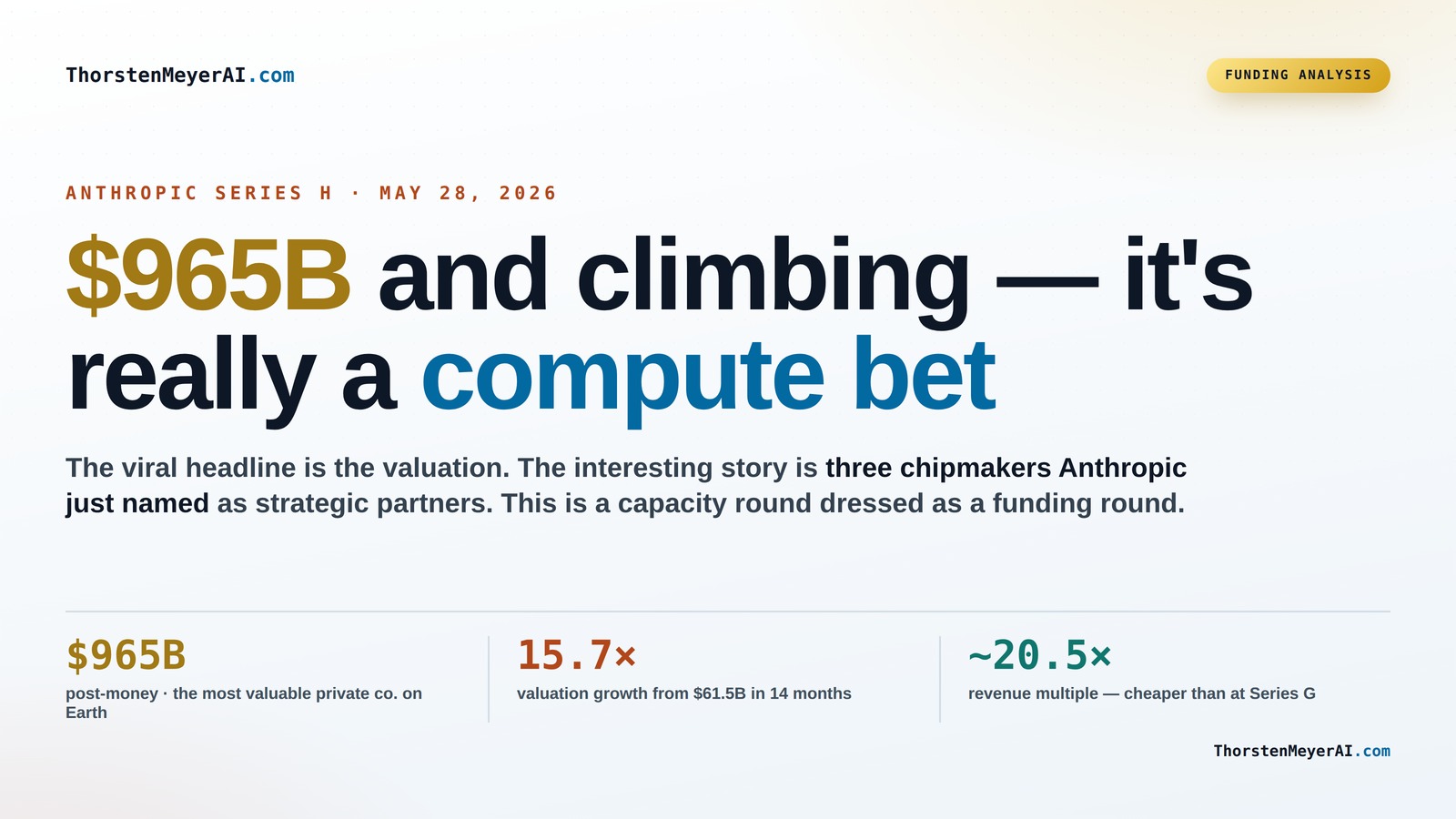
$965B and climbing — it’s really a compute bet
The viral headline is the valuation. The interesting story is in the press release’s middle paragraphs — and in three chipmakers Anthropic just named as strategic partners. This is a capacity round dressed as a funding round.
The numbers nobody can quite parse in sequence
Read together they describe a trajectory with no precedent in enterprise software. Read individually, each looks like a typo.
From $61.5B to $965B in fourteen months
Salesforce took roughly two decades to reach revenue numbers Anthropic just blew past. The sequence below is the part most coverage skips — it’s not the size, it’s the shape.
Anthropic’s valuation ladder · Mar 2025 → May 2026
Five rounds, fourteen months. Bar height is the valuation; the climb itself is the story. Tap any milestone for context.
The multiple actually got cheaper
Bubbles look like multiples expanding while revenue lags. Anthropic’s pattern is the inverse — the valuation tripled, but revenue grew faster, and the multiple compressed.
Revenue-to-valuation multiple · Series G → Series H
Same company, three months apart. The denominator (revenue) is outrunning the numerator (valuation) — exactly the opposite of what a bubble narrative predicts.
10+ gigawatts and three chipmakers
When you name Micron, Samsung & SK hynix alongside your equity backers, you’re saying the binding constraint isn’t demand or model quality — it’s the physical supply of memory chips. The Series H is a capacity round.
Compute commitments backing Anthropic’s capacity bet
$200B+ in announced compute spend across multi-year contracts. The $65B Series H raise has to be read against that bill, not against operating losses.
A genuinely durable bet — or a structural exposure?
Both readings can be true at once. The answer arrives over the next 18–24 months as the gigawatts come online and either fill with paying demand or don’t.
Revenue growth has no precedent in B2B software ($1B → $47B in 17 months). The multiple is compressing, not expanding. Claude is the only frontier model on all 3 major clouds. Enterprise AI spend share went from ~10% to >65% in a year. Compute commitments are tied to specific contracts with capacity dates.
20× revenue is not cheap by any historical software-investing standard. Revenue is reported gross of cloud-reseller pass-throughs, which inflates the top line. Profitability is 2 years out. Amodei’s own warning: a 12-month delay in AI progress “would make him bankrupt” — the compute commitments are a structural exposure to demand persistence.
The valuation race — and the IPO context
Anthropic shipped Opus 4.8 the same morning as Series H — not a coincidence. One week after OpenAI filed confidentially for IPO. The late-2026 frame is set: two frontier AI companies racing to public markets, each pitching durability.
Key Takeaways
- Anthropic’s $965 billion valuation is driven by a focus on infrastructure—chips, memory, cloud—rather than just hype.
- Massive revenue growth is outpacing valuation, causing multiples to shrink—indicating strong demand, not just inflated hype.
- The round includes major hardware and cloud partners, emphasizing that AI’s future hinges on compute capacity.
- This isn’t a traditional funding round; it’s a strategic capacity investment to dominate AI infrastructure.
- Dependence on a few hyperscalers and chipmakers creates potential risks for supply chain bottlenecks and market concentration.
As an affiliate, we earn on qualifying purchases.
Why the $965B valuation is just the tip of the iceberg
Anthropic’s valuation crossing $965 billion sounds massive — and it is. But what’s more telling is how that number is built. It’s not just hype; it reflects the company’s rapid revenue growth and the enormous infrastructure it’s betting on.
Since March 2025, Anthropic’s valuation has soared from $61.5 billion to nearly a trillion dollars in just over a year. During that same period, revenue exploded from about $1 billion to over $47 billion. This rapid valuation increase, outpacing revenue, signals investor confidence not just in current profits but in the company’s capacity to scale infrastructure rapidly. It indicates a belief that the core value lies in the physical and technological foundation—chips, memory, and cloud—necessary to support massive AI models. The real implication? The market is shifting focus from short-term revenue metrics to long-term capacity and infrastructure dominance, which will determine who controls the future of AI development. This trend underscores the importance of physical hardware and scalable infrastructure as the true driver of AI progress, rather than just the models themselves.

high performance cloud computing hardware
As an affiliate, we earn on qualifying purchases.
As an affiliate, we earn on qualifying purchases.
This isn’t just a funding round — it’s a capacity race
Most headlines focus on the $65 billion raised. But what’s really happening? This round is a giant capacity bet. Anthropic’s leadership, along with strategic partners like Micron, Samsung, and SK hynix, emphasize that this isn’t about just buying shares — it’s about buying power.
They’re investing in chips, memory, storage, and cloud capacity at a scale that could power the world’s largest AI models. It’s like laying down a new electric grid for AI, ensuring enough juice for the most demanding workloads.
Imagine a scenario where Anthropic trains models that are 10 times larger than today’s. Without the right hardware—powerful GPUs, vast memory pools, and reliable cloud infrastructure—that’s impossible. This round aims to solve that bottleneck.
The strategic importance here is that infrastructure is becoming a competitive moat. Companies that can secure and expand their hardware and cloud capacity will have a significant advantage in AI innovation and deployment. The tradeoff, however, is the enormous capital expenditure required, which could strain resources if demand doesn’t meet expectations. This push for capacity reflects a broader industry shift: the physical hardware and cloud infrastructure are now as critical as the software models, if not more so, in determining market leadership.

As an affiliate, we earn on qualifying purchases.
Revenue growth outpacing valuation: what it really means
Here’s a surprising twist: despite the valuation tripling from $380 billion to $965 billion, revenue grew even faster, causing the revenue multiple to shrink from about 27× to roughly 20.5×.
This inverse trend is significant. Usually, rapid valuation increases are accompanied by expanding multiples, reflecting hype rather than fundamentals. But in Anthropic’s case, the shrinking multiple signals that the market is recognizing tangible demand for compute power and infrastructure, rather than just speculative growth. It suggests that investors are now valuing the company’s capacity to scale hardware and cloud resources, which are the true enablers of AI’s future. The rapid revenue growth, driven by increasing demand for models like Claude, shows that the company’s core asset isn’t just its valuation but its ability to deliver the physical infrastructure needed for next-generation AI. This shift implies a more sustainable valuation approach—one rooted in real demand for compute capacity—reducing the risk of bubble-like corrections and emphasizing the importance of tangible assets in AI’s future.

power supply units for data centers
As an affiliate, we earn on qualifying purchases.
As an affiliate, we earn on qualifying purchases.
Strategic partners: chips, clouds, and giants
Anthropic’s round includes major investments from hyperscalers like Amazon, Microsoft, and Nvidia, alongside chip giants Micron, Samsung, and SK hynix. This isn’t a coincidence.
These partnerships are about more than funding—they’re about securing the supply chain for the hardware needed to train and run huge models.
Imagine Amazon committing $5 billion to cloud capacity, or Samsung ramping up memory chips specifically for AI workloads. It’s a signal that the infrastructure is as strategic as the models themselves. This strategic alignment means that hardware and cloud providers are becoming key stakeholders in the AI ecosystem, with their success increasingly tied to the growth of AI infrastructure. The tradeoff, however, is reliance on a limited number of suppliers, which could lead to bottlenecks or supply chain disruptions if any of these giants face challenges. This concentration of power underscores the importance of diversifying hardware sources and investing in robust supply chains to ensure long-term resilience.

What does all this mean for the AI race?
Anthropic’s massive valuation and infrastructure push set a new bar for AI dominance. It’s not just about better models—it’s about owning the compute supply chain that makes those models possible.
In practical terms, this means faster, larger, more capable models. It could also lead to a concentration of power among a handful of giants controlling the chips and cloud infrastructure.
For startups and tech giants alike, this signals the importance of securing hardware partnerships and investing heavily in infrastructure to stay competitive. The companies that control the physical backbone—chips, memory, cloud—will have a strategic advantage, potentially shaping the industry’s future landscape. The tradeoff is that this could lead to increased market concentration, where a few firms dominate hardware supply and cloud services, potentially stifling competition and innovation at smaller players. Recognizing this dynamic is crucial for understanding how AI progress may be shaped not just by algorithms, but by infrastructure control.

Risks lurking behind the shiny numbers
Big raises and valuations come with big risks. Anthropic’s heavy dependence on hyperscalers raises questions about supply chain concentration and power imbalance. If one chipmaker or cloud provider hits a snag, it could slow down AI progress.
Plus, the capex needed to sustain this growth is enormous. Will the revenue keep up? Or will costs spiral, making this a story of too much money chasing too few chips?
Investors and founders need to watch for signs of over-dependency and evaluate whether this infrastructure push is sustainable long term. Over-reliance on a handful of suppliers could lead to bottlenecks, price hikes, or delays, which would hinder AI deployment and growth. Additionally, the significant capital expenditure required to expand infrastructure might strain financial resources if expected demand does not materialize as anticipated. This risk underscores the importance of balancing infrastructure investments with revenue growth and diversifying supply chains to mitigate vulnerabilities.

What’s next? Watching the real proof in the pudding
The real test will be how quickly Anthropic deploys this capital into infrastructure and whether it translates into faster, more powerful models. Expect to see new model launches, bigger datasets, and more cloud capacity on the horizon.
If revenue continues to grow at this pace, it will confirm that demand for compute is the true driver. If not, the hype may fade.
Keep an eye on how much of the funding goes into hardware versus model development—this will reveal what’s truly valued.
Frequently Asked Questions
Why is Anthropic raising so much money if revenue is already so high?
Because the funds are primarily aimed at building the infrastructure—chips, memory, cloud capacity—that will support even larger models and faster growth. It’s about securing the supply chain for AI’s future expansion.What does “Series H” mean, and how unusual is a raise this large?
Series H is simply a late-stage funding round, often signaling large-scale capital needs. This particular raise is extraordinary in size—$65 billion—making it one of the biggest in AI history, reflecting the scale of infrastructure investment needed.Why do people say this round is really about compute?
Because most of the capital will go into hardware, cloud resources, and memory—building the physical backbone that enables training and deploying massive AI models at scale.How much of the money will go to GPUs, chips, cloud, and data-center infrastructure?
A significant chunk—likely over 80%—will be directed toward hardware and cloud capacity. Names like Amazon, Samsung, and Micron highlight the focus on securing physical resources.How does Anthropic’s valuation compare with OpenAI’s and other AI leaders?
At $965 billion, Anthropic surpasses OpenAI’s recent private valuation of around $852 billion. Interestingly, its revenue multiples are lower, signaling a shift toward valuing infrastructure and growth potential over hype.Conclusion
Anthropic’s recent maneuvers show that in AI, the real asset isn’t just clever models—it’s the raw compute muscle behind them. This funding milestone is a declaration: whoever owns the chips, the memory, and the cloud will shape the AI future.
As you watch this unfold, remember—behind every big valuation is a bigger power grid of hardware waiting to be tapped. The question isn’t just how smart the models are, but how quickly the infrastructure can grow to meet that intelligence.

Columbus Day / Indigenous Peoples' Day Picks
long weekend sales
As an affiliate, we earn on qualifying purchases.