


Portable field audio recorders range from pocket-sized stereo units to multitrack recorders built for crew work. My best overall pick is the Zoom H5studio, which balances flexible inputs and a practical handheld design; the Zoom F3 stands out for compact, dependable 32-bit-float field recording, while the TASCAM DR-40XP offers an appealing mix of multichannel capture and USB-C connectivity. The main tradeoffs are input count versus size, simpler operation versus routing flexibility, and built-in microphones versus external-mic support. Some recorders suit quick ambience capture, while others make more sense for lavaliers, video rigs, or multitrack sessions. Read on for the full comparison and a guide to choosing the right fit.

Get everyday essentials delivered free with Prime
- Fast, free delivery on millions of items
- Prime Video, Amazon Music and more included
- Member-only deals all year
Key Takeaways
- The Zoom H5studio leads as the most balanced pick for buyers who want a portable handheld recorder with room to work beyond basic stereo capture.
- 32-bit-float recording appears across several very different designs; the format alone does not determine whether a recorder is right for your mic setup, input needs, or workflow.
- The Zoom F3 and Zoom F2 serve distinct field roles: the F3 is aimed at external-mic production, while the F2 is a tiny lavalier-focused recorder for talent or hidden placement.
- Four-channel options split between video-friendly and field-production workflows, with the TASCAM DR-70D, DR-40XP, Zoom H4essential, and Zoom H6studio differing in connectivity and intended use.
- Bundled H1essential packages add accessories, not a fundamentally different recorder; compare the included mic, card, and other items against what you already own before choosing a bundle.
| Zoom H5studio Handy Recorder with 32-Bit Float Recording |  | Best Overall for Flexible Field Recording | Recording: Up to 6 tracks | Recording format: WAV | Maximum sample rate: 192 kHz | VIEW LATEST PRICE | See Our Full Breakdown |
| Zoom H1essential 2-Track 32-Bit Float Portable Audio Recorder Bundle with APH-1e Accessories |  | Best Ready-to-Go Stereo Bundle | Recording format: WAV | Recording channels: 2-track stereo | Recording resolution: 32-bit float | VIEW LATEST PRICE | See Our Full Breakdown |
| TASCAM DR-70D 4-Channel Portable Audio Recorder |  | Best for Camera-Based XLR Production | Inputs: 4 balanced XLR mic inputs with phantom power | Built-in microphones: 2 | Recording format: WAV | VIEW LATEST PRICE | See Our Full Breakdown |
| Zoom F3 Professional Field Recorder |  | Best Compact XLR Recorder | Channels: 2 | Recording format: WAV, 32-bit float | Inputs: 2 locking XLR/TRS | VIEW LATEST PRICE | See Our Full Breakdown |
| Zoom H1essential Stereo Handy Recorder with 32-Bit Float |  | Best Lightweight Recorder for Beginners | Recording format: WAV | Recording resolution: 32-bit float | Maximum sample rate: 96 kHz | VIEW LATEST PRICE | See Our Full Breakdown |
| Zoom F2 32-Bit Float Lavalier Recorder with LMF-2 Microphone |  | Best for Hands-Free Lavalier Recording | Recording format: WAV | Recording resolution: 32-bit float | Sample rates: 44.1 kHz or 48 kHz | VIEW LATEST PRICE | See Our Full Breakdown |
| Zoom H1 XLR 2-Channel Handy Recorder with 32-Bit Float |  | Best Compact Recorder for XLR Sources | Channels: 2 | Recording: WAV, 32-bit float, up to 96 kHz | Inputs: 2 locking XLR/TRS combo inputs and 3.5 mm stereo input | VIEW LATEST PRICE | See Our Full Breakdown |
| Zoom H1essential Stereo Recorder | | Best for First-Time Field Recording | Microphones: Built-in X/Y stereo microphones | Recording format: WAV, 32-bit float | Storage: SD card up to 1 TB | VIEW LATEST PRICE | See Our Full Breakdown |
| Xvive XV1-R Portable Stereo Audio Recorder with 32-Bit Float and X/Y Microphones |  | Best for Flexible Formats and Loud Sources | Recording formats: WAV (32-bit float or 24-bit PCM) and AAC | Maximum sample rate: 96 kHz | Microphones: Built-in X/Y directional microphones | VIEW LATEST PRICE | See Our Full Breakdown |
| TASCAM DR-40XP 4-Channel 32-Bit Float Portable Field Recorder and USB-C Audio Interface |  | Best for Four-Channel Field Sessions | Channels: 4 | Recording formats: 32-bit float, 24-bit, and 16-bit WAV | Sample rates: 44.1 kHz, 48 kHz, and 96 kHz | VIEW LATEST PRICE | See Our Full Breakdown |
| Zoom H1essential Handy Recorder Bundle with Lavalier Microphone and 32GB microSDHC Card |  | Best Ready-to-Record Interview Bundle | Recording format: 32-bit float | Built-in microphones: X/Y microphones | Maximum sound pressure level: 120 dB SPL | VIEW LATEST PRICE | See Our Full Breakdown |
| Zoom F6 Professional Field Recorder |  | Best for Multichannel Production | Recording format: WAV | Recording bit depth: 32-bit float | Inputs: 6 XLR | VIEW LATEST PRICE | See Our Full Breakdown |
| Tonfarb 64GB Digital Voice Recorder with Playback, Audio Recording Device |  | Best for Long-Running Voice Notes | Internal storage: 64GB | Supported formats: MP3, WAV | PCM quality: Up to 1536 kbps | VIEW LATEST PRICE | See Our Full Breakdown |
| Zoom H6studio Handy Recorder |  | Best Premium Handheld for Flexible Field Sessions | Recording: 32-bit float; up to 6 individual tracks plus stereo mix | Built-in microphones: 19.4 mm; up to 140 dB SPL | Sample rates: 44.1–192 kHz | VIEW LATEST PRICE | See Our Full Breakdown |
| Zoom H4essential 4-Track Handheld Recorder |  | Best Compact All-Rounder | Recording tracks: Up to 4 | Recording resolution: 32-bit float | Maximum sample rate: 96 kHz | VIEW LATEST PRICE | See Our Full Breakdown |
| portable field audio recorder | Weight | Recording format | Inputs |
|---|---|---|---|
| Zoom H5studio Handy Recorder w | 14.4 ounces | WAV | 2 XLR/TRS |
| Zoom H1essential 2-Track 32-Bi | — | WAV | — |
| TASCAM DR-70D 4-Channel Portab | 1.2 pounds | WAV | 4 balanced XLR mic inputs with phantom power |
| Zoom F3 Professional Field Rec | 8.48 ounces | WAV, 32-bit float | 2 locking XLR/TRS |
| Zoom H1essential Stereo Handy | 3.2 ounces | WAV | — |
| Zoom F2 32-Bit Float Lavalier | 181 g | WAV | — |
| Zoom H1 XLR 2-Channel Handy Re | 6.4 ounces | — | 2 locking XLR/TRS combo inputs and 3.5 mm stereo input |
| Zoom H1essential Stereo Record | 92 g | WAV, 32-bit float | — |
| Xvive XV1-R Portable Stereo Au | — | — | — |
| TASCAM DR-40XP 4-Channel 32-Bi | 6.1 ounces | — | 2 XLR/TRS |
| Zoom H1essential Handy Recorde | — | 32-bit float | — |
| Zoom F6 Professional Field Rec | 2.4 lb | WAV | 6 XLR |
| Tonfarb 64GB Digital Voice Rec | — | — | — |
| Zoom H6studio Handy Recorder | 1.05 lb | — | 4 XLR/TRS |
| Zoom H4essential 4-Track Handh | 243 g | — | 2 XLR/TRS |
More Details on Our Top Picks
Zoom H5studio Handy Recorder with 32-Bit Float Recording
The Zoom H5studio is the most adaptable handheld choice here for recording both a scene with its built-in microphones and separate sources through external mics. Its large 19.4 mm X/Y capsule, two XLR/TRS inputs, and up-to-six-track recording give it more room to grow than the two-track H1essential models. 32-bit float can help preserve usable audio when levels shift suddenly, while dedicated gain controls still offer hands-on adjustment when you want it. Compared with the Zoom F3, the H5studio is less focused on two-input professional XLR work and offers built-in stereo mics and more tracks; the F3 is smaller and uses locking inputs. The tradeoff is bulk and four-AA power, so this is less appealing for pocket carry or long outings without spare batteries.
Pros:- Large built-in X/Y microphones provide stereo capture without carrying a separate mic
- Records up to six tracks with two XLR/TRS inputs for more involved sessions
- 32-bit float recording helps handle unexpected changes in sound level
- Dedicated gain controls support direct, hands-on adjustments
Cons:- Four AA batteries add weight and require planning for extended field sessions
- At 14.4 ounces, it is less convenient to carry than the Zoom F3 or H1essential
- Its two XLR/TRS inputs provide fewer external mic connections than the TASCAM DR-70D
Best for: Field recordists who need built-in stereo capture plus multiple external microphones for interviews, music, or location production.
Not ideal for: Travelers seeking a very light, pocketable recorder or crews who need locking XLR connections and a smaller two-channel unit.
- Recording:Up to 6 tracks
- Recording format:WAV
- Maximum sample rate:192 kHz
- Built-in microphone:19.4 mm X/Y stereo capsule
- Inputs:2 XLR/TRS
- Storage capacity:Up to 2 TB
- Power:4 AA batteries
- Weight:14.4 ounces
Our verdict“Choose the H5studio if you want one portable recorder for built-in stereo capture and flexible multitrack work, and skip it if compact size matters most.”
Zoom H1essential 2-Track 32-Bit Float Portable Audio Recorder Bundle with APH-1e Accessories
This H1essential bundle is aimed at buyers who want a simple stereo recorder with useful field accessories already included. The hairy windscreen helps reduce wind noise outdoors, while the padded case and USB-C cable make carrying and connecting the unit less of a separate shopping task. Like the standalone Zoom H1essential Stereo Handy Recorder, it records two-track WAV in 32-bit float and can serve as a USB microphone; it does not add the H5studio’s XLR inputs or multitrack flexibility. Its X/Y microphones are rated for up to 120 dB SPL, which suits many loud real-world sources, but the recorder remains a two-track, built-in-mic option. Choose this bundle for straightforward ambience, notes, or interviews; skip it if you need external XLR mics or more channels.
Pros:- 32-bit float stereo WAV recording reduces the need to set gain before capture
- Included hairy windscreen is useful for outdoor recording
- Padded case and USB-C cable provide practical carrying and connection accessories
- Can function as a USB microphone with computers and mobile devices
Cons:- Two-track recording limits flexibility compared with the Zoom H5studio and TASCAM DR-70D
- Built-in X/Y microphones do not replace external mics for specialized placement
- The 3.5 mm headphone connection may require an adapter for some devices
Best for: Travel journalists, students, and outdoor recordists who want a basic stereo recorder with a windscreen and carrying case included.
Not ideal for: Audio crews using external XLR microphones or recording several isolated sources, since this is a two-track stereo recorder without XLR inputs.
- Recording format:WAV
- Recording channels:2-track stereo
- Recording resolution:32-bit float
- Maximum sample rate:96 kHz
- Microphone configuration:X/Y stereo
- Maximum sound pressure level:120 dB SPL
- USB interface:USB-C
- Included accessories:Hairy windscreen, padded shell case, AC adapter, USB-C cable
Our verdict“Pick this bundle for accessory-equipped, two-track stereo recording on the move, but choose a multitrack recorder if your sessions need separate mic inputs.”
TASCAM DR-70D 4-Channel Portable Audio Recorder
The TASCAM DR-70D fits field video work better than handheld stereo recording: it has four balanced XLR inputs with phantom power and a compact body designed to mount above or below a camera. Individual gain controls let a crew manage separate microphones, while dual recording creates a lower-level safety copy that can help when a take peaks unexpectedly. Unlike the Zoom H5studio, it prioritizes four external mic connections over large built-in stereo microphones and higher track-count flexibility. Its two built-in mics offer a fallback for quick capture, but this is not the lightest option at 1.2 pounds, and its listed card support tops out at 128 GB. It makes sense for camera operators who need multiple XLR sources; solo recordists seeking simple, pocketable ambience capture should look at the H1essential instead.
Pros:- Four balanced XLR inputs with phantom power support multiple external microphones
- Individual gain controls help manage sources independently
- Dual recording creates a lower-level safety copy
- Compact shape can mount above or below a camera
Cons:- At 1.2 pounds, it is heavier than the Zoom F3 and H1essential
- Four AA batteries are required for battery-powered use
- SD card support is listed up to 128 GB, less than the Zoom F3’s 512 GB microSD support
Best for: Camera operators and small video crews recording several XLR microphones with phantom power in the field.
Not ideal for: Solo travelers prioritizing low weight, or users who want 32-bit float recording and a simple handheld stereo workflow.
- Inputs:4 balanced XLR mic inputs with phantom power
- Built-in microphones:2
- Recording format:WAV
- Storage media:SD, SDHC, or SDXC cards up to 128 GB
- Input gain:Up to 64 dB
- Recording modes:Mono, stereo, dual recording
- Power:4 AA batteries
- Weight:1.2 pounds
Our verdict“Choose the DR-70D when your camera rig needs four phantom-powered XLR inputs and a safety recording, not when handheld portability is the main goal.”
Zoom F3 Professional Field Recorder
The Zoom F3 is a strong fit when you need clean external-mic recording in a small package rather than a built-in stereo microphone setup. Its two locking XLR/TRS inputs help keep cables seated, and 32-bit float WAV recording can accommodate quiet dialogue and sudden peaks without constant level changes. Compared with the TASCAM DR-70D, the F3 gives up two XLR inputs and camera-oriented multichannel capacity in exchange for a lighter 8.48-ounce body and a more compact footprint. It also offers flexible AA or USB power and wireless control. The main compromise is that it records to microSD rather than providing built-in storage, and it has no listed built-in microphones, so capturing ambient stereo sound requires external mics. Choose it for a compact XLR rig, not standalone grab-and-go recording.
Pros:- 32-bit float WAV recording helps manage unpredictable sound levels
- Locking XLR/TRS inputs help prevent accidental cable disconnects
- Low-noise preamps support clean external-microphone recordings
- Can run on two AA batteries or USB power
Cons:- Two inputs provide less channel capacity than the TASCAM DR-70D
- No built-in microphones are listed, so ambient capture requires external mics
- Recording requires a microSD card
Best for: Sound recordists and video crews who need a compact two-mic XLR recorder with locking connections and 32-bit float capture.
Not ideal for: Buyers who want built-in stereo microphones, several independent XLR channels, or a recorder that works without external mics.
- Channels:2
- Recording format:WAV, 32-bit float
- Inputs:2 locking XLR/TRS
- Storage:MicroSD, up to 512 GB
- Power:2 AA batteries or USB
- Digital recording time:73 hours
- Dimensions:3.04 x 2.95 x 1.88 inches
- Weight:8.48 ounces
Our verdict“Choose the F3 for compact, dependable two-input XLR work, but pick a handheld H1essential if you need built-in stereo microphones.”
Zoom H1essential Stereo Handy Recorder with 32-Bit Float
At 3.2 ounces, the H1essential is the simplest carry in this group for recording stereo sound without setting gain. Its built-in X/Y microphones and 32-bit float WAV capture suit quick interviews, ambient sound, and notes where minimal setup matters more than input flexibility. Audio guidance can also make basic operation more accessible to users with visual impairments. Compared with the bundled H1essential, this version is the more stripped-back choice: the bundle adds a windscreen, case, adapter, and cable, while the core recording approach is similar. Unlike the H5studio or TASCAM DR-70D, it has no XLR inputs and records only stereo, so it is not a fit for multichannel production. The sharpest limitation is the absence of a headphone jack, which makes direct monitoring less convenient in the field.
Pros:- Very light 3.2-ounce body is easy to carry on location
- 32-bit float recording removes the need to set gain before capture
- Built-in X/Y microphones record stereo without extra equipment
- Audio guidance supports users with visual impairments
Cons:- No headphone jack for direct monitoring
- Stereo-only recording lacks the separate inputs offered by the Zoom H5studio
- The bundled H1essential option includes a windscreen and carrying accessories
Best for: Beginners, travelers, and visually impaired users seeking an especially light recorder for quick stereo capture.
Not ideal for: Recordists who need headphone monitoring, external XLR microphones, or separate tracks for multiple sources.
- Recording format:WAV
- Recording resolution:32-bit float
- Maximum sample rate:96 kHz
- Microphone:Built-in stereo X/Y
- Maximum SPL:120 dB
- Storage:SD card
- USB interface:USB Type-C
- Weight:3.2 ounces
Our verdict“Pick the H1essential for light, straightforward stereo recording, but choose another model if you need headphone monitoring or external mic inputs.”
Zoom F2 32-Bit Float Lavalier Recorder with LMF-2 Microphone
The Zoom F2 is the most wearable option here: clip the recorder to a belt or pocket, attach the included LMF-2 omnidirectional lavalier, and record without managing a handheld microphone. Its 32-bit float format reduces the risk of clipped dialogue when a speaker gets unexpectedly louder, while the REC Hold switch helps prevent an accidental stop during a take. Compared with the Zoom H1essential, the F2 trades built-in stereo microphones and a more general-purpose handheld setup for a discreet, close-miked voice workflow. Its support for cards up to 512 GB and up to 15 hours on two AAA batteries suit longer interviews or location shoots. The tradeoff is a focused one: it records mono or stereo modes, but it is not the pick for capturing a broad stereo soundscape or connecting XLR microphones.
Pros:- 32-bit float recording reduces clipping risk without manual gain adjustment
- Includes an omnidirectional lavalier microphone, windscreen, and lapel clip
- Up to 15 hours of recording from two AAA batteries
- REC Hold switch helps prevent an accidental stop
Cons:- Lavalier-focused design is less suitable for capturing stereo ambience
- No XLR/TRS inputs for connecting professional external microphones
- Requires two AAA batteries
Best for: Documentary crews, interviewers, and video creators who need a small recorder and lavalier attached to a single speaker.
Not ideal for: Field recordists who need built-in stereo ambience capture, XLR inputs, or a recorder for several microphone sources.
- Recording format:WAV
- Recording resolution:32-bit float
- Sample rates:44.1 kHz or 48 kHz
- Included microphone:LMF-2 omnidirectional lavalier
- Storage:microSD, microSDHC, and microSDXC up to 512 GB
- Battery and runtime:2 AAA batteries; up to 15 hours
- Weight:181 g
Our verdict“Choose the F2 for discreet, long-running lavalier dialogue recording; choose the H1essential instead for built-in stereo capture.”
Zoom H1 XLR 2-Channel Handy Recorder with 32-Bit Float
The Zoom H1 XLR is a compact way to bring two professional microphone or instrument connections into a portable recording setup. Its locking XLR/TRS combo inputs help keep cables secure, and 32-bit float recording up to 96 kHz gives creators more latitude when source levels vary. The OLED waveform display offers a quick visual check, a useful addition when operating without the more expansive controls of a larger field rig. Compared with the TASCAM DR-40XP, the H1 XLR is the simpler, two-channel choice: it lacks adjustable built-in stereo microphones and the DR-40XP’s four-channel recording, but focuses on external sources in a smaller body. The 3.5 mm stereo input adds flexibility, though two AA batteries provide up to 10 hours, less specified runtime than the F2. Choose it for a pair of external sources, not a multi-mic production.
Pros:- Two locking XLR/TRS inputs accept microphones and instruments
- 32-bit float recording supports changing source levels
- OLED waveform display provides a visual recording check
- SDXC card support up to 1 TB
Cons:- Two-channel design limits simultaneous source count compared with the TASCAM DR-40XP
- No built-in stereo microphones are specified
- Up to 10 hours of runtime requires two AA batteries
Best for: Mobile musicians, interview crews, and camera operators who need two locking XLR/TRS inputs in a small recorder.
Not ideal for: Sound recordists who need four-channel capture, built-in adjustable stereo microphones, or longer battery runtime.
- Channels:2
- Recording:WAV, 32-bit float, up to 96 kHz
- Inputs:2 locking XLR/TRS combo inputs and 3.5 mm stereo input
- Headphone output:3.5 mm
- Storage:SDXC cards up to 1 TB
- Battery and runtime:2 AA batteries; up to 10 hours
- Weight:6.4 ounces
Our verdict“Pick the H1 XLR when two secure external inputs matter more than built-in microphones or four-channel capacity.”
Zoom H1essential Stereo Recorder
The Zoom H1essential makes a strong first field recorder because its built-in X/Y stereo microphones and spoken menu guidance keep the setup approachable: power it on, point it at the sound, and record. The 32-bit float** format handles sudden changes in volume with less need to manage input levels, and USB-C microphone mode adds a useful role for calls, streaming, or computer recording. Compared with the Zoom H1 XLR, this model favors immediate stereo capture over connecting professional XLR microphones; compared with the Xvive XV1-R, its listed features include spoken menu guidance and a headphone jack. It is also light at 92 g. The compromises are that recording requires a separate SD card and two AAA batteries, and its built-in microphones are less flexible than a recorder with external inputs when a specific mic or placement is needed.
Pros:- Built-in X/Y microphones capture stereo sound without extra microphones
- 32-bit float recording helps handle sudden changes in volume
- Spoken menu guidance and a simple workflow suit new users
- USB-C microphone mode supports compatible computers and mobile devices
Cons:- SD card is needed for standalone recording and is not listed as included
- No XLR/TRS inputs for external professional microphones
- Requires two AAA batteries
Best for: New creators, students, and travelers who want a lightweight recorder for interviews, music ideas, and ambient stereo sound.
Not ideal for: Audio crews who need XLR inputs, multiple external sources, or a complete recording setup without buying a memory card separately.
- Microphones:Built-in X/Y stereo microphones
- Recording format:WAV, 32-bit float
- Storage:SD card up to 1 TB
- USB interface:USB Type-C
- Connections:3.5 mm headphone jack
- Battery and runtime:2 AAA batteries; up to 10 hours
- Weight:92 g
Our verdict“Choose the H1essential for an approachable, lightweight stereo recorder; choose the H1 XLR when external microphone connections come first.”
Xvive XV1-R Portable Stereo Audio Recorder with 32-Bit Float and X/Y Microphones
The Xvive XV1-R stands out for combining stereo field capture with a choice of 32-bit float, 24-bit PCM WAV, or AAC. That makes it more adaptable than the H1essential when a project calls for compressed files as well as high-resolution recording. Its X/Y microphones handle up to 130 dB SPL, giving it a stated capacity for loud sources, and auto-record and pre-record features can help catch events that begin before the operator reacts. It also works as a USB-C microphone with compatible computers and mobile devices. Compared with the Zoom H1essential, the XV1-R offers more listed recording formats and a higher maximum sample rate, but its missing headphone jack removes a direct way to monitor audio on the unit. Storage support is also narrower than the H1essential’s, topping out at 128 GB.
Pros:- Records WAV in 32-bit float or 24-bit PCM, plus AAC
- X/Y microphones are specified for sound levels up to 130 dB SPL
- Auto-record and pre-record help capture unscripted sounds
- USB-C microphone mode works with compatible computers and mobile devices
Cons:- No headphone jack for direct monitoring
- Storage support is limited to microSDXC cards up to 128 GB
- Requires two AA batteries
Best for: Field recordists capturing loud live music, machinery, or outdoor sound who value multiple file formats and USB microphone use.
Not ideal for: Operators who need to monitor recordings through wired headphones or want support for larger memory cards.
- Recording formats:WAV (32-bit float or 24-bit PCM) and AAC
- Maximum sample rate:96 kHz
- Microphones:Built-in X/Y directional microphones
- Maximum SPL:130 dB SPL
- Storage:microSDHC up to 32 GB; microSDXC up to 128 GB
- USB microphone connection:USB Type-C; USB Audio Class 2.0; 48 kHz
- Battery and runtime:2 AA batteries; up to 12 hours
Our verdict“Choose the XV1-R for format flexibility and loud-source capture, but skip it if headphone monitoring is part of your field workflow.”
TASCAM DR-40XP 4-Channel 32-Bit Float Portable Field Recorder and USB-C Audio Interface
The TASCAM DR-40XP earns its place for buyers who need one recorder to handle both built-in stereo ambience and external microphones. Its four-channel recording can capture the adjustable A-B or X-Y condenser microphones alongside two XLR/TRS inputs, a more expansive field setup than the two-channel Zoom H1 XLR or the stereo-only H1essential. The 32-bit float, 24-bit, and 16-bit WAV options also let users choose a format to suit the session, while USB-C operation adds a 2-in/2-out interface role. This flexibility makes sense for location interviews, small performances, and sound gathering where separate sources need to stay distinct. The tradeoff is that its MicroSD card and batteries are not included, so the recorder is not ready for a field session straight out of the box. Its listed 125 dB SPL ceiling is below the XV1-R’s 130 dB figure.
Pros:- Four-channel recording can capture built-in microphones and external inputs together
- Adjustable A-B and X-Y microphone configurations suit different stereo perspectives
- Two XLR/TRS inputs support external microphones and other sources
- USB-C mode functions as a 2-in/2-out audio interface
Cons:- MicroSD card and batteries are not included
- Four-channel flexibility is unnecessary bulk for simple stereo recording
- 125 dB SPL maximum is lower than the XV1-R’s stated 130 dB SPL
Best for: Location sound recordists and small production teams who need built-in stereo microphones plus two external inputs recorded across four channels.
Not ideal for: Beginners seeking a ready-to-record kit, or minimalist users who only need a compact stereo recorder.
- Channels:4
- Recording formats:32-bit float, 24-bit, and 16-bit WAV
- Sample rates:44.1 kHz, 48 kHz, and 96 kHz
- Inputs:2 XLR/TRS
- Built-in microphones:Adjustable A-B or X-Y stereo condenser microphones
- Maximum SPL:125 dB SPL
- USB interface:2-in/2-out USB-C
- Weight:6.1 ounces
Our verdict“Pick the DR-40XP when you need four separate channels from built-in microphones and external inputs; choose a smaller stereo recorder for simpler sessions.”
Zoom H1essential Handy Recorder Bundle with Lavalier Microphone and 32GB microSDHC Card
I’d pick this bundle for solo interviews and location notes when I want to start recording without sourcing the basics separately. The 32-bit float format reduces the need to set levels precisely, while the built-in X/Y microphones suit ambient sound and quick stereo captures. The included lavalier microphone and furry windscreen give spoken-word recording a more direct option outdoors; that makes this more self-contained for one-person work than the Zoom H4essential, which adds XLR/TRS inputs and USB-C but requires separate accessories for a lav setup. The H1essential is the lighter-duty choice, though: it lacks the H4essential’s external inputs and multitrack flexibility. The bundle’s four AAA batteries are useful to have on hand, but they also mean ongoing battery changes rather than a built-in rechargeable power source.
Pros:- 32-bit float recording reduces the need for careful level setting.
- Built-in X/Y microphones capture stereo sound, with a stated maximum of 120 dB SPL.
- Bundle includes a lavalier microphone, furry windscreen, 32GB card, and four AAA batteries.
- Pre-record, auto-record, overdubbing, and playback-speed controls support varied field workflows.
Cons:- Four AAA batteries are required for portable use.
- No XLR/TRS inputs for connecting professional microphones or multiple external sources.
- The included 32GB card is less capacity than the recorder’s listed maximum supported storage.
Best for: Solo interviewers, students, and field reporters who want a compact recorder with a lav mic, windscreen, card, and batteries included.
Not ideal for: Audio crews connecting multiple XLR microphones or recording several isolated sources; the H1essential does not offer the H4essential’s two XLR/TRS inputs or four-track recording.
- Recording format:32-bit float
- Built-in microphones:X/Y microphones
- Maximum sound pressure level:120 dB SPL
- Headphone jack:3.5 mm
- Listed maximum storage:1 TB
- Included memory card:32GB microSDHC
- Bundle contents:Recorder, lavalier condenser microphone, furry windscreen, four AAA batteries, and cloth
Our verdict“Choose this bundle for straightforward solo field recording with both built-in stereo mics and a lavalier ready to go.”
Zoom F6 Professional Field Recorder
For location sound work with several microphones, I rank the F6 ahead of handheld recorders that trade input count for simpler operation. Its six XLR inputs and ability to record up to 14 tracks give a small crew room to capture separate sources, while 32-bit float recording with dual AD converters supports a wide range of input levels. Timecode I/O also makes it better suited to syncing production audio with video than the Zoom H6studio, which offers four XLR/TRS inputs and built-in microphones but is more self-contained as a handheld recorder. The F6’s compact 4 × 4.5 × 2.5-inch body is portable for a multitrack unit, yet the listed 2.4-pound weight is substantial beside pocket-sized field options. It also has no built-in microphones, so a complete recording setup depends on external mics and cables.
Pros:- Six XLR inputs support multi-microphone location recording.
- Records up to 14 tracks for separate sources and flexible post-production.
- 32-bit float recording and dual AD converters handle a wide dynamic range.
- Timecode I/O supports synchronization with video workflows.
Cons:- No built-in microphones, so external mics and cables are needed to record.
- At 2.4 pounds, it is heavier than compact handheld recorders.
- Portable operation requires four AA batteries.
Best for: Film and documentary sound crews needing multiple XLR microphone feeds, isolated tracks, and timecode synchronization in a portable recorder.
Not ideal for: Travelers or solo recordists who want an all-in-one handheld with built-in microphones; the F6 needs external microphones and weighs more than compact options.
- Recording format:WAV
- Recording bit depth:32-bit float
- Inputs:6 XLR
- Maximum tracks:14
- Timecode:I/O
- Power:Four AA batteries
- Dimensions:4 × 4.5 × 2.5 inches
- Weight:2.4 lb
Our verdict“Choose the F6 when isolated XLR tracks and timecode matter more than the convenience of built-in microphones.”
Tonfarb 64GB Digital Voice Recorder with Playback, Audio Recording Device
The Tonfarb is the voice-first option here: one-click recording, a built-in screen, and voice activation favor lectures, interviews, and spoken notes over stereo ambience or production sound. Its 64GB of internal storage suits people who keep many recordings on the device, while the Zoom H1essential is a stronger fit when 32-bit float capture and built-in X/Y microphones matter more than simple file storage. The Tonfarb lists PCM recording up to 1536 kbps and noise reduction, but its product data gives a digital recording time of 48 hours, so I would not treat the stated storage capacity as proof of equally long continuous recording. Its small body and single included AAA battery keep the setup simple, though heavy users may need to replace that battery, and the listed 3.5mm jack is useful for playback rather than a substitute for external microphone inputs.
Pros:- One-click recording and saving make quick voice capture straightforward.
- Built-in 64GB storage reduces reliance on removable cards.
- Voice-activated recording can limit unwanted silence in voice-note workflows.
- Compact 1.44-inch display and 3.5mm headphone jack support basic navigation and playback.
Cons:- A single AAA battery may need frequent replacement during heavy use.
- No XLR or other listed external microphone inputs for expanding a field setup.
- Listed digital recording time is 48 hours, despite the much larger stated storage capacity.
Best for: Students, meeting attendees, and interview note-takers who need simple voice capture, voice activation, and substantial onboard storage.
Not ideal for: Field recordists capturing music, detailed stereo ambience, or multiple external microphones; this voice recorder lacks XLR inputs and advanced multitrack features.
- Internal storage:64GB
- Supported formats:MP3, WAV
- PCM quality:Up to 1536 kbps
- Screen:1.44 inches
- Battery:One AAA battery, included
- Battery life:32 hours
- Digital recording time:48 hours
- Dimensions:0.47 × 1.45 × 4 inches
Our verdict“Choose the Tonfarb for simple, storage-heavy voice notes, but pick a Zoom H1essential for more demanding field audio.”
Zoom H6studio Handy Recorder
The H6studio makes the most sense when I want a handheld recorder that can move between ambient capture and a small multi-mic setup. Its 19.4 mm built-in microphones, rated up to 140 dB SPL, give it a stronger self-contained capture setup than the Zoom F6, which has more XLR inputs but no built-in microphones. Add four XLR/TRS inputs, interchangeable capsules, and up to six individual tracks plus a stereo mix, and this is the more adaptable choice for location music or field sessions that change from one job to the next. Look-ahead limiters and 32-bit float recording help protect recordings when levels shift. The tradeoff is size and power: it runs on four AA batteries, and its 11-inch length is less pocketable than the H4essential’s compact body. Its feature set may be excessive for simple interviews.
Pros:- 32-bit float recording and look-ahead limiters help manage sudden level changes.
- Built-in 19.4 mm microphones handle sound levels up to 140 dB SPL.
- Four XLR/TRS inputs and interchangeable capsules adapt to different recording setups.
- Records up to six individual tracks plus a stereo mix and can run up to 15 hours on four AA batteries.
Cons:- Four AA batteries are required for portable operation.
- At 11 inches long, it is less compact than the Zoom H4essential.
- Its input and capsule flexibility may be unnecessary for basic voice recording.
Best for: Field musicians and location recordists who want built-in stereo microphones, interchangeable capsules, and multiple external inputs in one handheld unit.
Not ideal for: Minimalist travelers and interviewers who need the smallest practical recorder; the H6studio is longer and more feature-rich than a basic handheld such as the H4essential.
- Recording:32-bit float; up to 6 individual tracks plus stereo mix
- Built-in microphones:19.4 mm; up to 140 dB SPL
- Sample rates:44.1–192 kHz
- Inputs:4 XLR/TRS
- Battery life:Up to 15 hours on four AA batteries
- Weight:1.05 lb
- Dimensions:11 × 4.8 × 2.5 inches
- USB interface:USB 2.0
Our verdict“Choose the H6studio for adaptable handheld recording across ambient, music, and multi-microphone sessions, not for the lightest carry.”
Zoom H4essential 4-Track Handheld Recorder
I’d choose the H4essential when one recorder needs to cover interviews, music, and direct connection to a phone or computer without becoming a larger multitrack rig. Its built-in stereo microphones handle quick captures, while two XLR/TRS inputs let me add external microphones or other sources. That makes it more flexible than the bundled H1essential, which includes a lavalier but lacks the H4essential’s listed XLR/TRS inputs. Against the larger Zoom H6studio, the H4essential is the more compact carry and still offers four-track, 32-bit float recording, though it gives up two external inputs, interchangeable capsules, and sample rates above 96 kHz. USB-C supports recording or streaming to a connected device, and spoken menu guidance aids accessible operation. The main practical limits are its two-AA power requirement and the need for an SD card for onboard backup.
Pros:- 32-bit float recording across up to four tracks accommodates changing sound levels.
- Built-in stereo microphones plus two XLR/TRS inputs cover quick capture and external mics.
- USB-C supports recording or streaming to a phone, tablet, or computer.
- Spoken menu guidance supports accessible operation.
Cons:- Portable use requires two AA batteries.
- An SD card is required for onboard backup recording.
- Two external inputs are limiting for larger multi-microphone setups.
Best for: Mobile podcasters, interviewers, and musicians who want built-in stereo recording, two external inputs, and USB-C connectivity in a compact handheld.
Not ideal for: Production crews needing four or more XLR/TRS inputs or recording above 96 kHz; the Zoom H6studio and F6 offer more input capacity.
- Recording tracks:Up to 4
- Recording resolution:32-bit float
- Maximum sample rate:96 kHz
- Microphones:Built-in stereo
- Inputs:2 XLR/TRS
- Connectivity:USB-C
- Storage:SD card; up to 1 TB
- Weight:243 g
- Power:Two AA batteries
Our verdict“Choose the H4essential for a compact, versatile recorder that balances built-in mics, two external inputs, and USB-C.”
How We Picked
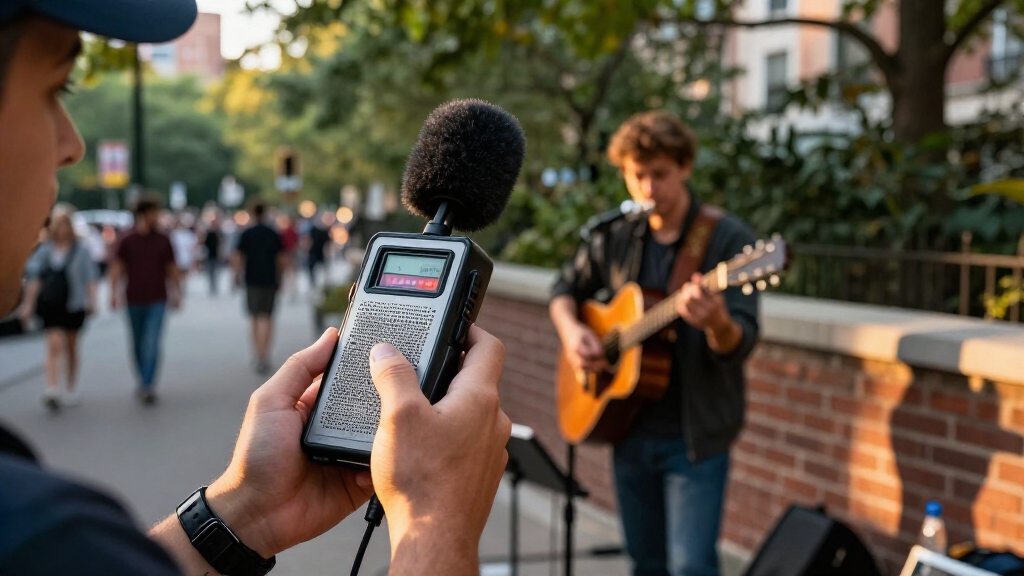
I compared these recorders as tools for portable field audio, weighing how easily each can capture usable sound away from a studio, how well its inputs fit common microphones, and how much control it gives the operator. I also considered form factor, recording formats, channel capacity, power and media requirements, and practical functions such as USB audio connectivity. A recorder’s feature list only counts when it improves a likely field workflow: a small body can matter more than extra tracks for ambience, while a video crew may value external inputs and mounting flexibility more.
The order reflects overall usefulness across likely buyers, not a claim that one device suits every job. The H5studio ranks first for its balance of portability and flexibility; specialized picks rank higher for their intended tasks but lower as all-purpose choices. Similar H1essential models and bundles are separated by configuration and included accessories, while voice-focused devices rank below recorders designed around microphone choice and field production. I treated 32-bit-float support as one factor, not a substitute for sound-source placement, suitable microphones, or a reliable recording routine.
Factors to Consider When Choosing Portable Field Audio Recorders
Before choosing from this group, match the recorder to the way you capture sound—not just the format printed on the box. These decisions can prevent a common mismatch: buying a tiny unit for a multichannel shoot, or carrying a larger recorder when all you need is a discreet lavalier track.
Match the Input Layout to Your Microphones
Start by listing the microphones and sources you expect to connect at the same time. Built-in stereo microphones can be convenient for ambience and quick notes, but they do not replace external inputs when you need a boom, lavalier receiver, or separate interview microphones. Count usable inputs, not just advertised tracks: some recorders can record internal and external sources together, while others are designed around a narrower setup. Check connector type, phantom-power needs, and whether controls are easy to reach while the recorder is mounted. A frequent mistake is buying extra channels without checking whether the device has the right connections for the actual microphones. If your setup changes from job to job, flexible inputs may be more useful than a smaller body or a headline recording format.
Treat 32-Bit Float as Headroom, Not a Mic Placement Fix
32-bit-float recording can give you more flexibility when adjusting level after capture, which is helpful when sound intensity changes unexpectedly. It does not fix clipped capsules, distorted wireless transmitters, wind, handling noise, or a microphone placed too far from the source. You still need to monitor when possible and make sensible gain and placement choices. A conventional recorder with well-managed levels can also produce clean, usable audio. Compare how each model handles your real recording routine rather than choosing by bit-depth label alone. For unpredictable events, float recording may ease one part of the job, but it cannot replace a backup track or careful listening.
Choose Track Count for the Session You Actually Record
More tracks help when you need separate sources for editing, such as multiple guests or a mix of camera and boom audio. They also add setup work: you may need more microphones, more cables, more storage, and a clearer plan for naming and backing up files. For a single-person ambience session, stereo capture may be faster and lighter than carrying multitrack capacity you rarely use. Video users should check how their recorder connects to the camera and whether a scratch track or a separate mix is needed. Do not confuse the number of recorded tracks with the number of independent inputs available. If a session depends on isolated sources, verify the routing and simultaneous-recording details before purchase.
Balance Portability Against Controls and Rigging
A pocket recorder is easier to carry and can be less intrusive, but small controls may slow down adjustments in cold, dark, or noisy locations. Larger handheld and field-production recorders can offer more direct access to inputs and functions, though they take up more space and may need a bag, mount, or cable management. Consider where the unit will sit: in a hand, on a camera, in a bag, or clipped to a person. For unattended recording, check how the device can be secured and whether its power plan fits the session length. A tiny recorder is not automatically the most practical choice if you cannot operate it confidently during a take. Think about the full carried setup, including microphones, batteries, wind protection, and media.
Plan Power, Storage, and File Handling Before a Long Session
Field reliability depends on more than the recorder itself. Check the power source and expected battery approach against the length of your sessions, especially when using external microphones or phantom power. Confirm compatible memory-card types and capacities, then leave room for multiple takes and backup files rather than filling a card to its limit. USB audio features can help when the same recorder also serves a desk setup, but they do not remove the need to check computer compatibility and monitoring workflow. Decide how files will be named, copied, and verified when you return from a shoot. For important work, carry spare power and media; a convenient recorder still cannot recover a take lost to a depleted battery or full card.
Buy Bundles for Missing Essentials, Not for Their Labels
Accessory bundles can save setup time when they include items you would otherwise need, such as a compatible microphone, card, or protective accessories. They are less useful when they duplicate equipment already in your kit or add low-priority items while omitting the component your recording requires. Compare the included accessories with your existing microphone, wind protection, headphones, and card inventory. For the H1essential listings here, the recorder name may be similar while the bundle contents differ, so verify the exact package rather than assuming every listing is equivalent. A lavalier bundle makes sense only if its mic suits the person and placement you plan to record. Keep the recorder’s capabilities and the accessory package as separate parts of the decision.
Frequently Asked Questions
Is a 32-bit-float recorder the best choice for a first field recorder?
It can be a helpful safety net when recording unpredictable levels, but it should not be the only reason to choose a recorder. Beginners may get more practical value from simple controls, clear monitoring, and inputs that match the microphones they already own. Float recording does not prevent distortion before the signal reaches the recorder, and it cannot fix poor mic placement. If you record mostly steady interviews, a straightforward model with appropriate inputs may be easier to learn. Choose the format as part of the workflow, not as a replacement for it.
Should I choose a handheld recorder or a dedicated field recorder?
A handheld recorder often suits quick stereo capture, location notes, and small crews that want microphones and controls in one unit. A dedicated field recorder is a stronger fit when external microphones, multiple isolated sources, or a camera-oriented setup are central to the job. The tradeoff is size and setup complexity: more routing can mean more equipment to carry and manage. Think about whether you will record in your hand, mount the device, or operate it from a bag. Choose around the recording position and input needs you face most often, rather than assuming one form factor is universally better.
Can I use a portable recorder as a USB audio interface too?
Some models in this roundup, including the TASCAM DR-40XP, offer USB-C audio-interface functionality, but capabilities and connection procedures vary by device. Check whether the recorder can send the required number of channels to your computer and whether it supports the monitoring arrangement you want. A field recorder may be convenient for occasional desk recording, yet it may not replace a dedicated interface for a permanent studio setup. Also check computer compatibility and how USB power affects the way you plan to use the recorder. If interface use is a major part of your decision, treat it as a core requirement and verify the specific model’s workflow.
Do I need a four-channel recorder for interviews?
Not always. A one-on-one interview may need only two microphone inputs, while a four-channel recorder can help when you want separate tracks for multiple guests, a boom, or a camera feed. The extra channels are useful only if the recorder can connect and record the sources you have in mind at the same time. If you mainly record one voice with a lavalier, a smaller dedicated recorder such as a lavalier-focused model may be simpler to place and operate. For a video shoot with changing setups, added input flexibility can prevent compromises. Make the choice based on simultaneous sources, not the word “four-channel” alone.
When does a bundled recorder make more sense than buying the recorder alone?
A bundle is convenient when its included accessories fill a real gap in your kit and are compatible with the recording task. A lavalier bundle may suit spoken-word capture, while a package with a memory card can help someone starting without recording media. If you already own a suitable mic, card, and accessories, the bundle may add little useful value. Check the exact contents because similar recorder listings can be packaged differently. Also confirm that the included microphone matches your connector and recording needs rather than assuming any bundled mic is appropriate for every job.
Conclusion
For the broadest range of portable field work, I recommend the Zoom H5studio as the best overall because it balances a handheld format with flexible recording options. The Zoom F3 is my best value for compact external-mic field production, while the Zoom F6 is the best premium choice for buyers who need a more capable production setup and can accommodate its added complexity. For beginners who want a straightforward pocket recorder, the Zoom H1essential is the clearest starting point; compare the standard recorder with its bundles based on the accessories you actually need. For specific work, choose the Zoom F2 for lavalier placement, the TASCAM DR-40XP for a four-channel recorder with USB-C interface use, or the TASCAM DR-70D for video-oriented recording needs. Match your input and carrying requirements first, then choose the recording format and extras that support them.
Halloween Picks

Star Wars Yoda and R2-D2 Inflatable Halloween Decor, 6 ft with LEDs, Indoor/Outdoor

10 ft Halloween Inflatable Archway with Built-in LEDs

9 ft Halloween Inflatable Haunted Castle with Dragon and Ghost
As an affiliate, we earn on qualifying purchases.