
For a versatile starting point, I’d choose the EVISTR L359: its 128GB storage and AI transcription features give it a wider role than a basic recorder. The Innioasis PR1 stands out for offline transcription and translation, while the Sony ICD-PX370 offers a simpler, established-style option with built-in USB. The main tradeoffs are between straightforward recording and added software features, as well as storage capacity, battery needs, and ease of transferring files. More storage can help with long sessions, but it does not guarantee clearer recordings or better transcription. Read on for how all 15 options differ and which one fits your recording habits.

Get everyday essentials delivered free with Prime
- Fast, free delivery on millions of items
- Prime Video, Amazon Music and more included
- Member-only deals all year
Key Takeaways
- EVISTR L359 is the most balanced feature-rich pick in this lineup, pairing 128GB storage with AI transcription; buyers should still check how its transcription features work for their languages and workflow.
- Innioasis PR1 has the clearest specialized role: offline transcription and translation may suit users who want those tools without relying on a live connection, but it is more feature-heavy than a basic class recorder.
- Sony ICD-PX370 is the straightforward-use alternative, with built-in USB and mono recording; it favors simple file transfer over high-capacity or AI-led features.
- Storage claims vary widely, from 8GB to 136GB, but the largest figure alone is not a reliable measure of recording quality, battery life, or ease of finding files.
- Voice activation appears across several models, including HoTiyan, COHANA, and EVIDA; it can reduce silent gaps, but buyers should check how activation behaves in quiet rooms and variable sound.
| HoTiyan 8GB Digital Voice Recorder with Voice Activation and MP3 Playback |  | Best for Playback Controls | Storage: 8 GB | Recording formats: MP3, WAV | Microphone: Built-in stereo | VIEW LATEST PRICE | See Our Full Breakdown |
| EVISTR L359 Digital Voice Recorder with 128GB Storage and AI Transcription |  | Best for High-Capacity Recording and Transcription | Storage: 128 GB | Maximum recording bitrate: 3072 Kbps | Audio formats: MP3, WAV | VIEW LATEST PRICE | See Our Full Breakdown |
| Innioasis PR1 AI Voice Recorder with 64GB Storage, Offline Transcription and Translation |  | Best for Offline AI Tools | Storage: 64 GB | Screen: 3.99 inches | Microphones: Four-array microphones plus one high-SNR microphone | VIEW LATEST PRICE | See Our Full Breakdown |
| Tonfarb 64GB Digital Voice Recorder with Playback |  | Best for Long Recording Sessions | Storage: 64 GB | Recording formats: MP3, WAV | Maximum PCM bitrate: 1536 kbps | VIEW LATEST PRICE | See Our Full Breakdown |
| Sunlan 16GB Digital Voice Recorder with Playback |  | Best Compact Pick for Simple Recording | Storage: 16 GB | Recording format: WAV | Recording quality: Up to 1536 kbps | VIEW LATEST PRICE | See Our Full Breakdown |
| NSRLO V57 128GB Portable Digital Voice Recorder |  | Best for High-Capacity Carry | Storage: 128 GB | Maximum recording bitrate: 3072 Kbps | Noise reduction: DSP 3.0, adjustable levels 1–7 | VIEW LATEST PRICE | See Our Full Breakdown |
| Tonfarb 136GB Digital Voice Recorder with Playback |  | Best for Long Sessions and On-Device Playback | Total storage: 136 GB: 8 GB built-in plus included 128 GB TF card | Recording formats: MP3, WAV | Maximum recording bitrate: 1536 kbps PCM | VIEW LATEST PRICE | See Our Full Breakdown |
| 72GB Digital Voice Recorder with USB-C |  | Best for Organized Voice-Activated Recording | Storage: 72 GB | Maximum recording time: 35 hours | Recording format: WAV | VIEW LATEST PRICE | See Our Full Breakdown |
| Cappsu Digital Voice Recorder with Playback, 32GB Built-In Memory |  | Best for Simple, Lightweight Recording | Built-in storage: 32 GB | Maximum recording bitrate: 1536 Kbps | Recording modes: Continuous and voice-activated | VIEW LATEST PRICE | See Our Full Breakdown |
| EVISTR L357 64GB Digital Voice Recorder with Playback |  | Best for Adjustable Stereo Recording | Storage: 64 GB | Recording formats: WAV, MP3 | Microphone: Built-in stereo | VIEW LATEST PRICE | See Our Full Breakdown |
| Sony ICD-PX370 Mono Digital Voice Recorder with Built-In USB |  | Best for Long Recording Days | Recording format: MP3 | Microphone mode: Mono, stereo | Built-in memory: 4GB | VIEW LATEST PRICE | See Our Full Breakdown |
| 48GB Digital Voice Recorder with Playback and Voice Activation |  | Best Value for Flexible Features | Storage: 48GB total: 16GB built in plus 32GB TF card | Expandable storage: Up to 128GB | Recording formats: MP3, WAV | VIEW LATEST PRICE | See Our Full Breakdown |
| COHANA 128GB Voice Recorder with AI Noise Reduction and Voice Activation |  | Best for High-Capacity Voice-Activated Recording | Storage capacity: 128GB | Recording format: WAV | Noise reduction: AI triple noise reduction with DSP | VIEW LATEST PRICE | See Our Full Breakdown |
| 16GB Voice-Activated Digital Voice Recorder with MP3/WAV Playback |  | Best Compact Pick for Playback Review | Storage capacity: 16GB | Recording formats: MP3, WAV | Microphone: Built-in stereo | VIEW LATEST PRICE | See Our Full Breakdown |
| EVIDA 128GB Digital Voice Recorder with Voice Activation, Playback, and Password Protection |  | Best for Organizing a Large Recording Library | Storage capacity: 128GB | Recording formats: MP3 at 128 or 192 kbps; WAV at 1536 kbps | Microphone: Built-in mono with noise cancellation | VIEW LATEST PRICE | See Our Full Breakdown |
| portable digital voice recorder | Storage | Microphone |
|---|---|---|
| HoTiyan 8GB Digital Voice Reco | 8 GB | Built-in stereo |
| EVISTR L359 Digital Voice Reco | 128 GB | Built-in mono |
| Innioasis PR1 AI Voice Recorde | 64 GB | — |
| Tonfarb 64GB Digital Voice Rec | 64 GB | Built-in stereo |
| Sunlan 16GB Digital Voice Reco | 16 GB | Built-in mono with noise cancellation |
| NSRLO V57 128GB Portable Digit | 128 GB | Built-in |
| Tonfarb 136GB Digital Voice Re | — | — |
| 72GB Digital Voice Recorder wi | 72 GB | Built-in 360° omnidirectional, mono |
| Cappsu Digital Voice Recorder | — | — |
| EVISTR L357 64GB Digital Voice | 64 GB | Built-in stereo |
| Sony ICD-PX370 Mono Digital Vo | — | — |
| 48GB Digital Voice Recorder wi | 48GB total: 16GB built in plus 32GB TF card | — |
| COHANA 128GB Voice Recorder wi | — | — |
| 16GB Voice-Activated Digital V | — | Built-in stereo |
| EVIDA 128GB Digital Voice Reco | — | Built-in mono with noise cancellation |
More Details on Our Top Picks
HoTiyan 8GB Digital Voice Recorder with Voice Activation and MP3 Playback
The HoTiyan is a straightforward choice for people who want to record, then review material directly on the device. Its A-B repeat and variable-speed playback are useful for revisiting a quote or slowing down a lecture without moving files to a computer. Voice activation can also cut down on long stretches of silence, though it does not make up for the modest 8GB storage. Compared with the Sunlan 16GB Digital Voice Recorder, the HoTiyan offers twice the listed storage and stereo recording, while the Sunlan is smaller and lighter. Its stated continuous recording time reaches 20 hours, but earphone playback is listed at up to 8 hours. I’d choose it for hands-on file review, not for extended trips where capacity and battery endurance take priority.
Pros:- A-B repeat and variable-speed playback make it easier to review specific passages
- Voice activation can reduce silent sections in recordings
- Stereo microphone and MP3/WAV support offer flexible recording options
- Password protection and timestamped filenames help organize and safeguard files
Cons:- 8GB storage is limited compared with the 64GB Tonfarb recorder and 128GB EVISTR L359
- Earphone playback is rated for up to 8 hours
- The stated continuous recording time of up to 20 hours is shorter than several larger-capacity options
Best for: Students and interviewers who want stereo recording and convenient on-device playback tools for reviewing short sessions
Not ideal for: People recording many days of lectures or meetings who need more than 8GB of storage or longer playback endurance
- Storage:8 GB
- Recording formats:MP3, WAV
- Microphone:Built-in stereo
- Continuous recording:Up to 20 hours
- Digital recording capacity:Up to 128 hours
- Playback time:Up to 8 hours with earphones
- USB interface:USB 2.0 Type-B
- Screen:1.1 inches
Our verdict“Choose the HoTiyan if playback controls and stereo capture matter more to you than high storage capacity or long playback time.”
EVISTR L359 Digital Voice Recorder with 128GB Storage and AI Transcription
The EVISTR L359 suits buyers who want a pocket recorder that can hold a large archive and pair recordings with app-based transcription. Its 128GB storage and stated capacity of up to 9,216 hours at 32 kbps give it a clear advantage over the HoTiyan 8GB recorder for frequent, long-running capture. One-touch controls and voice activation keep the basic recording process simple; the AI DVR Link app adds transcription in 113 languages, summaries, and speaker identification. That software is also the main tradeoff: transcription and AI tools depend on the app, so this is less self-contained than the Innioasis PR1, which offers offline processing. The EVISTR records in mono, and phone transfers use wired OTG rather than Bluetooth. I’d pick it for capacity and app-assisted workflows, not for users seeking offline AI features.
Pros:- 128GB storage supports a large recording library
- AI app offers transcription in 113 languages, summaries, mind maps, and speaker identification
- One-touch recording and voice activation simplify capture
- USB-C and wired OTG support file transfers to compatible phones
Cons:- AI transcription and processing require the AI DVR Link app
- Built-in microphone is mono rather than stereo or an array
- OTG transfers are wired, and the supplied battery is listed as nonstandard
Best for: Journalists, students, and meeting-heavy professionals who need substantial onboard storage and app-based multilingual transcription
Not ideal for: Buyers who require offline transcription, stereo microphones, or wireless phone transfers
- Storage:128 GB
- Maximum recording bitrate:3072 Kbps
- Audio formats:MP3, WAV
- Maximum continuous recording:33 hours
- Storage recording capacity:Up to 9,216 hours at 32 kbps
- Transcription languages:113
- Microphone:Built-in mono
- Connectivity:USB Type-C, wired OTG
- Weight:65 g
Our verdict“Choose the EVISTR L359 if storage and app-based transcription matter more than offline processing or stereo capture.”
Innioasis PR1 AI Voice Recorder with 64GB Storage, Offline Transcription and Translation
The Innioasis PR1 is the most self-contained option here for buyers who want recordings turned into usable text without relying on a cloud connection. Its on-device transcription in over 70 languages and offline translation in more than 40 languages give it a privacy advantage over the EVISTR L359, whose AI features run through an app. A four-microphone array, additional high-SNR microphone, and several recording modes are designed to help with speech capture in varied settings. The large touchscreen also makes it feel more like a small recording workstation than a basic pocket recorder. That capability comes with tradeoffs: AI recording is rated for up to 17 hours, well below its 58-hour audio-only figure, and online translation or backup still needs internet access. I’d choose it for transcription and privacy, not for the simplest, longest-running audio-only use.
Pros:- On-device transcription keeps processing available without cloud uploads
- Offline translation supports more than 40 languages
- Four-microphone array and multiple recording modes are suited to varied speech environments
- Audio-only recording is rated for up to 58 hours
Cons:- AI recording time is listed at up to 17 hours, much less than audio-only runtime
- Online translation and cloud backup require an internet connection
- Its touchscreen and AI feature set add complexity compared with basic recorders such as the Sunlan
Best for: Researchers, reporters, and professionals handling sensitive interviews who want on-device transcription and translation
Not ideal for: Buyers seeking a simple recorder with long runtime across all modes or who do not need a touchscreen and AI functions
- Storage:64 GB
- Screen:3.99 inches
- Microphones:Four-array microphones plus one high-SNR microphone
- AI recording time:Up to 17 hours
- Audio recording time:Up to 58 hours
- Transcription languages:More than 70
- Offline translation languages:More than 40
- Connectivity:Bluetooth 5, USB Type-C, dual-band Wi-Fi
- Battery capacity:2800 mAh
Our verdict“Choose the PR1 if offline transcription and translation are worth more to you than a simpler interface and longer AI-mode runtime.”
Tonfarb 64GB Digital Voice Recorder with Playback
For buyers who want substantial recording capacity without adding an AI workflow, the Tonfarb offers a practical middle ground. Its 64GB storage and up to 48 hours of continuous recording make it better suited to extended seminars or multi-session field notes than the HoTiyan 8GB recorder. One-click recording helps when a conversation starts unexpectedly, while scheduled recording, voice activation, and file segmentation support more organized capture. Its stereo microphone and MP3/WAV support also give it a more conventional recorder setup than the EVISTR L359, which emphasizes app-based transcription and uses a mono mic. The battery figures need some caution: the listing gives 32 hours as average life and up to 48 hours for continuous recording. I’d favor it for straightforward, long-form capture, but not if clearly documented battery performance is a priority.
Pros:- 64GB storage accommodates a substantial collection of recordings
- One-click recording supports quick starts
- Voice activation and scheduled recording provide flexible capture options
- Stereo microphone, MP3/WAV recording, and playback tools suit general-purpose use
Cons:- Battery specifications differ: 32 hours average life versus up to 48 hours continuous recording
- No AI transcription or translation features are listed
- Charging time is not specified
Best for: Students, lecturers, and interviewers who need lots of storage and long recording sessions with basic file-management tools
Not ideal for: Buyers who need AI transcription or a clearly stated, consistent battery-life estimate
- Storage:64 GB
- Recording formats:MP3, WAV
- Maximum PCM bitrate:1536 kbps
- Microphone:Built-in stereo
- Continuous recording:Up to 48 hours
- Average battery life:32 hours
- Screen:1.44 inches
- Battery capacity:600 mAh
- Dimensions:0.47 × 1.45 × 4 inches
Our verdict“Choose the Tonfarb for high-capacity, long-session recording with familiar controls, provided its differing battery figures fit your expectations.”
Sunlan 16GB Digital Voice Recorder with Playback
The Sunlan is the lightest, most basic-minded choice in this group: a 35 g recorder with one-button operation, voice activation, and a built-in speaker for quick playback. That makes it easier to carry and use for short notes than the larger-screen Innioasis PR1, which is built around transcription and translation rather than minimal controls. The Sunlan’s 16GB capacity is double the HoTiyan’s, but recording is mono WAV only, so it lacks the format flexibility and stereo capture available from the HoTiyan and Tonfarb. Its noise reduction and voice activation can help with speech-focused recordings, though they do not change the single-microphone design. Playback is rated for up to seven hours. I’d choose it for uncomplicated notes and everyday carry, not for stereo interviews or editing-friendly format choice.
Pros:- Lightweight 35 g design is easy to carry daily
- One-button recording keeps operation simple
- Voice activation and noise reduction are suited to speech capture
- Built-in speaker and headphone jack allow direct playback
Cons:- Records in mono WAV only
- Playback time is rated for up to 7 hours
- Does not list advanced playback controls such as A-B repeat or variable speed
Best for: People who want a lightweight, uncomplicated recorder for spoken reminders, classes, and short interviews
Not ideal for: Buyers who need stereo recording, MP3 capture, long playback sessions, or advanced file-review tools
- Storage:16 GB
- Recording format:WAV
- Recording quality:Up to 1536 kbps
- Microphone:Built-in mono with noise cancellation
- Recording time:Up to 30 hours
- Playback time:Up to 7 hours
- Screen:1 inch
- Weight:35 g
- Dimensions:0.5 × 1.4 × 3.3 inches
Our verdict“Choose the Sunlan for lightweight, no-fuss voice notes, but pick the HoTiyan or Tonfarb if stereo recording and broader format support matter.”
NSRLO V57 128GB Portable Digital Voice Recorder
The NSRLO V57 suits buyers who want substantial onboard storage in a small recorder they can attach to a bag, keychain, or metal surface. Its 128GB capacity avoids the card-management step required by the Tonfarb 136GB, which splits storage between built-in memory and an included TF card. One-touch recording starts as the device powers on, making it a practical choice for capturing a conversation quickly. The adjustable seven-level DSP noise reduction offers room to tune processing to the setting, while the metal body weighs just 1.05 ounces. The tradeoffs are less convenient connections: its headphone jack is 2.5 mm, and its battery is listed as nonstandard. I’d choose it for portable capacity, not for buyers who prioritize easy battery replacement or standard headphone compatibility.
Pros:- 128GB of storage for keeping many recordings on the device
- One-touch recording starts as the recorder powers on
- Seven adjustable DSP noise-reduction levels
- Lightweight metal body supports wristband, lanyard, keychain, and magnetic attachment
Cons:- The 2.5 mm headphone jack may require a different headset or adapter
- The listed nonstandard battery can make replacement less convenient
Best for: People who record frequently on the move and want high built-in capacity with several ways to attach the recorder.
Not ideal for: Buyers who use standard 3.5 mm headphones or want a recorder with a conventional, easy-to-replace battery.
- Storage:128 GB
- Maximum recording bitrate:3072 Kbps
- Noise reduction:DSP 3.0, adjustable levels 1–7
- Playback formats:MP3, WAV, APE, FLAC, WMA, and more
- Connection:USB Type-C
- Microphone:Built-in
- Headphone jack:2.5 mm
- Weight and construction:1.05 ounces; one-piece metal design
Our verdict“Choose the V57 if portable 128GB storage and flexible carrying options matter more than standard headphone and battery convenience.”
Tonfarb 136GB Digital Voice Recorder with Playback
The Tonfarb 136GB is a strong fit for extended recording days where battery life and basic playback controls matter as much as storage. It pairs 8GB built-in memory with an included 128GB TF card, so its total capacity is high, though managing recordings across built-in and removable storage may be less straightforward than using the NSRLO V57’s single listed storage capacity. Its 1.44-inch LCD, voice activation, A-B repeat, and password protection make it more capable for reviewing and organizing audio on the device than the simpler Cappsu V02. The advertised battery life reaches 68 hours per charge. One caveat: the stated 9,775-hour recording capacity applies to MP3, and the listed weight varies between the description and specifications. I’d favor it for long sessions, not for buyers seeking a lightest-possible recorder.
Pros:- Includes a 128GB TF card alongside 8GB of built-in storage
- Advertised battery life of up to 68 hours per charge
- Voice activation and one-touch recording support hands-off capture
- LCD, A-B repeat, and password protection add on-device playback and file-management options
Cons:- Recording-time claims depend on format; the stated 9,775 hours is for MP3
- Weight is listed as both 97 g and 100 g
- Using both built-in and TF-card storage may complicate file organization
Best for: Students, interviewers, and meeting attendees who need long battery life, substantial storage, and playback controls on the recorder.
Not ideal for: Buyers who want a very lightweight pocket recorder or who prefer one clearly specified weight and a simpler storage setup.
- Total storage:136 GB: 8 GB built-in plus included 128 GB TF card
- Recording formats:MP3, WAV
- Maximum recording bitrate:1536 kbps PCM
- Battery life:Up to 68 hours
- Battery capacity:1100 mAh lithium polymer
- Microphones:Built-in dual microphones
- Display:1.44-inch LCD
- Connections:USB-C; 3.5 mm headphone jack
- Weight:97 g in description; 100 g in specifications
Our verdict“Pick the Tonfarb for long recording days and useful playback controls, provided its card-based storage and weight discrepancy don’t bother you.”
72GB Digital Voice Recorder with USB-C
This 72GB recorder puts practical file organization and voice-triggered capture ahead of broad format support. Its voice-activated mode can reduce stretches of silence, while timestamped files and adjustable segment saving—from 10 to 240 minutes—help break long sessions into more manageable recordings. That makes it more suited to structured lectures or meetings than the Cappsu V02, whose listed strengths center on simple one-click recording and included accessories. The built-in 360° omnidirectional microphone is designed to pick up sound from around the device, but it records in mono and uses WAV, so buyers have less format flexibility than with the EVISTR L357, which supports both MP3 and WAV. USB-C file transfer and low-battery auto-save are useful safeguards. The advertised maximum hours depend on low-bitrate settings, and DSP processing cannot remove all background noise.
Pros:- Voice activation can limit silent sections in recordings
- Timestamped files and adjustable 10-to-240-minute segments support organized sessions
- 360° omnidirectional built-in microphone captures sound from around the recorder
- USB-C transfer and low-battery auto-save help with file handling and recording protection
Cons:- Recording is mono and the listed recording format is WAV
- The advertised maximum recording hours depend on low-bitrate settings
- DSP noise reduction may reduce background noise but does not eliminate it
Best for: Lecture attendees and meeting note-takers who want voice-triggered recording, timestamped files, and adjustable recording segments.
Not ideal for: Buyers who need stereo capture, multiple recording formats, or a recorder that can eliminate noisy surroundings.
- Storage:72 GB
- Maximum recording time:35 hours
- Recording format:WAV
- Microphone:Built-in 360° omnidirectional, mono
- Recording modes:One-touch and voice-activated
- Segment saving:Adjustable from 10 to 240 minutes
- Connection:USB Type-C
- Headphone jack:3.5 mm
- Included accessories:USB-C to USB-A cable, 3.5 mm headphones, USB-C to 3.5 mm headphone cable, replacement refills, screwdriver, user manual
Our verdict“Choose this model for organized, voice-activated mono recordings rather than stereo capture or format flexibility.”
Cappsu Digital Voice Recorder with Playback, 32GB Built-In Memory
The Cappsu V02 keeps the basic recording routine simple: press one button, capture audio, and transfer files over USB-C. Its 32GB built-in memory means there’s no TF card to insert or manage, though it offers less capacity than the EVISTR L357’s 64GB or the NSRLO V57’s 128GB. At 1.6 ounces, it is also a straightforward choice for people who want a compact recorder they can carry daily. Voice activation can extend the listed battery life from up to 20 hours of continuous recording to up to 50 hours in that mode. The included external microphone and 3.5 mm earphones add flexibility, but balanced recordings may require placing the device close to the speaker. Compared with the Tonfarb 136GB, this is the simpler, lighter option—not the better pick for long sessions or extensive on-device playback controls.
Pros:- 32GB of built-in memory requires no TF card
- One-click operation makes starting a recording simple
- Voice-activated mode is listed for up to 50 hours of battery life
- Lightweight body includes USB-C, earphones, and an external microphone
Cons:- The 32GB capacity is lower than the NSRLO V57 and EVISTR L357
- For more balanced recordings, the device should be placed close to the sound source
Best for: Students and casual interviewers who want a light, easy-to-operate recorder with built-in storage and no memory-card setup.
Not ideal for: People recording long events who need high storage capacity, detailed on-device controls, or reliable pickup from far away.
- Built-in storage:32 GB
- Maximum recording bitrate:1536 Kbps
- Recording modes:Continuous and voice-activated
- Continuous recording battery life:Up to 20 hours
- Voice-activated battery life:Up to 50 hours
- Connection:USB Type-C
- Headphone jack:3.5 mm
- Dimensions and weight:4.16 × 1.46 × 0.47 inches; 1.6 ounces
- Included accessories:USB-C cable, 3.5 mm earphones, external microphone, user manual
Our verdict“Choose the Cappsu V02 for uncomplicated, lightweight everyday recording, but look elsewhere for greater capacity or long-distance pickup.”
EVISTR L357 64GB Digital Voice Recorder with Playback
The EVISTR L357 earns its place for buyers who want more control over how a portable recorder captures speech. Its built-in stereo microphone, seven recording-gain levels, and seven voice-activation sensitivity levels give it more recording adjustments than the one-touch-focused Cappsu V02. It also supports both WAV and MP3, plus scheduled recording and playback tools such as A-B repeat and variable speed. Those controls make it a better fit for reviewing interviews or studying spoken material, while the EVISTR’s 64GB storage sits between the Cappsu’s 32GB and the NSRLO V57’s 128GB. A metal body and USB-C connection round out the practical package. The compact one-inch screen may make navigation fiddly, and the supplied recording-time figures are inconsistent: continuous use is listed as 32 hours, while another figure says 107 hours.
Pros:- Built-in stereo microphone with seven adjustable recording-gain levels
- Voice activation offers seven sensitivity settings
- Records in WAV and MP3 and includes A-B repeat and variable-speed playback
- 64GB storage, metal construction, and USB-C file transfer
Cons:- The one-inch screen may make on-device navigation difficult
- Listed recording-time figures conflict: 32 hours continuous recording and 107 hours of digital recording time
Best for: Interviewers and students who want stereo capture, adjustable recording sensitivity, and playback controls for reviewing audio.
Not ideal for: Buyers who need a large, easy-to-read screen or a clearly consistent estimate of continuous recording time.
- Storage:64 GB
- Recording formats:WAV, MP3
- Microphone:Built-in stereo
- Recording gain:7 adjustable levels
- Voice activation:7 sensitivity levels
- Battery:500 mAh lithium polymer
- Continuous recording battery life:Up to 32 hours
- Connections:USB Type-C; 3.5 mm headphone jack
- Dimensions and weight:3.86 × 1.2 × 0.47 inches; 2.24 ounces
Our verdict“Choose the L357 if adjustable stereo capture and playback tools matter more than a larger screen or unambiguous runtime figures.”
Sony ICD-PX370 Mono Digital Voice Recorder with Built-In USB
The Sony ICD-PX370 is my pick for buyers who value long stretches of recording over a large feature set. Its up-to-57-hour battery life and two AA batteries make it a practical choice for multi-day note-taking when charging is inconvenient. The built-in USB connection also keeps file transfer simple: plug the recorder into a computer instead of carrying a separate cable. Compared with the rechargeable 48GB Digital Voice Recorder, the Sony has less built-in storage and fewer recording modes, but its battery runtime is longer on the stated specs. Its 4GB capacity can fill quickly if you keep many recordings, and mono capture is less suited to preserving spatial detail. I’d skip it if you prefer USB-C charging or need a standard 3.5 mm headphone jack; this model uses a 2.5 mm jack.
Pros:- Up to 57 hours of battery life on two AA batteries
- Built-in USB connection makes computer transfers straightforward
- Auto voice recording can help reduce background noise
- Compact body with 4GB of built-in memory
Cons:- 4GB of storage is limited compared with the 48GB recorder and 128GB options
- Requires two AA batteries rather than rechargeable USB-C charging
- The 2.5 mm headphone jack may require an adapter
Best for: Students and meeting attendees who need a straightforward recorder for long days and want direct computer file transfers.
Not ideal for: Buyers who need stereo recordings, USB-C charging, or a standard 3.5 mm headphone connection.
- Recording format:MP3
- Microphone mode:Mono, stereo
- Built-in memory:4GB
- Battery life:Up to 57 hours
- Power:Two AA batteries
- Computer connection:Built-in direct USB
- Headphone jack:2.5 mm
- Dimensions and weight:0.76 x 1.51 x 4.49 inches; 136 g
Our verdict“Choose the Sony ICD-PX370 for long recording sessions and simple USB transfers, but look elsewhere for more storage or stereo capture.”
48GB Digital Voice Recorder with Playback and Voice Activation
This recorder packs several useful tools into a portable format, making it my best value for flexible features rather than a pick for any single headline spec. One-touch, scheduled, and voice-activated recording give it more ways to capture an interview or class than the simpler Sony ICD-PX370. Its listed 48GB storage combines 16GB built in with a 32GB TF card, and the card slot supports expansion up to 128GB. USB-C transfers and timestamped files can make a growing archive easier to manage. The tradeoff is that battery life is more modest than the Sony’s stated 57 hours: this model lists up to 20 hours of recording. High-bitrate files may also need computer playback, so I’d choose it for everyday flexibility, not maximum runtime or assured phone playback at every setting.
Pros:- One-touch, voice-activated, and scheduled recording options
- 48GB listed storage with expansion support up to 128GB
- USB-C transfers and timestamped files aid organization
- Also works as an MP3 player and USB flash drive
Cons:- Up to 20 hours of recording is shorter than the Sony ICD-PX370’s stated runtime
- High-bitrate recordings may require playback on a computer
- Actual battery life and storage use vary with recording settings
Best for: Students, interviewers, and note-takers who want voice activation, timestamped files, USB-C, and room to expand storage.
Not ideal for: People recording for multiple long days without access to charging, or buyers who require every high-bitrate recording to play directly on the device.
- Storage:48GB total: 16GB built in plus 32GB TF card
- Expandable storage:Up to 128GB
- Recording formats:MP3, WAV
- Microphones:Built-in dual sensitive microphones
- Recording features:One-touch, voice activation, scheduled recording, timestamped files
- Battery life:Up to 20 hours recording; up to 34 hours headphone playback
- Connectivity:USB Type-C
- Dimensions and weight:0.58 x 1.6 x 4.5 inches; 96 g
Our verdict“Pick this model for a broad set of recording and file-management features, provided its 20-hour recording runtime suits your schedule.”
COHANA 128GB Voice Recorder with AI Noise Reduction and Voice Activation
The COHANA makes the most sense for buyers who want a large archive on the recorder itself and prefer voice-activated capture. Its 128GB storage and USB-C charging and data connection distinguish it from the 48GB Digital Voice Recorder, which has less listed capacity but a more clearly specified set of playback and scheduling tools. COHANA’s stated AI triple noise reduction and DSP processing aim to help with noisy settings, while magnetic attachment can keep the recorder within reach on a ferrous surface. I would not treat the long battery claims as a substitute for a dependable charging plan: the description cites up to 35 days or 1,000 hours, while the spec also lists a 40-day average battery life, and these figures depend on usage conditions. The 45 dB activation threshold is another limitation; quieter speech may not trigger recording.
Pros:- 128GB of storage for a large recording library
- Voice activation can skip silent periods
- USB-C supports charging and data transfer
- Magnetic attachment can secure it to ferrous surfaces
Cons:- The 45 dB activation threshold may miss quieter speech
- Magnetic attachment works only on ferrous surfaces
- Very long battery-life claims are stated in different ways and may depend heavily on use
Best for: People who keep extensive WAV archives and record recurring conversations where voice activation and magnetic placement are useful.
Not ideal for: Buyers recording quiet speakers, or anyone who needs clearly stated, conventional battery-runtime expectations and flexible playback controls.
- Storage capacity:128GB
- Recording format:WAV
- Noise reduction:AI triple noise reduction with DSP
- Voice activation:Starts above 45 dB and stops below 45 dB
- Battery capacity:5000 mAh
- Battery life claims:40-day average; description states up to 35 days or 1,000 hours continuous recording
- Connectivity:USB 3.0 Type-C
- Headphone jack:3.5 mm
Our verdict“Choose the COHANA for high-capacity, voice-activated WAV recording, but avoid it if you regularly need to capture quiet voices.”
16GB Voice-Activated Digital Voice Recorder with MP3/WAV Playback
At just 3.26 inches long and 1.6 ounces, this is the most pocket-friendly option in this group by the listed dimensions and weight. I’d give it the compact pick for students and interviewers who want a recorder that is easy to carry and includes useful ways to review audio: A-B repeat and variable playback speed can help when checking a quote or revisiting a lecture segment. Compared with the larger-capacity EVIDA 128GB recorder, it offers much less storage but adds a built-in stereo microphone and a 3.5 mm headphone jack. Its 16GB capacity and Micro USB connection make it a more basic choice for long-term file storage and transfers. Battery figures also differ by task: up to 20 hours recording, but 8 hours of headphone playback.
Pros:- Small, lightweight body is easy to carry in a pocket
- Built-in stereo microphone and MP3/WAV support
- A-B repeat and variable playback speed aid audio review
- Voice activation, noise reduction, and password protection
Cons:- 16GB storage is far below the capacity of the EVIDA and COHANA recorders
- Playback battery life is listed as 8 hours, shorter than recording runtime
- Uses Micro USB rather than USB-C
Best for: Students and interviewers who want a small, lightweight recorder with stereo capture and playback tools for reviewing short-to-medium sessions.
Not ideal for: People building a large recording archive or relying on long playback sessions away from a charger.
- Storage capacity:16GB
- Recording formats:MP3, WAV
- Microphone:Built-in stereo
- Recording time:Up to 1,120 hours, depending on bitrate
- Battery life:Up to 20 hours recording; 8 hours playback with earphones
- Connectivity:Micro USB
- Playback features:A-B repeat and variable playback speed
- Dimensions and weight:0.46 x 1.37 x 3.26 inches; 1.6 ounces
Our verdict“Choose this compact recorder for portable stereo capture and convenient playback review, not for a large archive or extended playback.”
EVIDA 128GB Digital Voice Recorder with Voice Activation, Playback, and Password Protection
The EVIDA is aimed at buyers who want a large onboard archive plus tools to sort and revisit recordings. Its 128GB capacity is shared with the COHANA, but EVIDA’s six voice-activation sensitivity levels give users more adjustment than a single stated threshold. Bookmarks, A-B repeat, and password protection add practical ways to manage and review files. It also records in MP3 or WAV, although the listed maximum continuous recording time is 54 hours, far below the COHANA’s much longer stated figure. That makes the EVIDA the more clearly defined choice for buyers who care about playback and file organization, rather than the longest claimed unattended runtime. Its USB 2.0 connection is older than the USB-C found on the COHANA and 48GB recorder, and there is no headphone jack for private listening.
Pros:- 128GB storage supports a sizable recording archive
- Six voice-activation sensitivity levels allow adjustment for different environments
- MP3 and WAV recording with playback, bookmarks, and A-B repeat
- Password protection and an 18-month warranty
Cons:- No headphone jack for private listening
- USB 2.0 is less current than USB-C on the COHANA and 48GB recorder
- Requires a C battery and lists up to 54 hours of continuous recording
Best for: Researchers, students, and meeting-heavy professionals who keep many recordings and want bookmarks, adjustable voice activation, and password protection.
Not ideal for: Buyers who need headphone monitoring, USB-C transfers, or very long uninterrupted recording without recharging.
- Storage capacity:128GB
- Recording formats:MP3 at 128 or 192 kbps; WAV at 1536 kbps
- Microphone:Built-in mono with noise cancellation
- Voice activation:Six sensitivity levels
- Maximum continuous recording time:54 hours
- Connectivity:USB 2.0
- Battery:One C battery required
- Additional features:Password protection, bookmarks, A-B repeat, USB flash drive and MP3 player functions
Our verdict“Pick the EVIDA to organize and review a large library of recordings, but skip it if headphone listening or USB-C is a priority.”
How We Picked
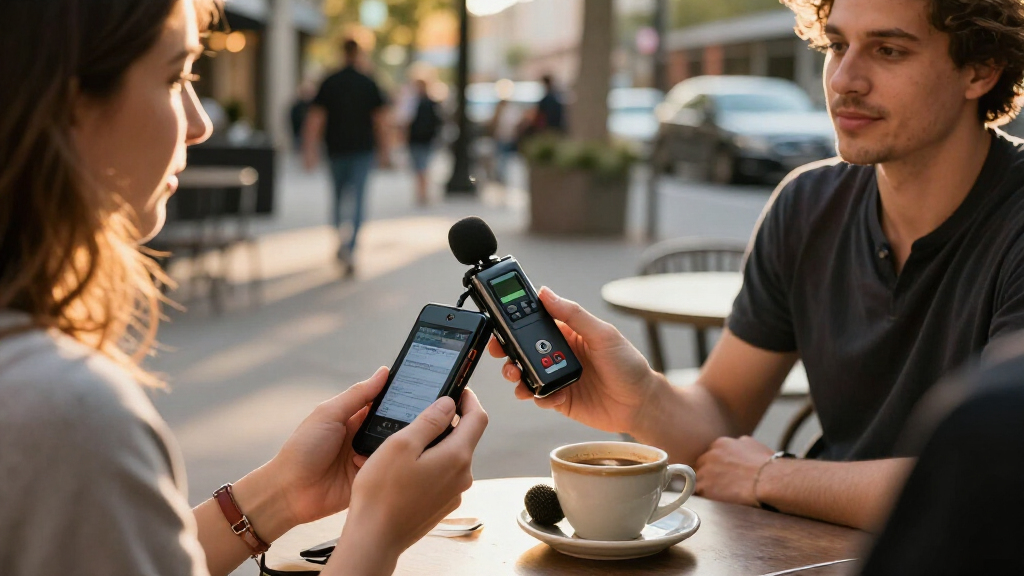
I ranked these portable digital voice recorders by how well their stated features serve common recording jobs: lectures, interviews, personal notes, and longer sessions away from a desk. I weighed storage capacity alongside transfer options, playback, voice activation, and any transcription or noise-reduction claims. I also considered how much extra setup a feature may require, since a recorder that is harder to use can be a poor fit for quick notes even when it offers more functions.
The order favors useful versatility and a clear buyer fit, not the biggest storage number or longest feature list. Models with AI tools rank well when those tools create a distinct advantage, while simpler devices remain relevant for people who want direct recording and file access. Because the supplied product information does not establish comparative audio tests, battery runtimes, or transcription accuracy, I do not treat those as proven advantages; buyers should confirm them before purchase.
| portable digital voice recorder | Microphone |
|---|---|
| HoTiyan 8GB Digital Voice Reco | Built-in stereo |
| EVISTR L359 Digital Voice Reco | Built-in mono |
| Innioasis PR1 AI Voice Recorde | — |
| Tonfarb 64GB Digital Voice Rec | Built-in stereo |
| Sunlan 16GB Digital Voice Reco | Built-in mono with noise cancellation |
| NSRLO V57 128GB Portable Digit | Built-in |
| Tonfarb 136GB Digital Voice Re | — |
| 72GB Digital Voice Recorder wi | Built-in 360° omnidirectional, mono |
| Cappsu Digital Voice Recorder | — |
| EVISTR L357 64GB Digital Voice | Built-in stereo |
| Sony ICD-PX370 Mono Digital Vo | — |
| 48GB Digital Voice Recorder wi | — |
| COHANA 128GB Voice Recorder wi | — |
| 16GB Voice-Activated Digital V | Built-in stereo |
| EVIDA 128GB Digital Voice Reco | Built-in mono with noise cancellation |
Factors to Consider When Choosing Portable Digital Voice Recorders
I’d choose a recorder by starting with the recording situation, then checking whether its extra features actually reduce work. A large memory figure or an AI label can look persuasive, but neither answers whether the device is easy to start, review, and transfer after a session.
Match Storage to Your Recording Routine
Storage affects how often you need to move or delete files, but the amount you need depends on recording format, length, and how frequently you archive. A student making short class notes may have little use for 128GB, while someone capturing long interviews may value more room between transfers. Avoid treating capacity as a proxy for sound quality: memory holds recordings but does not improve microphone performance. Check whether storage is built in or expandable, and whether the recorder clearly shows remaining space. If you keep files for work or research, plan a regular backup routine rather than relying on the recorder as your only archive.
Decide Whether Transcription Features Fit Your Workflow
Transcription can save time when recordings need to become searchable notes, but it adds a separate layer to the recording process. Check whether the feature runs on the device or depends on a companion app, account, or internet connection. Offline options, such as the PR1’s stated offline transcription and translation, may suit travel or sensitive settings, but buyers should verify supported languages and export formats. AI-generated text can mishear names, technical terms, and overlapping speech, so it should not replace checking the original audio. If you mainly need a reliable audio file, a simpler recorder may be easier to manage.
Treat Voice Activation as a Convenience, Not a Guarantee
Voice activation can reduce long stretches of silence in meetings or interviews, which may make files easier to review. It can also miss soft speech or clip the beginning of a sentence if its trigger level is poorly matched to the room. Background noise may keep a recorder active even when nobody is speaking, limiting the expected storage savings. Before relying on this mode for an important session, try it with the actual speaker distance and room sound. For critical interviews, continuous recording is safer when you can spare the battery and storage.
Check Transfer and Playback Before You Buy
A recorder is only useful if you can get its files onto the device where you edit, share, or store them. Built-in USB, as on the Sony ICD-PX370, may make direct transfer more convenient, while USB-C can suit newer cables and accessories. Confirm file compatibility with your computer or phone, and check whether a cable or adapter is needed. On-device playback helps with quick checks, but small controls or displays can make reviewing long recordings slow. If you regularly share audio, prioritize a simple export path over features you may rarely use.
Choose Simplicity or Added Controls Deliberately
Basic record-and-playback models can be a better match for quick reminders or first-time users because they involve fewer menus and settings. More specialized models may add voice activation, noise reduction, password protection, or transcription, each of which can help with a particular task. Extra controls also create more chances to select the wrong mode or spend time learning the device. Think about who will operate the recorder and whether they need to review files on the device itself. A feature is worth prioritizing when it solves a recurring problem, not simply because it appears on the specification list.
Pay More Attention to Recording Conditions Than Capacity
Room acoustics, microphone placement, and distance from the speaker can matter as much as the recorder itself. A high-capacity model will not rescue speech recorded from across a noisy room, and noise-reduction claims do not guarantee clean results in every setting. For interviews, place the recorder near the speakers and test levels before the conversation starts. For lectures, confirm that the device can capture a distant voice clearly from the seat you use. If recording quality is central to your work, look for detailed microphone and format information rather than choosing by storage alone.
Frequently Asked Questions
Is a 128GB recorder worth choosing over a 16GB model?
It depends on how long you record and how often you transfer files. A 16GB model can be enough for short notes or occasional classes if you regularly copy recordings elsewhere. The EVISTR L359, NSRLO V57, COHANA, and EVIDA offer stated 128GB capacity, which can reduce how often you need to clear space. Before paying for more memory, check recording formats and whether capacity is expandable, since file sizes vary. Extra storage is most useful when it solves a real archiving or transfer problem.
Can I rely on AI transcription instead of keeping the audio?
No: I’d keep the original recording even when transcription is available. Automated text can misinterpret names, jargon, accents, or speakers talking over one another. The EVISTR L359 and Innioasis PR1 advertise transcription features, but the supplied product details do not establish their accuracy for every language or environment. Check whether transcripts can be edited and exported in a format you use. For interviews, class notes, or records that matter, treat transcription as a starting point and verify key passages against the audio.
Should I use voice activation for lectures or interviews?
Voice activation can help reduce silence in settings where speakers pause often, but it may cut off quiet words or the start of a sentence. That risk matters more for interviews and lectures than for casual reminders. Several options here advertise the feature, including HoTiyan, COHANA, and EVIDA, but the product names alone do not show how sensitive their triggers are. Test the mode with the expected speaker distance and room noise before depending on it. For an important session, continuous recording is the safer choice if battery and memory allow.
Is the Sony ICD-PX370 a better choice than a higher-capacity model?
It may be a better fit if you value a simpler recording workflow and built-in USB more than large stated storage or AI features. The Sony is a mono recorder, so buyers should check whether that format suits their intended use. Higher-capacity options such as the EVISTR L359 and NSRLO V57 are more appealing when long sessions or fewer file transfers matter. Capacity alone does not establish better audio quality, and the available product details do not support a direct sound-quality comparison. Choose based on the tasks you repeat most, then confirm format and compatibility.
What should I check before using a recorder for sensitive meetings?
Check how recordings are protected, where any transcripts are processed, and how files are transferred or backed up. The EVIDA advertises password protection, but that feature does not by itself explain encryption, recovery, or protection after a file leaves the device. AI services may involve apps or online processing, so review their data practices before recording confidential material. Also follow consent rules and workplace policies for your location. If privacy is a priority, a basic recorder with a clear local-file workflow may be easier to evaluate than a model centered on connected tools.
Conclusion
For the best overall feature set, I’d start with the EVISTR L359, especially if 128GB storage and AI transcription fit your routine. The best specialized pick is the Innioasis PR1 for buyers who want offline transcription and translation, while the best straightforward choice is the Sony ICD-PX370 for people who prefer mono recording and built-in USB over extra software features. For beginners or light note-taking, compare the simpler playback-focused models, such as Sunlan, Cappsu, or Tonfarb, and choose by storage and transfer needs rather than feature count. I can’t name a defensible best-value or best-premium model from the supplied product details alone, since there is no verified pricing, build comparison, or performance testing; instead, prioritize the lowest-complexity option that meets your recording needs. For voice-activated recording, look at HoTiyan, COHANA, or EVIDA, and test the trigger before using one for an important session.