

TL;DR

Get everyday essentials delivered free with Prime
- Fast, free delivery on millions of items
- Prime Video, Amazon Music and more included
- Member-only deals all year
IdeaClyst acts as a private, digital war room that helps founders rigorously test ideas through AI-driven council debates, grounded research, and a personal workspace—all on your own machine. It reduces wasted time and builds confidence in decision-making.
Ever stare at a blank screen, overwhelmed by the sheer number of ideas bouncing around in your head? You’re not alone. Most founders face this chaos daily—multiple ideas, few clear paths, and the constant fear of wasting months chasing the wrong one. A War Room for Your Next Idea: Inside IdeaClyst
What if you had a digital war room—an environment where your ideas are not just stored but rigorously tested, debated, and shaped into something worth building? That’s exactly what IdeaClyst offers. It’s more than a tool; it’s a strategic battleground designed to give you confidence in your next move, grounded in real research and honest critique.
In this post, I’ll walk you through how IdeaClyst turns the messy process of idea validation into a focused, private, and data-driven decision-making hub. You’ll learn why it’s a game-changer for founders who want to avoid costly mistakes and build with conviction.
A war room for your next idea
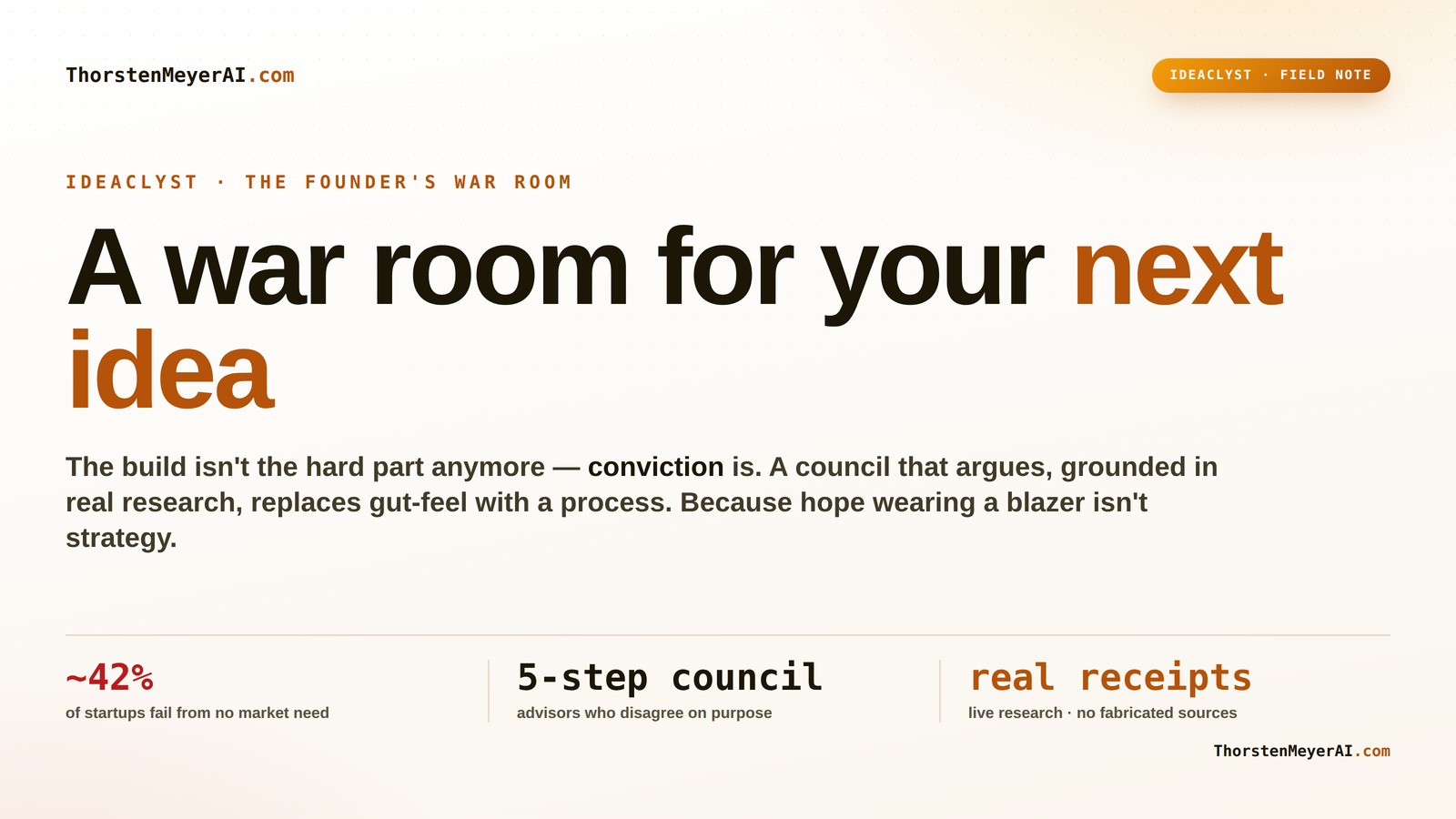
The build isn’t the hard part anymore — conviction is. Knowing which idea deserves the next six months, and being able to defend it. Most founders answer with gut feel and optimistic math. That’s hope wearing a blazer. IdeaClyst replaces it with a process.
The most expensive decision is what to build
The single most valuable thing a tool can do is talk you out of the wrong six months. The numbers make the case better than any pitch.
Three tools in one — on your own machine
Strip away the framing and IdeaClyst is three things at once, all running locally with nothing leaving your laptop.
An AI council
Pressure-tests an idea you bring it — advisors who argue on purpose.
A discovery engine
Finds ideas you didn’t know to look for by hunting real demand signals.
A founder’s workspace
Carries winners from “interesting” all the way to “ready to build.”
Advisors who disagree on purpose
Not one confident, agreeable answer — a structured five-step deliberation where models play different roles and turn on their own work. The disagreement is the feature.
The five-step deliberation
A council that leads with the bad news surfaces the objections you’d otherwise find the expensive way, on month five.
Product strategy
Who’s it for, what’s the wedge, why now, what’s the business model.
Technical architecture
What would it actually take to build — and where’s the risk.
Critique pass
The council turns on its own work. Where’s the hand-waving? What kills this?
Second, independent critique
A different voice, a different angle — so blind spots don’t survive.
Final synthesis
Everything into one coherent founder packet: strategy, architecture, validation, plan.
When IdeaClyst cites a source, it actually fetched it
The hard departure from “ask an AI what it thinks of my startup.” It runs in a strict, real-data-only mode — if it can’t gather genuine evidence, it says so plainly rather than inventing a plausible paragraph.
Confidence with receipts
No fabricated statistics, no imaginary competitors, no made-up citations. The packet survives a skeptical co-founder or a sharp investor because the reasoning has receipts.
Market research first
Scouts the landscape before the council reasons about anything.
Competitor read
Real positioning, pricing signals, feature claims — differentiation vs. reality.
Validation with links
Not “talk to customers” — concrete signals & sources you can click.
From the blank page to build-ready
Evaluation is half the problem; the blank page is the other half. And a plan is worthless if it dies in a tab you never reopen.
Bring a space, not an idea
“AI for accountants,” “tools for indie game studios” — plus your goal and real capacity. It hunts demand signals across HN, Reddit, Product Hunt, GitHub, pricing pages.
- An honest market read — leads with the bad news when a space is hard
- An opportunity map — high pain, thin competition
- Ranked candidates — wedge, who pays, effort, risk, confidence
- each with KILL CRITERIA — when to walk away
A home and a forward path
Every promising idea gets carried forward, with every artifact in plain files on your disk.
- Validation tooling — sprint board, interview list, evidence browser
- Founder profile — a personal-fit lens; same discovery, different advice
- Build workspaces — funnel, personas, landing draft, version history
- “Build this idea” → a PRD + task queue, ready for a coding agent
Key Takeaways
- IdeaClyst turns idea validation into a private, structured debate, reducing founder bias and increasing success chances.
- The AI council’s disagreement surfaces hidden flaws, making your plan more resilient before you build.
- Grounding ideas in live web research prevents reliance on outdated or overly optimistic assumptions.
- A war room can be physical or digital—choose what fuels your focus and fits your environment.
- Regularly review and update your war room to keep your strategy sharp and relevant.
As an affiliate, we earn on qualifying purchases.
Why Your Next Idea Needs a War Room, Not Just a Spreadsheet
Think of a war room as your command center—where every piece of intel, every strategy, and every critique comes together. For founders, that’s the difference between guessing and knowing.
When you bring an idea into IdeaClyst’s war room, it’s like putting it on a battle map. You see the terrain—market needs, technical risks, competitive landscape—all laid out visually. This visualization helps you understand the interconnectedness of factors that influence success or failure. It’s not just about brainstorming; it’s about strategic testing—assessing assumptions, uncovering blind spots, and iterating quickly. According to recent research, 42% of startup failures stem from building something nobody wants. exquisitepost.com A war room helps you see that danger early, so you can pivot or refine before investing too much.
Deciding whether to build a new feature or pivot your entire product involves complex tradeoffs—cost, time, market fit, technical feasibility. A War Room for Your Next Idea: Inside IdeaClyst A structured debate within a war room allows you to weigh these factors systematically, rather than relying on gut feelings. This process reduces emotional bias, highlights data-driven insights, and aligns your team around current news shared understanding. The ability to visualize and debate these elements accelerates decision-making and minimizes costly missteps.
private brainstorming workspace software
As an affiliate, we earn on qualifying purchases.
As an affiliate, we earn on qualifying purchases.
How IdeaClyst Turns Your Idea Into a Battle-Tested Plan
IdeaClyst is a three-in-one powerhouse: an AI council, a discovery engine, and a personal workspace. It takes your raw idea—no matter how fuzzy—and transforms it into a clear, validated plan. This systematic approach ensures that your ideas are not just brainstormed but thoroughly examined from multiple angles, reducing the risk of overlooking critical flaws or opportunities.
Here’s how it works:
- Input your idea: Type a sentence or paragraph describing your concept. This initial step is intentionally simple, encouraging free thinking without overthinking the phrasing. The quality of your input influences the depth of analysis, so clarity helps.
- Debate and critique: The AI council stages a structured five-step discussion—covering strategy, technical risks, market assumptions, and potential pitfalls. Different models are programmed with varying perspectives—some conservative, others more innovative—to simulate a diverse range of opinions. This layered critique exposes hidden flaws and biases, prompting you to address them proactively.
- Discover new angles: The discovery engine suggests related ideas, emerging trends, or overlooked niches—uncovering opportunities that might have been invisible initially. This broadens your horizon, helping you see the bigger picture and refine your approach accordingly.
- Final plan: All insights—critiques, discoveries, and adjustments—compile into a Markdown document. This becomes your battle plan, ready for review, presentation, or further iteration. This systematic documentation ensures clarity and facilitates communication with stakeholders or team members.
For example, a startup founder in Silicon Valley might input their idea for a new subscription model. The AI council highlights potential legal issues and suggests alternative pricing strategies based on recent market data. This comprehensive vetting process often reveals pitfalls or opportunities that might otherwise be missed, saving the founder from costly mistakes and guiding them toward a more viable plan.
AI-powered decision making software
As an affiliate, we earn on qualifying purchases.
As an affiliate, we earn on qualifying purchases.
The Power of Disagreeing AI Advisors: Why Contradiction Wins
Ever feel like your ideas are just echo chambers? That’s because one AI model agreeing with you isn’t validation—it’s confirmation bias. IdeaClyst’s secret sauce is its council of AI models designed to argue with each other, simulating a diverse panel of experts and skeptics. This multiplicity of perspectives is crucial because it prevents groupthink and surface-level consensus, which often lead to overlooked flaws or overly optimistic assumptions.
Think of it as a courtroom where different attorneys present conflicting arguments: one emphasizes market potential, another questions technical feasibility, while a third highlights regulatory hurdles. This dynamic forces your idea to confront its weaknesses head-on, revealing blind spots that would otherwise go unnoticed. The process encourages you to think critically about your assumptions, tradeoffs, and risks, leading to more robust and resilient plans.
For instance, a founder pitching a new app might receive conflicting critiques: one model emphasizes the importance of user experience, while another warns about scalability challenges. The final synthesis combines these viewpoints, allowing you to address both concerns simultaneously. Such disagreement-driven debate enhances your understanding and confidence, making your final plan more robust and resilient.
collaborative startup planning tool
As an affiliate, we earn on qualifying purchases.
As an affiliate, we earn on qualifying purchases.
Grounding Ideas in Real Data, Not Just Model Vibes
If an AI just parrots what it ‘thinks,’ you might as well ask your mirror. IdeaClyst breaks that mold by anchoring its debates in live web research—current market data, recent news, and real-time trend analysis. This grounding in live data is essential because it ensures your ideas are based on reality, not just assumptions or outdated information. It shifts the process from speculative to evidence-based, increasing the likelihood of success.
Vague statements like “market is growing” become meaningful when backed by specific, recent statistics. The AI pulls in the latest reports, competitor analyses, and customer reviews—directly from the web—allowing you to make decisions rooted in fact. This real-time research provides a dynamic foundation that adapts to changing conditions, helping you avoid the trap of confirmation bias or overconfidence.
For example, if you’re considering launching a new fitness app, IdeaClyst checks current trends, reviews competitors’ features, and identifies gaps—before you write a single line of code. This reduces the risk of building on faulty assumptions and makes your idea more resilient to market shifts. In essence, grounding ideas in fresh data leads to smarter, more adaptable strategies that stand the test of time.
Physical or Digital? Building Your War Room Your Way
A war room isn’t just a fancy conference room. It can be a physical wall, a whiteboard, or a digital space—whatever fuels your focus and productivity. The key is creating an environment that encourages honest critique, strategic thinking, and iteration without distractions.
With IdeaClyst, the war room lives on your laptop—completely private, portable, and customizable. This setup allows you to keep your ideas, critiques, and research all stored locally, which is crucial for privacy and security. It also offers flexibility—you can work from anywhere, whether that’s a co-working space, a coffee shop, or your home office. This adaptability makes it easier to integrate your idea validation process into your daily routine, ensuring continuous progress without unnecessary friction.
Imagine a remote founder in Bali who uses IdeaClyst on their tablet, reviewing and refining their startup plan while enjoying the ocean view. The digital war room’s portability means your strategic workspace isn’t confined to a specific location. Whether you prefer a physical whiteboard or a digital dashboard, the core principle remains: create a dedicated, focused space that nurtures critical thinking and strategic refinement.
What to Put in Your Idea War Room for Maximum Impact
Your war room should be a dynamic repository of everything that influences your idea—data, critiques, plans, and related ideas. But clutter and disorganization can dilute focus and hinder decision-making. To maximize effectiveness, structure your war room around core categories that promote clarity and strategic insight.
Here’s a practical approach:
- Gather recent market research snippets, trend reports, and customer insights. Keeping this data fresh ensures your decisions are grounded in current realities.
- Include technical risk assessments and possible architectural diagrams. Visual representations help clarify complex technical considerations and highlight potential bottlenecks.
- Document critiques and counterpoints from your AI council. These serve as a record of challenges to address and validate your assumptions.
- Add related ideas, discovery suggestions, and emerging opportunities from the AI’s exploration. These broaden your strategic perspective and spark innovation.
- Finally, compile a final synthesized plan and clear next steps, ideally in a Markdown or similar format. This keeps your strategy actionable and easy to update as new information emerges.
For example, a founder working on a new SaaS platform might include recent customer reviews, a diagram of the technical architecture, and objections raised during council debates—all organized into a single, accessible document. This structured approach ensures your war room remains a powerful tool rather than a cluttered space of scattered ideas.
Avoid These Common War Room Mistakes
Many founders treat their war room like a cluttered bulletin board—full of ideas but no clarity. The biggest mistake? Overloading it with unfiltered information or neglecting updates. This dilutes focus and can lead to decision paralysis, where it’s hard to identify the most critical issues or next steps. Regular pruning and organization are essential to keep the space functional and insightful.
Another trap is relying solely on AI for validation. While AI provides valuable perspectives, it should complement— not replace—real-world validation. Blindly trusting AI outputs without context or external validation can lead to misguided strategies or missed opportunities. Always cross-reference AI insights with actual data, customer feedback, or expert opinions.
Finally, don’t forget to revisit and revise your war room regularly. A static space quickly becomes outdated, leading to stale strategies and missed opportunities. Schedule regular reviews to update critiques, incorporate new research, and refine your plan. This habit keeps your war room relevant and your strategy agile.
For example, a startup that failed to update their competitor analysis in their war room based on recent market shifts ended up pursuing an outdated strategy. Regular reviews and pruning kept their focus sharp and aligned with current realities, significantly improving their decision quality.
Example Workflow: From Idea to Decision in Your War Room
Here’s a step-by-step example of how a founder might use IdeaClyst to validate a new product idea:
- Start: Write a brief description of the idea—“A personalized meal plan app for busy professionals.” This initial step encourages clarity and helps focus subsequent analysis, but the quality of your input influences the depth of critique and discovery. Clear, specific descriptions lead to more actionable insights.
- Debate: Let the AI council critique it—covering market fit, technical challenges, legal hurdles, and scalability. This structured debate surfaces assumptions and biases, prompting you to consider factors you might overlook. It also helps prioritize risks and opportunities based on the council’s collective insights.
- Discover: The engine suggests related niches, emerging trends, or alternative approaches—broadening your strategic perspective and uncovering hidden opportunities.
- Refine: Incorporate the feedback, adjust your plan, and identify key validation tests. This iterative process ensures your idea is robust and ready for real-world testing.
- Decide: With a comprehensive, debate-backed plan, you can confidently move forward, build, or pivot—knowing you’ve thoroughly tested your assumptions.
This structured workflow reduces guesswork, accelerates decision-making, and builds a solid foundation for your next steps, giving you confidence and clarity.
Frequently Asked Questions
What exactly is a war room for startups?
A war room is a dedicated space—physical or digital—where founders gather all relevant data, critiques, and strategies to test and refine ideas. It’s a focused environment for making better, faster decisions.How does IdeaClyst differ from just asking an AI for feedback?
Unlike simple AI chats, IdeaClyst’s council stage stages structured debates among multiple models, surfacing objections and alternative views. It grounds ideas in real research and provides a comprehensive plan, not just opinions.Can I use IdeaClyst on my own laptop?
Yes. IdeaClyst is designed to run entirely offline on your machine. Your ideas, critiques, and research stay local—no cloud, no subscriptions, just private, open-source software.What should I include in my war room?
Include market data, technical risks, critiques, related ideas, and your final plan. Keep it organized with Markdown files or whatever format helps you stay clear and focused.Is this tool only for solo founders or teams too?
It works for both. Solo founders use it to stay disciplined, while teams can share the same local files and collaborate, ensuring everyone’s on the same strategic page.Conclusion
Think of IdeaClyst as your personal battlefield for ideas—a space where uncertainty is challenged, weaknesses are exposed, and your plans are forged with confidence. It’s the secret weapon every founder needs to turn chaos into clarity.
Next time you’re stuck between multiple ideas, remember: a structured war room isn’t just for big corporations. It’s for anyone ready to fight for an idea that’s worth building. And with IdeaClyst, that fight stays private, grounded, and smart.
Halloween Picks
halloween
As an affiliate, we earn on qualifying purchases.