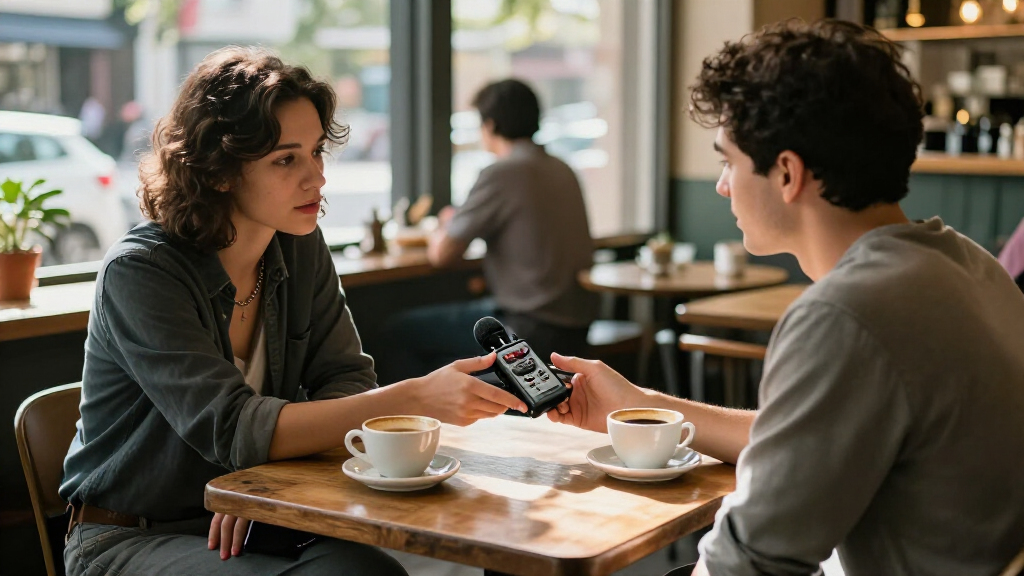
For portable audio recorders for interviews, I’d make the EVIDA V618 my best overall starting point: its 128GB capacity suits longer projects, while its straightforward recorder format avoids making AI features the main attraction. The EVISTR 128GB stands out for buyers who want transcription and summaries, and the 16GB voice-activated recorder is a simpler fit for occasional conversations. The main tradeoffs are easy operation versus extra features, and generous storage versus a compact, low-fuss workflow. For interviews, mic placement, monitoring, and dependable file transfer matter more than a huge advertised recording-hour figure. Read on for the full breakdown of how the 15 options differ and which buyer each one suits.

Get everyday essentials delivered free with Prime
- Fast, free delivery on millions of items
- Prime Video, Amazon Music and more included
- Member-only deals all year
Key Takeaways
- The EVIDA V618 is the roundup’s best overall pick for interviewers who want substantial storage without making transcription tools central to the workflow.
- The EVISTR 128GB and AI Voice Recorder prioritize post-interview assistance, but buyers should check how transcription works, what it requires, and whether the workflow suits their privacy needs.
- Storage claims vary widely across this lineup—from 8GB and 16GB models to devices advertised with 132GB or 136GB—yet capacity alone does not establish recording quality or runtime.
- Voice activation is a situational feature, not a universal interview upgrade: it may help with long, intermittent recordings, but uninterrupted recording is often safer for natural conversation.
- USB-C, OTG transfer, and magnetic mounting create distinct workflow advantages; they matter most when moving files often or recording discreetly, not when the recorder will sit on a table.
| AI Voice Recorder with Transcription & Summarization |  | Best for Interview Follow-Up | Storage: 64 GB | Battery life: Up to 30 hours | Microphone: Built-in | VIEW LATEST PRICE | See Our Full Breakdown |
| EVIDA 64GB Digital Voice Recorder with USB, 750 Hours Storage, Noise Reduction, Rechargeable |  | Best for Simple, Quick Interviews | Storage: 64 GB | Recording time: 15 hours | Battery life: 15 hours | VIEW LATEST PRICE | See Our Full Breakdown |
| EVISTR Digital Voice Recorder 128GB with AI Transcription & Summarization |  | Best for High-Volume Interview Work | Storage: 128 GB | Battery life: Up to 33 hours | Audio formats: MP3, WAV | VIEW LATEST PRICE | See Our Full Breakdown |
| Digital Voice Recorder with Playback, 32GB Built-in Memory |  | Best for Beginners | Storage: 32 GB, built-in | Recording quality: 1536 Kbps | Battery life: Up to 20 hours | VIEW LATEST PRICE | See Our Full Breakdown |
| 72GB Voice Activated Recorder with Playback, Noise Reduction DSP 6.0, Portable Audio Recorder for Lectures, Interviews & Meetings |  | Best for Long Recording Archives | Storage: 72 GB | Claimed recording time: Up to 10,860 hours | Format: WAV | VIEW LATEST PRICE | See Our Full Breakdown |
| Tonfarb 136GB Digital Voice Recorder with Playback and Noise Reduction |  | Best for Long Interview Runs | Storage: 136 GB | Battery life: Up to 68 hours | Recording formats: MP3, WAV | VIEW LATEST PRICE | See Our Full Breakdown |
| Digital Voice Recorder 16GB with Playback and USB Rechargeable |  | Best for Simple, Lightweight Interview Recording | Storage: 16 GB | Battery life: 30 hours | Microphone: Mono with noise cancellation | VIEW LATEST PRICE | See Our Full Breakdown |
| 64GB Digital Voice Recorder with Playback and Voice Activation |  | Best for Stereo Interviews and Voice-Triggered Capture | Storage: 64 GB | Battery life: 100 hours | Recording time: 107 hours | VIEW LATEST PRICE | See Our Full Breakdown |
| Tonfarb 64GB Digital Voice Recorder with Playback |  | Best for Higher-Detail PCM Recording | Storage: 64 GB | Battery details: 600mAh battery; listing also specifies 1 AAA battery | Recording time: Up to 48 hours | VIEW LATEST PRICE | See Our Full Breakdown |
| 136GB Double-Sided Magnetic Voice Activated Recorder with AI Noise Reduction, USB-C, and 100H Continuous Recording |  | Best for Hands-Free Placement | Storage: 136 GB | Continuous recording time: 100 hours | Total recording capacity: Up to 18,800 hours | VIEW LATEST PRICE | See Our Full Breakdown |
| 132G Voice Activated Recorder with AI Noise Reduction and 9800 Hours Storage |  | Best for Long Interview Archives | Memory storage: 136 GB | Claimed recording time: Up to 9,800 hours | Battery life: Up to 100 hours | VIEW LATEST PRICE | See Our Full Breakdown |
| Digital Voice Recorder with 8GB Storage, Voice Activation, MP3 Player, and Microphone |  | Best for Simple, Short Interviews | Storage capacity: 8 GB | Battery life: 20 hours recording; 8 hours playback | Claimed recording time: Up to 128 hours | VIEW LATEST PRICE | See Our Full Breakdown |
| Voice Recorder 16GB, Voice Activated Digital Recorder for Lectures, Meetings, Interviews, WAV/MP3 Playback |  | Best Compact Everyday Pick | Storage capacity: 16 GB | Battery life: Up to 20 hours | Recording formats: WAV, MP3 | VIEW LATEST PRICE | See Our Full Breakdown |
| 136GB AI Noise Reduction Voice Activated Recorder with OTG Transfer |  | Best Lightweight High-Capacity Pick | Storage capacity: 136 GB | Battery life: 48 hours | Audio recording time: 48 hours listed; description claims up to 18,800 hours | VIEW LATEST PRICE | See Our Full Breakdown |
| 128GB Digital Voice Recorder for Lectures and Meetings – EVIDA V618 |  | Best for Organized Interview Archives | Memory storage capacity: 128 GB | Battery life: 54 hours | Recording formats: WAV, MP3 at 128 kbps or 192 kbps | VIEW LATEST PRICE | See Our Full Breakdown |
| portable audio recorders for interview | Battery life | Microphone | Storage | Weight |
|---|---|---|---|---|
| AI Voice Recorder with Transcr | Up to 30 hours | Built-in | 64 GB | — |
| EVIDA 64GB Digital Voice Recor | 15 hours | High-sensitivity microphone with noise reduction | 64 GB | 14.7 g |
| EVISTR Digital Voice Recorder | Up to 33 hours | Built-in, mono operation | 128 GB | 2.24 oz |
| Digital Voice Recorder with Pl | Up to 20 hours | — | 32 GB, built-in | 1.6 oz |
| 72GB Voice Activated Recorder | — | — | 72 GB | — |
| Tonfarb 136GB Digital Voice Re | Up to 68 hours | Built-in microphone with noise cancellation | 136 GB | 100 g |
| Digital Voice Recorder 16GB wi | 30 hours | Mono with noise cancellation | 16 GB | 35 g |
| 64GB Digital Voice Recorder wi | 100 hours | Stereo | 64 GB | 2.24 ounces |
| Tonfarb 64GB Digital Voice Rec | — | Built-in stereo | 64 GB | — |
| 136GB Double-Sided Magnetic Vo | — | — | 136 GB | — |
| 132G Voice Activated Recorder | Up to 100 hours | Built-in; clip-on included | — | 0.17 kg |
| Digital Voice Recorder with 8G | 20 hours recording; 8 hours playback | Stereo | — | — |
| Voice Recorder 16GB | Up to 20 hours | Built-in stereo microphone | — | 1.6 ounces |
| 136GB AI Noise Reduction Voice | 48 hours | Built-in | — | 1 ounce |
| 128GB Digital Voice Recorder f | 54 hours | Built-in, noise-cancellation; mono operation | — | 3.35 ounces |
More Details on Our Top Picks
AI Voice Recorder with Transcription & Summarization
For interviewers who need searchable notes as well as an audio file, this model puts transcription and summaries ahead of storage or advanced recording controls. Its built-in microphone and one-touch, voice-activated operation suit quick sit-down conversations, while support for more than 90 languages can help when interviews span languages. Compared with the EVISTR 128GB Digital Voice Recorder, it offers less space and a shorter stated battery life, but its 30-hour runtime and password-protected storage make it a practical choice for recurring interviews and follow-up work. The tradeoff is dependence on a compatible app for full AI features; it also has no Wi-Fi for recording, and transferring files requires USB-C. I would choose it for streamlined interview notes, not for a workflow that needs large local archives or app-free use.
Pros:- Transcription and summaries support more than 90 languages.
- Up to 30 hours of battery life suits multiple interview sessions between charges.
- One-touch and voice-activated operation makes it quick to start recording.
- Password protection and cloud storage options support managed access to recordings.
Cons:- 64GB storage is less suited to extensive interview archives than the EVISTR model’s 128GB.
- Full functionality depends on a compatible app.
- No Wi-Fi recording; files transfer through USB-C.
Best for: Interviewers who want transcripts and concise summaries to speed up note-taking and follow-up.
Not ideal for: Researchers building large local audio archives or buyers who want the full feature set without a compatible app.
- Storage:64 GB
- Battery life:Up to 30 hours
- Microphone:Built-in
- Headphone jack:3.5 mm
- Hardware interface:USB Type-C
- Transcription:More than 90 languages
- Recording controls:One-touch operation and voice activation
- Security:Password protection; cloud storage options
Our verdict“Choose this recorder if interview transcripts and summaries matter more than maximum onboard storage or an app-free workflow.”
EVIDA 64GB Digital Voice Recorder with USB, 750 Hours Storage, Noise Reduction, Rechargeable
The EVIDA is the straightforward pick for someone who wants to press a switch and capture an interview without navigating transcription tools or extra settings. Its one-switch operation and high-sensitivity microphone with noise reduction favor speed, while the 14.7-gram body is easy to carry between appointments. Compared with the AI Voice Recorder with Transcription & Summarization, it skips automated notes and language tools, but that simplicity can suit interviewers who plan to review recordings themselves. Its listed recording time and battery life are both 15 hours, so it offers less stated endurance than the 20-hour basic recorder in this group. The supplied data also lists a built-in rechargeable battery and an included C battery, leaving the power setup unclear. I would pick it for uncomplicated capture, not for a dependable long-session workflow without clarifying that detail.
Pros:- One-switch operation makes recording quick to start.
- High-sensitivity microphone with noise reduction is suited to spoken conversations.
- At 14.7 g, it is easy to carry in a pocket or interview kit.
- USB 2.0 connectivity and USB flash-drive functionality simplify file handling.
Cons:- Listed battery life and recording time are 15 hours, below the 20-hour basic recorder in this group.
- No advanced editing or transcription features are specified.
- Power information is unclear: the data lists a built-in rechargeable battery and an included C battery.
Best for: Students, community reporters, and first-time interviewers who want a compact recorder with minimal setup.
Not ideal for: Interviewers who need automated transcripts, detailed editing, or clearly specified power arrangements for long sessions.
- Storage:64 GB
- Recording time:15 hours
- Battery life:15 hours
- Microphone:High-sensitivity microphone with noise reduction
- Weight:14.7 g
- Dimensions:2.58 × 0.4 × 0.78 in
- Connectivity:USB 2.0
- Battery information:Built-in rechargeable battery; listing also specifies one included C battery
Our verdict“Pick the EVIDA if simple, portable recording matters more than automated transcription or a clearly documented long-session power setup.”
EVISTR Digital Voice Recorder 128GB with AI Transcription & Summarization
Among these five, the EVISTR makes the strongest case for interviewers who record often and want both substantial local capacity and automated text. Its 128GB storage is twice the capacity of the 64GB AI Voice Recorder, while the stated 33-hour battery life also gives it an endurance advantage over that model. Transcription and summaries in 113 languages, voice activation, and password encryption make it a more feature-rich fit for ongoing research than the simpler 32GB playback recorder. That capacity comes with a practical compromise: transfers require a wired USB-C OTG connection, and the microphone operates in mono rather than offering multiple mic modes. Battery life may vary by use, too. I would favor it for a large archive of spoken interviews and multilingual notes, but not for buyers who need wireless transfer or a more flexible microphone setup.
Pros:- 128GB storage provides more room for interviews than the 64GB AI recorder.
- AI transcription and summaries support 113 languages.
- Up to 33 hours of battery life supports extended recording schedules.
- Voice activation, noise reduction, and password encryption add useful interview workflow controls.
Cons:- File transfer requires a wired USB-C OTG connection.
- Mono microphone operation limits recording flexibility.
- Battery life can vary with usage.
Best for: Researchers, journalists, and students recording frequent interviews who need a large local archive and multilingual transcription.
Not ideal for: Interviewers who need wireless file transfer, stereo capture, or a flexible multi-microphone setup.
- Storage:128 GB
- Battery life:Up to 33 hours
- Audio formats:MP3, WAV
- Recording quality:Up to 3072 Kbps
- Microphone:Built-in, mono operation
- Transcription languages:113
- Connectivity:USB Type-C OTG
- Security:Password encryption
- Weight:2.24 oz
Our verdict“Choose the EVISTR for frequent, high-volume interview recording when large storage and multilingual transcription outweigh wired transfer and mono capture.”
Digital Voice Recorder with Playback, 32GB Built-in Memory
This recorder is the least complicated choice for someone who wants a dedicated device for capturing and replaying interviews. One-click operation and voice activation reduce setup steps, while 20 hours of battery life is a useful middle ground between the EVIDA’s stated 15 hours and the AI-focused models’ longer runtimes. Its 1536 Kbps recording quality and built-in 32GB memory provide a clear, self-contained starting point without relying on removable cards. Compared with the EVISTR 128GB Digital Voice Recorder, it gives up storage, AI transcription, and password encryption; compared with the EVIDA, it offers five more hours of stated battery life. The tradeoff is a basic interface and no expansion beyond its internal memory. I would choose it for straightforward interview capture and playback, not for managing a growing research archive.
Pros:- One-click operation and voice activation simplify starting a recording.
- 20-hour battery life exceeds the EVIDA’s listed 15 hours.
- 1536 Kbps recording quality is specified for clear spoken audio.
- Built-in 32GB memory avoids a separate memory card.
Cons:- 32GB capacity is much smaller than the EVISTR’s 128GB.
- Built-in storage cannot be expanded.
- Basic controls lack the transcription and security tools offered by the AI models.
Best for: New interviewers who want simple recording and playback, with enough built-in storage for a modest set of sessions.
Not ideal for: Researchers with a large audio archive or buyers who need transcription, expandable storage, or advanced controls.
- Storage:32 GB, built-in
- Recording quality:1536 Kbps
- Battery life:Up to 20 hours
- Dimensions:4.16 × 1.46 × 0.47 in
- Weight:1.6 oz
- Microphone operation:Voice activated
- Hardware interface:USB Type-C
- Headphone jack:3.5 mm
Our verdict“Choose this model for uncomplicated interview recording and playback, but move to a higher-capacity option if you plan to keep a large archive.”
72GB Voice Activated Recorder with Playback, Noise Reduction DSP 6.0, Portable Audio Recorder for Lectures, Interviews & Meetings
This model is aimed at interviewers who value a large stated recording capacity and noise-reduction processing over transcription tools. Its 72GB storage, WAV recording, and voice activation offer a simple way to collect spoken material, while OTG transfer can support direct file handling. Compared with the Digital Voice Recorder with Playback, 32GB Built-in Memory, it provides more than double the listed capacity and names DSP 6.0 noise reduction, but its specs do not give a battery-life figure, so I would be cautious about relying on it for long days of back-to-back interviews. The claimed 10,860-hour recording capacity also lacks a stated recording-quality context, making it hard to judge against practical interview archives. Mono operation and WAV files may add workflow limits: WAV can require conversion for MP3-based systems, and no transcription feature is listed.
Pros:- 72GB storage exceeds the 32GB beginner recorder’s capacity.
- DSP 6.0 noise reduction is specified for spoken audio.
- Voice activation can reduce empty recording time.
- USB Type-C OTG transfer supports direct file handling.
Cons:- Battery life and charging details are not provided.
- Mono microphone operation limits recording modes.
- WAV is the listed format and may require conversion for MP3 workflows; transcription is not specified.
Best for: Interviewers who prioritize local storage, voice activation, and WAV files for spoken-word archives.
Not ideal for: Field reporters who need a documented battery runtime, stereo capture, or built-in transcription and easy MP3-ready files.
- Storage:72 GB
- Claimed recording time:Up to 10,860 hours
- Format:WAV
- Microphone operation:Mono
- Noise reduction:DSP 6.0
- Hardware interface:USB Type-C
- Headphone jack:Mini-USB
- Dimensions:0.58 × 0.58 × 6 in
Our verdict“Choose this recorder if storage and WAV capture matter most, but skip it for fieldwork that depends on a known battery runtime or automated transcripts.”
Tonfarb 136GB Digital Voice Recorder with Playback and Noise Reduction
For interviewers who want plenty of room for ongoing projects, the Tonfarb 136GB pairs substantial storage with a stated 68-hour battery life. One-touch recording helps when a conversation starts quickly, while voice activation can reduce stretches of empty audio. Compared with the 64GB Tonfarb model, this recorder offers more than double the storage and a longer listed battery life, making it a better fit for frequent field sessions without regular file clearing. Its MP3 and WAV support covers common editing and playback needs, but the supplied details do not mention external microphone support or rugged protection. The small 1.44-inch screen also limits how much information is visible at once. I’d choose it for long, mostly hands-off recording, not for a setup built around upgrading microphones.
Pros:- 136GB storage leaves room for many interview files before transfers are needed.
- Listed 68-hour battery life suits long stretches between charging.
- One-touch recording and voice activation simplify capture during conversations.
- USB-C and a 3.5 mm headphone jack support file transfer and direct listening.
Cons:- External microphone support is not specified, limiting confidence for more controlled interview audio.
- No waterproofing or rugged construction is listed for demanding field use.
- The 1.44-inch screen may make file selection and settings less convenient.
Best for: Interviewers recording frequent, extended sessions who want large onboard storage and simple one-touch operation.
Not ideal for: Reporters who need an external-microphone workflow, a rugged recorder for harsh locations, or detailed on-device file navigation.
- Storage:136 GB
- Battery life:Up to 68 hours
- Recording formats:MP3, WAV
- Microphone:Built-in microphone with noise cancellation
- Screen:1.44 inches
- Connectivity:USB-C
- Headphone jack:3.5 mm
- Weight:100 g
Our verdict“Choose this Tonfarb for frequent interviews where long battery life and ample storage matter more than microphone expansion or rugged protection.”
Digital Voice Recorder 16GB with Playback and USB Rechargeable
This 16GB recorder is the straightforward pick for someone who wants to press one button and focus on the conversation. At 35 g, it is lighter than the Tonfarb 136GB and easier to keep in a shirt pocket or small interview kit. Its mono, noise-cancelling microphone and WAV recording are suited to capturing a single speaker clearly, but they offer less flexibility than the stereo microphones and MP3/WAV options listed for the 64GB Digital Voice Recorder with Voice Activation. The stated battery life of over 30 hours is useful for regular interview days, while 16GB means more frequent file transfers than the larger-capacity options. I’d favor this model for basic sit-down conversations and uncomplicated controls; buyers who need stereo capture, longer archives, or external mic options should look elsewhere.
Pros:- At 35 g, it is easy to carry in a pocket or compact field kit.
- One-button recording and playback reduce setup steps before an interview.
- Mono noise-cancellation microphone is a simple fit for focused speech capture.
- Over 30 hours of stated battery life supports repeated sessions between charges.
Cons:- 16GB storage is modest beside the 64GB and 136GB recorders in this group.
- Mono recording is less suitable for capturing room ambience or multiple speakers spatially.
- External microphone compatibility is not specified.
Best for: New interviewers and students who want a light recorder with simple controls for single-speaker conversations.
Not ideal for: Interviewers capturing multiple people in a room, needing stereo recording, or keeping a large archive on the device.
- Storage:16 GB
- Battery life:30 hours
- Microphone:Mono with noise cancellation
- Recording format:WAV
- Dimensions:0.5 × 1.4 × 3.3 inches
- Weight:35 g
- Interface:USB
- Headphone jack:3.5 mm
Our verdict“Pick this model for lightweight, single-speaker interviews and simple operation, but choose a stereo recorder for group conversations.”
64GB Digital Voice Recorder with Playback and Voice Activation
The stereo microphone gives this 64GB recorder a useful distinction for interviews with more than one speaker: it can capture a broader sense of the room than the mono Digital Voice Recorder 16GB. Voice activation may also help cut down on silent gaps, though sensitivity needs manual setup, so I would check it before relying on it for a live conversation. The listed 107 hours of recording time and 100-hour battery life make it a strong option for long projects, while MP3 and WAV support provide familiar file choices. Its simple two-button operation keeps handling uncomplicated, but playback controls are basic. Compared with the Tonfarb 64GB model, this pick is better suited to buyers who value stereo capture and longer stated endurance over a 1.44-inch screen and listed PCM bitrate detail.
Pros:- Stereo microphone is better suited to conversations involving multiple speakers than a mono recorder.
- 64GB storage provides substantial room for interview files.
- Voice activation can reduce empty sections in recordings when sensitivity is set appropriately.
- USB Type-C, MP3/WAV support, and a 3.5 mm headphone jack offer practical file and listening options.
Cons:- Voice activation sensitivity requires manual setup before use.
- Playback controls are described as basic, which may slow review and file navigation.
- Battery life may vary with usage.
Best for: Interviewers recording two-person conversations or room discussions who want stereo capture, voice activation, and long stated runtime.
Not ideal for: Users who need advanced playback controls or want voice activation to work reliably without sensitivity setup.
- Storage:64 GB
- Battery life:100 hours
- Recording time:107 hours
- Microphone:Stereo
- Recording formats:MP3, WAV
- Dimensions:0.47 × 1.2 × 3.86 inches
- Weight:2.24 ounces
- Connectivity:USB Type-C
Our verdict“Choose this recorder for stereo interview capture and long recording sessions if you are willing to configure voice activation and accept basic playback controls.”
Tonfarb 64GB Digital Voice Recorder with Playback
For interviewers who want a stated audio-quality ceiling alongside familiar file formats, this Tonfarb lists PCM up to 1536 kbps, plus WAV and MP3 recording. Its 64GB capacity and voice activation cover everyday interview needs, while one-click recording keeps the start of a conversation easier to catch. Compared with the Tonfarb 136GB, it gives up half the storage and lists up to 48 hours of recording rather than 68 hours of battery life, but its stereo microphone and PCM specification make the recording details more explicit. There is a practical caveat: the product data lists both a 600mAh battery and one AAA battery, so the power arrangement is not fully clear. Its 1.44-inch screen is also small. I’d shortlist it for PCM-focused workflows, while buyers seeking simpler charging may prefer a rechargeable USB-C model.
Pros:- PCM recording is listed up to 1536 kbps for buyers seeking a high-bitrate option.
- Stereo built-in microphone supports conversations with more than one speaker.
- One-click recording and voice activation simplify capture during interviews.
- WAV and MP3 formats offer flexibility for recording and playback.
Cons:- Power details are unclear: the listing mentions a 600mAh battery and one AAA battery.
- Its 64GB capacity is lower than the 136GB Tonfarb model.
- The 1.44-inch screen may make settings and file review less convenient.
Best for: Interviewers who want stereo recording with a stated high-bitrate PCM option and can manage battery replacement.
Not ideal for: Frequent field users who prioritize clear, consistent rechargeable-battery details or maximum storage capacity.
- Storage:64 GB
- Battery details:600mAh battery; listing also specifies 1 AAA battery
- Recording time:Up to 48 hours
- Recording formats:WAV, MP3
- Audio quality:PCM up to 1536 kbps
- Microphone:Built-in stereo
- Screen:1.44 inches
- Connectivity:USB 2.0
Our verdict“Pick this Tonfarb if its stated PCM bitrate and stereo microphone matter more than maximum storage or unambiguous rechargeable power details.”
136GB Double-Sided Magnetic Voice Activated Recorder with AI Noise Reduction, USB-C, and 100H Continuous Recording
The defining advantage here is magnetic attachment: it can be positioned hands-free on a suitable metal surface, which may help when the interviewer needs to keep the recorder out of the way. It also pairs 136GB storage with a listed 100 hours of continuous recording and AI noise filtering. Compared with the Tonfarb 136GB recorder, it claims longer continuous operation and adds magnetic placement, but its product data does not specify battery capacity, microphone configuration, recording formats, or a headphone jack. Those omissions make it harder to judge monitoring and editing fit for an interview workflow. USB-C and OTG transfer support broaden file access across phones and computers, though the feature set may take more setup than a one-touch basic recorder. I’d choose it for flexible placement and long unattended sessions, not when dependable battery details or audio-format specifics are priorities.
Pros:- Magnetic attachment allows hands-free placement on suitable metal surfaces.
- 136GB internal storage supports a large archive of interview recordings.
- Listed 100-hour continuous recording time suits long unattended sessions.
- USB-C and OTG provide transfer options across phones and computers.
Cons:- Battery capacity and battery life details beyond the continuous recording claim are not specified.
- Microphone configuration and recording formats are not listed, making audio workflow fit harder to assess.
- No headphone jack or rugged protection is specified.
Best for: Interviewers who need hands-free recorder placement on metal surfaces and want long continuous sessions with USB-C or OTG transfers.
Not ideal for: Buyers who need documented microphone specifications, known battery capacity, or a listed headphone jack for monitoring.
- Storage:136 GB
- Continuous recording time:100 hours
- Total recording capacity:Up to 18,800 hours
- Noise reduction:AI smart noise filtering
- Attachment method:Magnetic adsorption
- Connectivity:USB-C, OTG
- Supported platforms:iPhone, Android, Mac, Windows
Our verdict“Choose this recorder for magnetic, hands-free placement and long continuous sessions, but favor a better-documented model when monitoring and audio formats matter.”
132G Voice Activated Recorder with AI Noise Reduction and 9800 Hours Storage
For interviewers who record often and keep their source audio, this model’s 136 GB of listed storage and claimed 9,800 hours of recording reduce the need to offload files between sessions. One-touch recording and voice activation can also help capture an unexpected answer without fussing through menus. Compared with the more compact 136GB AI Noise Reduction Voice Activated Recorder with OTG Transfer, this recorder is heavier and bulkier, but its listed 100-hour battery life is longer than that model’s 48 hours. The included clip-on microphone gives buyers another placement option, though the product data does not specify its connection type or recording quality. Treat the enormous storage figure as a capacity claim, not a measure of interview runtime at a particular audio setting.
Pros:- 136 GB listed storage and a claimed 9,800 hours of recording
- Voice activation can reduce recording of long pauses
- One-touch recording helps start a session quickly
- Listed battery life reaches 100 hours
Cons:- Bulkier than the one-ounce 136GB AI Noise Reduction Voice Activated Recorder with OTG Transfer
- Audio format is listed as MP3, with no bitrate or detailed quality settings supplied
- Digital features may take time to learn, and the clip-on microphone connection is unspecified
Best for: Interviewers who make frequent, long recordings and want substantial onboard storage plus a clip-on microphone option.
Not ideal for: Mobile reporters prioritizing a very small recorder, or buyers who need documented external-mic compatibility and specific audio-quality settings.
- Memory storage:136 GB
- Claimed recording time:Up to 9,800 hours
- Battery life:Up to 100 hours
- Audio format:MP3
- Microphone:Built-in; clip-on included
- Connectivity:USB Type-C
- Headphone jack:3.5 mm
- Dimensions:4.5 × 4 × 1.1 inches
- Weight:0.17 kg
Our verdict“Choose it for long interview archives and extended battery life, but skip it if pocketability or clearly documented mic options matter more.”
Digital Voice Recorder with 8GB Storage, Voice Activation, MP3 Player, and Microphone
This is the straightforward pick for someone recording occasional interviews who values a simple recorder more than a huge archive. Its stereo microphone, voice activation, and MP3/WAV support cover the basics, while the MP3-player function gives it another everyday use. The tradeoff is the 8 GB capacity: unlike the 16GB Voice Recorder, it leaves less room for keeping multiple sessions on the device, so regular interviewers may need to transfer files more often. The listed 20-hour recording battery life should cover many individual sessions, but it is far below the 100-hour claim for the 132G Voice Activated Recorder. A small screen and USB 2.0 Type-B transfer also make file handling less convenient than a more modern USB-C setup.
Pros:- Stereo microphone and noise reduction are suited to capturing conversational audio
- Voice activation can limit empty recording during pauses
- Supports both MP3 and WAV files
- Can also play MP3 files
Cons:- 8 GB storage is limited for keeping many interview files onboard
- USB 2.0 Type-B transfer requires a wired connection
- Small screen may make navigating files and settings harder
Best for: Students, volunteers, and occasional interviewers who want a compact, basic stereo recorder for shorter sessions.
Not ideal for: Journalists building a large archive or anyone who needs fast, wireless, or USB-C file transfer.
- Storage capacity:8 GB
- Battery life:20 hours recording; 8 hours playback
- Claimed recording time:Up to 128 hours
- File formats:MP3, WAV
- Microphone:Stereo
- Battery:Rechargeable lithium-ion
- Interface:USB 2.0 Type-B
- Headphone jack:3.5 mm
Our verdict“Pick this for occasional interviews and basic stereo recording, but choose the 16GB Voice Recorder if you want more onboard file space.”
Voice Recorder 16GB, Voice Activated Digital Recorder for Lectures, Meetings, Interviews, WAV/MP3 Playback
At 1.6 ounces and about 3.26 inches tall, this recorder is an easy fit for a pocket or small interview kit. Its 16 GB capacity gives it twice the listed storage of the 8GB Digital Voice Recorder, making it a more practical choice for keeping several sessions before transferring them. It also records in WAV and MP3, so buyers have a choice between larger files and a more space-conscious format. Voice activation and noise reduction are useful for conversational settings, though neither replaces careful mic placement in a noisy room. The built-in stereo microphone keeps the setup simple, but there is no stated external-microphone input. Compared with the high-capacity EVIDA V618, this model is far lighter, with much less room for a long-term archive.
Pros:- Light 1.6-ounce body is convenient to carry between interviews
- 16 GB capacity exceeds the 8 GB model’s listed storage
- WAV and MP3 support offers file-size flexibility
- Voice activation and noise reduction suit basic interview use
Cons:- No external-microphone option is specified
- 16 GB is modest beside the 128 GB EVIDA V618
- Listed battery life is 20 hours
Best for: Traveling interviewers and students who want a lightweight recorder for short or moderate sessions and routine file transfer.
Not ideal for: Interviewers who need an external microphone connection, extensive onboard archiving, or recording sessions beyond the listed 20-hour battery life.
- Storage capacity:16 GB
- Battery life:Up to 20 hours
- Recording formats:WAV, MP3
- Microphone:Built-in stereo microphone
- Weight:1.6 ounces
- Dimensions:0.46 × 1.37 × 3.26 inches
- Headphone jack:3.5 mm
- Storage file limit:Up to 199 files
Our verdict“Choose this compact recorder for portable, everyday interviews, but look elsewhere if external mics or large archives are part of your workflow.”
136GB AI Noise Reduction Voice Activated Recorder with OTG Transfer
This model pairs a one-ounce body with 136 GB of storage, an unusual combination for interviewers who want to carry a light recorder without immediately running out of room. One-button operation can make starting a conversation recording less fiddly than using a multi-function device such as the EVIDA V618. Its listed 48-hour battery life is also substantial, though it trails the 100-hour claim for the 132G Voice Activated Recorder. There is a data inconsistency worth noting: the description claims up to 18,800 hours of audio, while the specifications list 48 hours of audio recording. That makes the storage figure easier to interpret than the advertised runtime. OTG transfer may simplify moving files to compatible devices, but compatibility is not broadly detailed.
Pros:- One-ounce weight is well suited to carrying between interviews
- 136 GB listed storage provides room for many files
- Voice activation and AI noise reduction are included
- USB Type-C and OTG transfer are listed
Cons:- Description’s 18,800-hour claim conflicts with the 48-hour recording-time specification
- OTG transfer depends on compatible devices
- Product data offers little detail about durability or recording formats
Best for: On-the-go interviewers who want a very light recorder with large listed storage and simple one-button operation.
Not ideal for: Buyers who need verified recording-duration figures, detailed durability information, or dependable transfer across a range of devices.
- Storage capacity:136 GB
- Battery life:48 hours
- Audio recording time:48 hours listed; description claims up to 18,800 hours
- Charging time:1.5 hours
- Weight:1 ounce
- Hardware interface:USB Type-C
- Microphone:Built-in
- Headphone jack:3.5 mm
Our verdict“Choose it for a light carry and large listed storage, but avoid relying on its advertised recording-hour claim until clarified.”
128GB Digital Voice Recorder for Lectures and Meetings – EVIDA V618
The EVIDA V618 is the strongest fit here for interviewers who want a large onboard archive plus practical file security. Its 128 GB storage, voice activation, and password protection suit people who keep recordings on the device between sessions; WAV and MP3 options also allow a choice between higher-detail files and smaller ones. Against the 16GB Voice Recorder, it offers far more storage but weighs 3.35 ounces rather than 1.6. The listed 54-hour battery life is respectable, though shorter than the 100-hour claim for the 132G recorder. One tradeoff matters during interviews: the V618 uses a mono microphone and has no headphone jack listed, limiting stereo capture and direct headphone monitoring. Its C-battery requirement is also unclear in the product details and merits verification before purchase.
Pros:- 128 GB storage supports a substantial onboard interview archive
- Password protection adds a layer of access control for saved files
- WAV and MP3 formats offer recording-file flexibility
- Voice activation can reduce recording of extended silence
Cons:- Mono microphone does not provide stereo capture
- No headphone jack is listed for direct monitoring
- C-battery requirement is unclear in the supplied product details
Best for: Researchers and professionals who keep many interview files onboard and value password protection and WAV/MP3 recording options.
Not ideal for: Interviewers who need stereo capture, headphone monitoring, or a clearly documented rechargeable-battery setup.
- Memory storage capacity:128 GB
- Battery life:54 hours
- Recording formats:WAV, MP3 at 128 kbps or 192 kbps
- Microphone:Built-in, noise-cancellation; mono operation
- Weight:3.35 ounces
- Dimensions:2.59 × 0.41 × 0.77 inches
- Compatibility:Personal computer
- USB:USB 2.0
Our verdict“Choose the V618 for secure, high-capacity interview storage, but skip it if stereo recording or headphone monitoring is a requirement.”
How We Picked
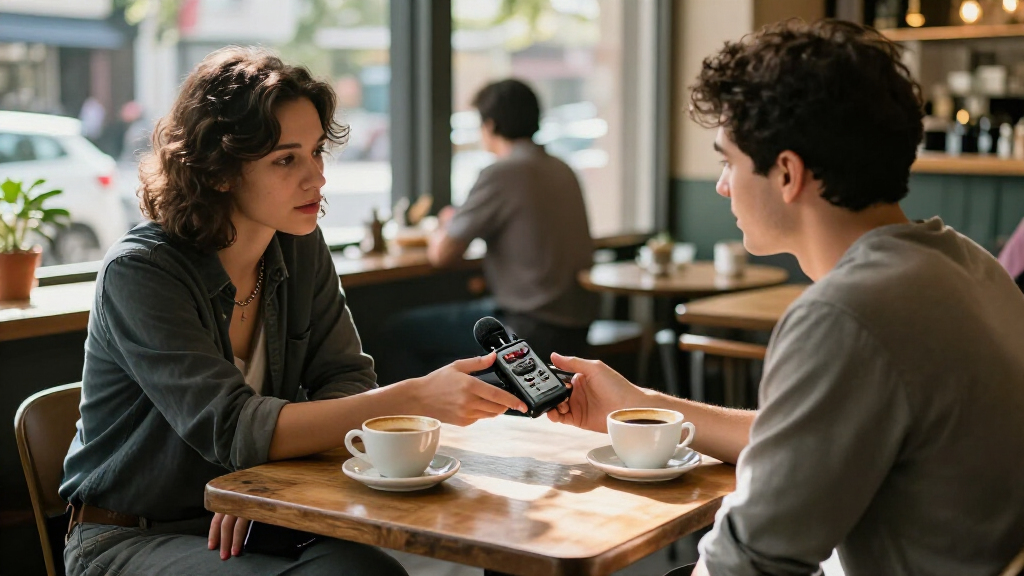
I ranked these recorders around the demands of an interview: capturing a complete conversation, operating the device without distracting from the guest, and getting the audio files onto another device afterward. I compared stated features such as playback, voice activation, noise reduction, storage capacity, rechargeable power, and connection options. A feature only counted as an advantage when it could support a practical interview task; large storage claims, for example, do not by themselves prove better sound or longer battery life.
The top positions favor options with a balanced interview workflow and clearly stated capabilities, while specialized models rank higher for buyers who specifically need transcription, discreet placement, or transfer flexibility. Simpler and lower-capacity recorders can still suit occasional use, but they offer less room for long projects or expanded workflows. Product listings do not establish every detail an interviewer should verify—such as microphone inputs, monitoring, recording format, or battery runtime—so I call out those points as checks rather than assume the features are present.
Factors to Consider When Choosing Portable Audio Recorders For Interviews
Interview recording involves more than choosing a storage number. I’d start with how the recorder will sit relative to both speakers, how you’ll confirm it is recording, and what happens to the file after the conversation. These broader choices can matter more than adding features you may never use.
Prioritize microphone placement before advertised noise reduction
Noise reduction labels do not tell you how a recorder will handle a distant guest, room echo, or overlapping voices. For a sit-down interview, placing the recorder between speakers and keeping it away from typing, HVAC vents, and table knocks can make a larger difference than a DSP version number. If the device supports external microphones, check which connector it uses and whether it can record both voices cleanly; the product names in this roundup do not confirm that capability. A built-in microphone can be convenient for quick conversations, but it leaves less flexibility when the room or seating arrangement is difficult. Avoid choosing on the promise of noise reduction alone: it cannot reliably repair poor placement or clipped speech.
Choose voice activation only when silence is the bigger problem
Voice activation can conserve storage during a meeting with long pauses, but its threshold may miss quiet openings, soft-spoken answers, or the first word after silence. That risk is especially unwelcome in an interview where a short response can carry the key detail. Continuous recording is often the safer default when the conversation is important and the recorder has enough battery and space. If you want activation, check whether its sensitivity can be adjusted and test it with realistic speaking volume before relying on it. Treat activation as a convenience for low-stakes or intermittent sessions, not a substitute for checking the recording.
Match storage to your recording schedule, not the biggest number
More memory helps when you record lengthy sessions, keep original files, or cannot offload audio between interviews. Still, advertised hours depend on recording format and quality, so a capacity figure or hours claim alone cannot predict how much usable, clear audio the device stores. Estimate your longest session and the number of recordings you need to retain, then leave room for a spare take or an unexpectedly extended conversation. Smaller-capacity models can be sensible for short, occasional interviews if you can transfer files promptly. Before buying, confirm whether storage is built in, expandable, or tied to a particular recording setting.
Check the full transfer and transcription path
A recorder is only useful if its files reach the editing or transcription workflow you rely on. USB, USB-C, and OTG can simplify transfers, but connector type does not guarantee compatibility with every phone, computer, or operating system. AI transcription and summaries may save time after a conversation, yet buyers should check whether processing happens on the recorder, through an app, or through an online service. That distinction affects setup, ongoing access, and the handling of sensitive interview material. If privacy matters, confirm where audio and transcripts are stored before recording a confidential conversation.
Do not overlook controls, playback, and confirmation
For an interviewer, clear record and stop controls can matter more than a crowded feature menu: a missed start cannot be repaired later. Playback on the recorder can help confirm that a session exists, though listening through headphones or transferring a sample file gives a more useful check of speech clarity. Look for controls you can operate without fumbling and a display or indicator that makes the recording state obvious. If the recorder will be used during live conversations, test button sounds and handling noise so operating it does not disrupt the exchange. A short pre-interview check of recording, playback, and file transfer is a better safeguard than trusting a feature list.
Pay extra for workflow improvements you will use repeatedly
Added capacity, AI tools, USB-C, or magnetic mounting can justify choosing a more specialized recorder when each one solves a recurring problem. A journalist moving many files may value a faster, simpler transfer path; an interviewer producing transcripts may benefit from a well-understood AI workflow. By contrast, a large memory claim has little value if you record brief sessions and routinely offload them. Magnetic mounting can help with discreet positioning, but it should not compromise microphone placement or put the device against a noisy surface. I’d spend first on reliable operation and a workable audio setup, then on convenience features matched to the job.
Frequently Asked Questions
Is voice activation a good choice for recording interviews?
It can help when sessions contain long pauses or when conserving storage is a priority, but it adds a risk: quiet speech or the start of a reply may not trigger recording. For an important interview, continuous recording is usually the safer choice if the device has enough power and space. If you prefer activation, test it with the quietest expected speaker and listen for clipped beginnings. Also check whether sensitivity is adjustable rather than assuming all voice-activated models behave alike.
Do I need AI transcription in an interview recorder?
No; it is a convenience, not a prerequisite for capturing a useful interview. AI features can reduce the time spent creating a rough transcript or summary, but their value depends on the service, supported languages, editing needs, and how audio is processed. Confirm whether transcription requires an app, account, internet access, or separate service terms. For sensitive interviews, find out where recordings and transcripts are stored before using cloud-based processing.
How much storage should I choose for interview recording?
Base the choice on your longest expected session, recording settings, and how often you can transfer files—not on the largest capacity printed in a listing. Higher-quality or less-compressed audio can use more space, while advertised recording-hour totals may assume a particular setting. If you record several interviews before offloading, extra capacity gives you a useful buffer. For short sessions that you transfer after each interview, a smaller recorder may be adequate; check whether the storage is built in or expandable.
Can a compact voice recorder replace a dedicated microphone setup?
For a simple, close-range conversation in a quiet room, a portable recorder’s built-in microphone may be enough. It is less predictable when speakers sit far apart, the room is reverberant, or background noise is prominent. Before relying on a recorder for paid or important work, check whether it supports external microphones and whether its inputs match your intended setup. Even with a capable recorder, placing microphones near the speakers and making a test recording remains important.
What should I verify before using a recorder for a sensitive interview?
Check how the device records, where files are saved, and whether any transcription or summary feature sends audio to an app or online service. Confirm that you can transfer and delete files as needed, and decide how backups will be handled. Do a short test to verify that both voices are clear and that the recording starts and stops as expected. Follow the consent and recording rules that apply to the people and location involved; a feature list cannot settle those requirements.
Conclusion
For the broadest mix of interview practicality and storage, I’d choose the EVIDA V618 as best overall. The best value depends on the buyer’s workflow: the EVIDA 64GB model is a straightforward option for routine recordings, while the 16GB recorder suits lighter use if limited capacity is acceptable. For a best premium-style feature set, I’d look at the EVISTR 128GB or AI Voice Recorder for transcription and summaries, after checking how those tools process files. The best option for beginners is a simple playback recorder with clear controls, rather than a model whose extra features add setup steps. For specific needs, choose the magnetic USB-C model for discreet placement and transfer flexibility, or a voice-activated model for intermittent sessions—while using continuous recording when missing a quiet answer is not an option.
Halloween Picks
halloween
As an affiliate, we earn on qualifying purchases.