For podcast headphones for broadcasting, I’d start with the Audio-Technica ATH-M50x as the best overall choice for detailed monitoring and a detachable cable. The RØDE NTH-100 stands out for content creators who want a broadcast-focused fit, while the Audio-Technica BPHS1 is the specialist pick when you need a built-in boom microphone. The main tradeoff is whether you want headphones only for monitoring or a headset that also handles your voice, alongside choices about comfort, isolation, and connection flexibility. Read on for the full breakdown of all 12 models and how I’d match them to different broadcasting setups.

Get everyday essentials delivered free with Prime
- Fast, free delivery on millions of items
- Prime Video, Amazon Music and more included
- Member-only deals all year
Complete the kit


Key Takeaways
- The ATH-M50x leads for all-around monitoring: its detachable cable and studio-monitor design make it a versatile fit for recording, editing, and live podcast work.
- The BPHS1 is the dedicated headset option: its boom microphone suits presenters who need a mic attached, unlike the monitoring-only headphones in most of this lineup.
- The RØDE NTH-100 has a content-creation focus: it offers a distinct alternative to the more traditional Audio-Technica monitor models.
- Several models trade advanced flexibility for a simpler wired setup: options such as the ATH-M20x and TASCAM TH-02 are aimed at straightforward monitoring rather than feature-rich studio workflows.
- Detachable cables and microphones matter for different reasons: a removable headphone cable can make replacement easier, while a boom mic changes how the headset fits into a broadcast setup.
| Audio-Technica ATH-M30x Professional Studio Monitor Headphones, Black |  | Best for Midrange Clarity | Brand: Audio-Technica | Model: ATH-M30x | Driver size and type: 40 mm dynamic | VIEW LATEST PRICE | See Our Full Breakdown |
| Audio-Technica ATH-M20x Professional Studio Monitor Headphones |  | Best Entry-Level Studio Pick | Brand: Audio-Technica | Model: ATH-M20x | Type: Closed-back over-ear headphones | VIEW LATEST PRICE | See Our Full Breakdown |
| RØDE NTH-100 Professional Over-Ear Headphones for Content Creation |  | Best for Long Broadcast Sessions | Brand: RØDE | Model: NTH-100 | Color: Black | VIEW LATEST PRICE | See Our Full Breakdown |
| FIFINE H8 Wired Studio Monitor Headphones with Detachable Cables |  | Best for Flexible Studio Connections | Brand: FIFINE | Model: H8 | Type: Wired over-ear studio monitor headphones | VIEW LATEST PRICE | See Our Full Breakdown |
| OneOdio Pro-10 Wired Over-Ear DJ Headphones, Black |  | Best for Single-Ear Monitoring | Brand: OneOdio | Model: Pro-10 | Connectivity: Wired | VIEW LATEST PRICE | See Our Full Breakdown |
| Audio-Technica BPHS1 Broadcast Stereo Headset with Dynamic Cardioid Boom Microphone |  | Best Dedicated Broadcast Headset | Microphone type: Dynamic | Microphone polar pattern: Cardioid | Headphone design: Closed-back, circumaural | VIEW LATEST PRICE | See Our Full Breakdown |
| MAONO MH601 Wired Studio Headphones for Podcast, Recording, Streaming, and DJ Mixing |  | Best Value-Style Pick for Separate-Mic Setups | Driver size: 50 mm | Cable length: 9.8 ft | Cable: Detachable spring cable | VIEW LATEST PRICE | See Our Full Breakdown |
| Maono MH700 Wired Studio Headphones |  | Best for Multi-Device Studio Monitoring | Driver size: 50 mm | Frequency response: 20 Hz–20 kHz | Connectivity: Wired | VIEW LATEST PRICE | See Our Full Breakdown |
| TASCAM TH-02 Wired Over-Ear Studio Monitor Headphones |  | Best Compact Monitoring Pick | Type: Wired, closed-back over-ear headphones | Driver type and size: Dynamic, 50 mm | Frequency response: 18 Hz–22 kHz | VIEW LATEST PRICE | See Our Full Breakdown |
| talomen W550X Wired Studio Monitor Headphones with Detachable Boom Microphone |  | Best Detachable-Mic Alternative | Connectivity: Wired | Driver type and size: Dynamic, 50 mm | Microphone: Detachable cardioid boom microphone | VIEW LATEST PRICE | See Our Full Breakdown |
| Philips Over-Ear Wired Stereo Headphones with 6.3 mm Adapter |  | Best for Flexible One-Ear Monitoring | Fit: Over-ear | Connectivity: Wired | Driver type and size: Dynamic, 40 mm | VIEW LATEST PRICE | See Our Full Breakdown |
| Audio-Technica ATH-M50x Studio Monitor Headphones – Black, Detachable Cable | 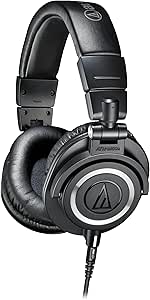 | Best for Detailed Studio Monitoring | Fit: Circumaural over-ear | Driver type and size: Dynamic, 45 mm | Impedance: 38 ohms | VIEW LATEST PRICE | See Our Full Breakdown |
| podcast headphones for broadcasting | Frequency response | Impedance | Warranty | Sensitivity |
|---|---|---|---|---|
| Audio-Technica ATH-M30x Profes | 20 Hz–20,000 Hz | 38 ohm | 2 years on parts and labor | 100 dB |
| Audio-Technica ATH-M20x Profes | 15–20,000 Hz | 47 ohm | 2 years on parts and labor | 96 dB |
| RØDE NTH-100 Professional Over | — | — | Lifetime manufacturer warranty after registration | — |
| FIFINE H8 Wired Studio Monitor | — | — | 1 year | — |
| OneOdio Pro-10 Wired Over-Ear | 40 kHz as listed in supplied product data | 32 ohm | — | 110 dB |
| Audio-Technica BPHS1 Broadcast | Headphones: 20 Hz–20 kHz; microphone: 40 Hz–20 kHz | 65 ohms | — | — |
| MAONO MH601 Wired Studio Headp | — | — | 3 years | — |
| Maono MH700 Wired Studio Headp | 20 Hz–20 kHz | — | 1 year | — |
| TASCAM TH-02 Wired Over-Ear St | 18 Hz–22 kHz | 32 ohms | — | 98 dB |
| talomen W550X Wired Studio Mon | 40 kHz (as listed) | — | — | 95 dB |
| Philips Over-Ear Wired Stereo | — | 16 ohms | — | — |
| Audio-Technica ATH-M50x Studio | 20 Hz–28,000 Hz | 38 ohms | 2 years | 99 dB |
More Details on Our Top Picks
Audio-Technica ATH-M30x Professional Studio Monitor Headphones, Black
For broadcasting, I’d favor the ATH-M30x when intelligible speech and isolation matter more than wireless convenience. Its 40 mm drivers and midrange-focused presentation can help voices remain clear while monitoring a recording, and the circumaural cups limit some room sound from reaching your ears. Compared with the lower-cost-oriented ATH-M20x, this model is the stronger fit when vocal detail is the priority rather than enhanced low-frequency emphasis. The foldable frame also suits hosts who carry headphones between a home booth and field sessions. The tradeoff is a fixed cable, which is less convenient to replace or reconfigure than the detachable leads on the RØDE NTH-100 and FIFINE H8. It is also wired, with no active noise cancellation or wireless mode.
Pros:- Midrange-focused sound supports clear speech monitoring.
- Over-ear circumaural design provides passive isolation.
- Foldable construction is convenient for field recording.
- Single-side cable and stated two-year parts-and-labor warranty.
Cons:- Fixed cable cannot be detached or replaced independently.
- No wireless connectivity or active noise cancellation.
- Does not include a microphone for live broadcast talkback.
Best for: Podcast hosts and editors who want a portable, isolated wired pair with a clear midrange for speech monitoring.
Not ideal for: Broadcasters who need a replaceable cable, wireless listening, or a headset with a built-in boom microphone.
- Brand:Audio-Technica
- Model:ATH-M30x
- Driver size and type:40 mm dynamic
- Impedance:38 ohm
- Frequency response:20 Hz–20,000 Hz
- Sensitivity:100 dB
- Design:Over-ear, circumaural, foldable
- Warranty:2 years on parts and labor
Our verdict“Choose the ATH-M30x if voice clarity, passive isolation, and portability matter more than a detachable cable or built-in microphone.”
Audio-Technica ATH-M20x Professional Studio Monitor Headphones
The ATH-M20x is the straightforward choice for a new podcaster who needs closed-back wired monitoring without extra connection options to manage. Its contoured earcups provide passive isolation, while the 40 mm drivers tuned for stronger low frequencies give program audio some weight. Compared with the ATH-M30x, the M20x puts less emphasis on midrange definition, so I’d choose the M30x when speech detail is the main priority. The M20x’s 3 m single-side cable can reach a desk interface without requiring an extension, but it can also snag or restrict movement in a compact recording space. As with the M30x, there’s no detachable cable or active noise cancellation, and this model has no microphone for direct broadcast use.
Pros:- Closed-back earcups help reduce room sound during tracking.
- 40 mm drivers are tuned for enhanced low-frequency performance.
- Long single-side cable can reach a desk-mounted interface.
- Stated two-year warranty covers parts and labor.
Cons:- The 3 m wired cable can limit movement and clutter a small setup.
- Passive isolation does not actively cancel background noise.
- Fixed cable and lack of a built-in microphone limit broadcast flexibility.
Best for: First-time podcasters setting up a fixed recording desk who need passive isolation and a long cable for an audio interface.
Not ideal for: Hosts who prioritize fine vocal detail over low-frequency emphasis, need a replaceable cable, or want a headphone-and-microphone headset.
- Brand:Audio-Technica
- Model:ATH-M20x
- Type:Closed-back over-ear headphones
- Driver size and type:40 mm dynamic
- Impedance:47 ohm
- Frequency response:15–20,000 Hz
- Sensitivity:96 dB
- Cable length:3 m (9.8 ft)
- Warranty:2 years on parts and labor
Our verdict“Pick the ATH-M20x for a simple fixed studio setup, but choose the ATH-M30x if speech clarity is your higher priority.”
RØDE NTH-100 Professional Over-Ear Headphones for Content Creation
For extended interviews, editing blocks, or all-day studio schedules, the NTH-100’s strongest case is session comfort paired with accurate monitoring. Its custom-matched drivers are designed for a consistent frequency response, while Alcantara cushions with CoolTech gel are intended to reduce heat buildup over long listening stretches. That makes it a different proposition from the more basic ATH-M20x: I’d choose the RØDE for comfort and setup flexibility, not simply to get closed-back monitoring. The locking, removable cable can be detached for storage or replaced, unlike the fixed cables on both Audio-Technica ATH-M models. The tradeoffs are that the standard setup is wired and the supplied data gives no weight or size figures for judging portability. This is a monitoring headphone, not a headset with a broadcast boom mic.
Pros:- Custom-matched drivers are designed for accurate frequency response.
- Alcantara and CoolTech gel cushions target comfort during long sessions.
- Locking removable cable supports replacement and flexible setup.
- Includes a 3.5 mm-to-1/4-inch adapter and a stated lifetime warranty after registration.
Cons:- Standard connectivity is wired; Bluetooth is optional rather than included.
- No weight or size specifications are provided in the supplied product data.
- No integrated boom microphone for direct voice capture.
Best for: Hosts, producers, and editors who spend long sessions monitoring speech and value a removable cable and cooling-focused ear cushions.
Not ideal for: Broadcasters seeking wireless audio included as standard, published portability measurements, or an integrated microphone.
- Brand:RØDE
- Model:NTH-100
- Color:Black
- Connectivity:3.5 mm wired; Bluetooth optional, not included by default
- Driver design:Custom-matched drivers
- Cable:Removable, locking connector with dual-sided attachments
- Included adapter:3.5 mm to 1/4 inch
- Warranty:Lifetime manufacturer warranty after registration
Our verdict“Choose the NTH-100 for long broadcast and editing sessions where comfort and a replaceable cable matter more than wireless use.”
FIFINE H8 Wired Studio Monitor Headphones with Detachable Cables
The FIFINE H8 is a practical fit for a broadcast desk that switches between devices, thanks to its two detachable coiled cables and included 3.5 mm and 6.35 mm connections. That flexibility gives it an advantage over the fixed-cable ATH-M20x and ATH-M30x: a damaged or inconvenient cable does not mean the same limitations at the connection point. Its closed-back design offers passive isolation for monitoring in a shared room, and the stated 265 g weight gives buyers a useful reference for headband comfort. The 50 mm drivers are described as delivering dynamic bass, clear mids, and accurate treble, though the supplied data does not establish a particular speech-tuning advantage over the RØDE NTH-100. The tradeoffs are wired-only operation, isolation that cannot block all room noise, and a one-year warranty.
Pros:- Includes detachable coiled cables with 3.5 mm and 6.35 mm connectors.
- Closed-back construction provides passive isolation for studio monitoring.
- Adjustable headband and padded cushions support extended listening.
- Stated weight of 265 g helps buyers gauge fit and portability.
Cons:- Wired-only design restricts movement away from the recording setup.
- Passive isolation may not block all environmental noise.
- One-year warranty is shorter than the stated coverage on several alternatives.
Best for: Home-studio podcasters and small production teams who connect to both 3.5 mm devices and 6.35 mm studio equipment.
Not ideal for: Broadcasters who need wireless monitoring, active noise cancellation, or the longer stated warranty of the RØDE NTH-100 and Audio-Technica models.
- Brand:FIFINE
- Model:H8
- Type:Wired over-ear studio monitor headphones
- Driver size:50 mm
- Frequency range:20 Hz–20 kHz
- Weight:265 g
- Cable and connectors:Two detachable 9.8 ft coiled cables; 3.5 mm and 6.35 mm
- Design and isolation:Closed-back, passive noise isolation
- Warranty:1 year
Our verdict“Pick the H8 if switching between common studio jack sizes and replacing cables easily matter more than wireless freedom or a longer warranty.”
OneOdio Pro-10 Wired Over-Ear DJ Headphones, Black
The Pro-10 stands apart from the ATH-M30x and RØDE NTH-100 by catering to broadcasters who need to monitor playback while keeping one ear available for the room or a conversation. Its 90° swiveling ear cups support that single-ear style, a useful option when coordinating guests or listening for studio cues. The 50 mm drivers are described as producing powerful bass, clear vocals, and crisp highs, a broad presentation that may suit general program checks but is less specifically framed around accurate speech monitoring than the NTH-100. Dual 3.5 mm and 6.35 mm jack compatibility also helps when moving between consumer devices and studio gear. The tradeoff is a 415 g listed weight, which may feel substantial during long sessions, plus wired-only connectivity and no built-in broadcast microphone.
Pros:- 90° rotating ear cups support single-ear monitoring.
- 50 mm dynamic drivers are described as delivering clear vocals and broad frequency detail.
- 3.5 mm and 6.35 mm audio jacks support varied studio and personal devices.
- Stated two-year warranty.
Cons:- Listed weight of 415 g may be less comfortable for extended wear.
- Wired-only operation limits movement around the studio.
- The supplied frequency-response figure is listed as 40 kHz, without a lower endpoint.
Best for: Hosts and producers who monitor one ear at a time and need compatibility with both 3.5 mm and 6.35 mm connections.
Not ideal for: Broadcasters who prioritize lightweight all-day wear, wireless listening, or a headphone with an integrated microphone.
- Brand:OneOdio
- Model:Pro-10
- Connectivity:Wired
- Driver size and type:50 mm dynamic
- Impedance:32 ohm
- Frequency response:40 kHz as listed in supplied product data
- Sensitivity:110 dB
- Audio jacks and ear cup rotation:3.5 mm and 6.35 mm; 90° rotation
- Weight and warranty:415 g; 2 years
Our verdict“Choose the Pro-10 if swiveling cups for single-ear monitoring matter more than lighter wear or a clearly specified frequency-response range.”
Audio-Technica BPHS1 Broadcast Stereo Headset with Dynamic Cardioid Boom Microphone
For a broadcast setup where a mic must stay in position and room sound needs controlling, the BPHS1 is the most purpose-built choice here. Its dynamic cardioid boom microphone is designed to favor the speaker over off-axis sound, while the closed-back ear cups help limit headphone bleed into the mic. That integrated arrangement is more straightforward for announcing and interviews than the MAONO MH601 or TASCAM TH-02, which require a separate microphone. The boom can be positioned on either side, and the headset offers separate XLR microphone and 6.3 mm headphone outputs. The tradeoff is a specialized 8-pin headset connector and wired operation, so it is less flexible than ordinary studio headphones and may need compatible broadcast equipment. I would skip it if a detachable, standalone headset mic is not a priority.
Pros:- Dynamic cardioid boom mic helps reduce pickup of off-axis sound.
- Closed-back, circumaural ear cups help limit ambient noise and headphone bleed.
- Boom microphone can be positioned on the left or right.
- Separate XLRM microphone and 6.3 mm TRS headphone outputs suit broadcast setups.
Cons:- The 8-pin headset connection makes compatibility more specialized than standard headphone connections.
- Wired cable limits movement around the studio.
- Its integrated broadcast design is less versatile than standalone headphones paired with a separate mic.
Best for: Broadcasters, announcers, and interview hosts who need a close-positioned boom mic and separate mic and headphone connections.
Not ideal for: Podcasters seeking headphones for a general-purpose audio interface or casual listening, especially if they do not have compatible connections for the headset.
- Microphone type:Dynamic
- Microphone polar pattern:Cardioid
- Headphone design:Closed-back, circumaural
- Frequency response:Headphones: 20 Hz–20 kHz; microphone: 40 Hz–20 kHz
- Impedance:65 ohms
- Cable length:3.3 m (10.8 ft)
- Connectors:8-pin headset connector, 3-pin XLRM microphone output, 6.3 mm TRS headphone output
- Weight:9.3 oz
Our verdict“Choose the BPHS1 for voice-led broadcasting when a boom mic and closed-back monitoring in one headset matter more than plug-and-play versatility.”
MAONO MH601 Wired Studio Headphones for Podcast, Recording, Streaming, and DJ Mixing
The MAONO MH601 makes sense for a broadcaster who already owns a microphone and wants one set of headphones for monitoring, editing, and other studio tasks. Its 50 mm drivers, closed listening fit, and long detachable spring cable give it a more studio-oriented role than the Audio-Technica BPHS1, which is built around an integrated broadcast boom mic. The MH601 has no microphone, so it cannot serve as a single-piece host headset; that is a real limitation for call-ins or portable interview rigs. Its foldable design and interchangeable 3.5 mm and 6.35 mm connections are useful when moving between a computer and mixer, while the listed 85% noise isolation may help reduce distractions during monitoring. I would choose it over the similarly mic-free Maono MH700 for the stated long cable and three-year warranty, but not if a compact, short-cable setup is the priority.
Pros:- 50 mm drivers are suited to monitoring and general studio listening.
- Detachable spring cable includes 3.5 mm and 6.35 mm connection options.
- Foldable design is convenient for transport and storage.
- Protein memory cushions and stated 85% noise isolation support longer monitoring sessions.
Cons:- No built-in or detachable microphone, so a separate mic is required for broadcasting.
- The 9.8 ft spring cable may feel cumbersome in a compact desk setup.
Best for: Home-studio podcasters who already have a dedicated microphone and want wired headphones that can connect to both consumer devices and studio gear.
Not ideal for: Hosts who need an integrated boom microphone, or editors who prefer a short, straight cable for desk use.
- Driver size:50 mm
- Cable length:9.8 ft
- Cable:Detachable spring cable
- Connectivity:Wired
- Jack options:3.5 mm and 6.35 mm
- Noise isolation:85% (as stated in product description)
- Design:Foldable
- Warranty:3 years
Our verdict“Pick the MH601 if you already have a broadcast microphone and want adaptable wired monitoring rather than an all-in-one headset.”
Maono MH700 Wired Studio Headphones
The Maono MH700 is a practical pick when broadcasting involves switching between a computer, interface, or mixer. It includes both a 1.2 m straight cable with a 3.5 mm plug and a 3 m coiled cable ending in 6.35 mm, so the connection can match the session without relying on one long cable and adapter. Its closed-back construction and soft cushions suit voice monitoring, though the headphones have no microphone; unlike the Audio-Technica BPHS1, they cannot handle host voice capture on their own. The foldable, reversible ear cups also make storage easier than with a fixed studio design. Compared with the MAONO MH601, the MH700’s separate cable choices are more tailored to switching setups, but its listed one-year warranty is shorter than the MH601’s three years. It is wired only and weighs 0.4 kg, so it is not the lightest portable option.
Pros:- Includes separate straight 3.5 mm and coiled 6.35 mm cables for different studio connections.
- Closed-back design helps contain playback during microphone recording.
- Foldable, reversible ear cups aid storage and portability.
- 50 mm drivers and a stated 20 Hz–20 kHz response suit general monitoring.
Cons:- No microphone is included, so broadcasting requires separate voice-capture equipment.
- Wired-only connectivity offers no wireless option.
- Its one-year warranty is shorter than the three-year warranty listed for the MAONO MH601.
Best for: Podcasters and small studios that alternate between consumer devices and mixers or interfaces and already use a separate microphone.
Not ideal for: Broadcasters who need an integrated mic, wireless listening, or a particularly lightweight headset for frequent travel.
- Driver size:50 mm
- Frequency response:20 Hz–20 kHz
- Connectivity:Wired
- Included cables:1.2 m straight 3.5 mm cable and 3 m coiled 6.35 mm cable
- Weight:0.4 kg
- Design:Closed-back, foldable, reversible ear cups
- Included items:Headphones, two cables, storage bag, user manual
- Warranty:1 year
Our verdict“Choose the MH700 if separate cables for computer and studio gear matter more than an included mic or wireless use.”
TASCAM TH-02 Wired Over-Ear Studio Monitor Headphones
The TASCAM TH-02 suits a broadcaster who wants a basic, foldable monitoring pair that can travel between a desk and a recording space. Its 32-ohm impedance and 3.5 mm connector make it a straightforward match for many everyday audio sources, while the included 6.3 mm adapter extends use to studio equipment. That is simpler than the Maono MH700’s two-cable arrangement, but less flexible if you want to switch cable lengths or connectors. The closed-back design and padded contact points are useful for tracking, yet this model has no microphone, so it cannot replace the Audio-Technica BPHS1 for an announcer who needs a headset mic. A retractable cable helps with storage, although it gives less control over cable choice than detachable-cable options. This is a functional monitoring pick, not a complete broadcast headset.
Pros:- Foldable design is convenient for storage and transport.
- Includes a 3.5 mm to 6.3 mm adapter for different audio connections.
- Closed-back construction supports monitoring while recording.
- 32-ohm impedance suits a broad range of common wired sources.
Cons:- No microphone is included, unlike the integrated BPHS1 broadcast headset.
- Retractable cable limits replacement and cable-length choices.
- Wired connection restricts movement away from the source.
Best for: Beginning podcasters who need foldable wired headphones for monitoring and editing, with an adapter for occasional mixer or interface use.
Not ideal for: Hosts who need a boom microphone, or studio users who want a detachable cable and multiple cable-length options.
- Type:Wired, closed-back over-ear headphones
- Driver type and size:Dynamic, 50 mm
- Frequency response:18 Hz–22 kHz
- Impedance:32 ohms
- Sensitivity:98 dB
- Connector and adapter:3.5 mm jack; 3.5 mm to 6.3 mm adapter included
- Cable:Retractable
- Weight:0.3 kg
Our verdict“The TH-02 is a sensible basic monitor pair for mobile or entry-level setups, provided you have a separate microphone.”
talomen W550X Wired Studio Monitor Headphones with Detachable Boom Microphone
The talomen W550X stands apart from the MAONO and TASCAM monitor headphones by including a detachable cardioid boom microphone. That makes it a more complete option for a streamer or podcaster who wants one wired headset for voice capture and monitoring, although the mic detaches when you want to use the headphones independently. Compared with the broadcast-focused Audio-Technica BPHS1, the W550X offers a 3.5 mm/6.35 mm connection path and a supplied splitter, but its product data does not provide the same microphone frequency-response or headset-connector detail. The coiled cable, case, and replaceable ear cushions add practical studio flexibility. Its listed weight of 1 kg is a substantial drawback for long sessions, and the stated 40 kHz frequency response is not clearly specified as a range. I would favor it for accessory breadth, not for a lightweight broadcast rig.
Pros:- Detachable cardioid boom microphone provides an integrated voice-capture option.
- 3.5 mm and 6.35 mm connections support a range of wired audio gear.
- Includes a coiled cable, mic splitter, protective case, and replaceable ear cushions.
- Memory foam cushions and passive noise control support studio monitoring.
Cons:- Listed weight of 1 kg may be tiring during long recording sessions.
- Wired-only connectivity limits movement.
- The listed 40 kHz frequency response is not given as a range, making the specification unclear.
Best for: Streamers and podcasters who want a detachable boom mic, wired monitoring, and a supplied splitter and case in one kit.
Not ideal for: Broadcasters who prioritize a lightweight headset for long sessions or need clearly documented microphone and frequency-response specifications.
- Connectivity:Wired
- Driver type and size:Dynamic, 50 mm
- Microphone:Detachable cardioid boom microphone
- Headphone jacks:3.5 mm and 6.35 mm
- Audio impedance:32 ohms
- Frequency response:40 kHz (as listed)
- Sensitivity:95 dB
- Weight:1 kg
- Included accessories:Coiled audio cable, mic Y-splitter, protective case, replaceable leather ear cushions, user manual
Our verdict“Choose the W550X if a detachable boom mic and included studio accessories matter more than low weight and precise published specifications.”
Philips Over-Ear Wired Stereo Headphones with 6.3 mm Adapter
The Philips P2000 is a straightforward pick for broadcasters who want to monitor a voice feed while keeping one ear available to the room. Its 90-degree swiveling ear cups make that practical, and the 6.3 mm adapter lets the included 3.5 mm plug connect to compatible studio equipment. The cushioned over-ear fit and 2 m cable suit a fixed recording desk, though the cable limits movement compared with a wireless setup.
Compared with the Audio-Technica ATH-M50x, the Philips offers less supplied detail about sound performance and lacks a detachable cable, but its lower 16-ohm impedance is a simple match for many everyday headphone outputs. Choose it for basic monitoring and one-ear use; skip it if you need a replaceable cable or a more fully specified studio-monitoring option.
Pros:- 90-degree swiveling ear cups support one-ear monitoring
- Includes a 6.3 mm adapter for compatible studio connections
- Cushioned ear cups and adjustable headband suit extended sessions
- 40 mm dynamic drivers provide a full-size over-ear listening format
Cons:- Fixed 2 m cable restricts movement and cannot be detached for replacement
- No water resistance for use around drinks or in damp settings
- The supplied specifications provide less sound-performance detail than the ATH-M50x
Best for: Home podcasters and radio presenters who want a wired monitoring option with a swiveling cup for listening with one ear.
Not ideal for: Broadcasters who move around the studio, need a detachable cable for frequent replacement, or require water-resistant headphones.
- Fit:Over-ear
- Connectivity:Wired
- Driver type and size:Dynamic, 40 mm
- Impedance:16 ohms
- Headphone jack:3.5 mm
- Included adapter:6.3 mm snap-on
- Cable length:2 m
- Ear cup rotation:90 degrees
- Weight:8.8 ounces
Our verdict“Choose the Philips P2000 for simple wired podcast monitoring and one-ear listening, but pick the ATH-M50x if you want a detachable cable and more detailed published audio specifications.”
Audio-Technica ATH-M50x Studio Monitor Headphones – Black, Detachable Cable
The ATH-M50x is the more specification-rich choice for broadcasters who want to hear subtle details in dialogue and playback. Its 45 mm drivers, stated 20 Hz–28,000 Hz response, and circumaural isolation support focused monitoring, while the detachable cable can be removed for storage or replaced if it becomes damaged. That cable flexibility is a clear advantage over the fixed-cable Philips P2000.
Its strengths come with practical limits: the over-ear design can feel bulky when packed, and the headphones are not water-resistant. The 38-ohm impedance is also higher than the Philips’s 16 ohms, so buyers should check compatibility with their monitoring source rather than assume every output will drive them equally well. This is a stronger fit for a dedicated recording setup than for lightweight, mobile use.
Pros:- 45 mm drivers and a stated 20 Hz–28,000 Hz frequency response
- Circumaural design provides isolation for focused monitoring
- Detachable cable simplifies storage and replacement
- Robust construction with an aluminum enclosure and durable earpads and headband
Cons:- Bulky over-ear design is less convenient for travel
- Not water-resistant
- 38-ohm impedance is higher than the Philips P2000’s 16 ohms, so source compatibility merits a check
Best for: Podcasters and broadcast editors who monitor in a fixed studio, value detailed playback, and want a cable they can detach or replace.
Not ideal for: Mobile broadcasters prioritizing a compact travel pair, or anyone who needs water resistance or a built-in broadcast microphone.
- Fit:Circumaural over-ear
- Driver type and size:Dynamic, 45 mm
- Impedance:38 ohms
- Frequency response:20 Hz–28,000 Hz
- Sensitivity:99 dB
- Cable:Detachable
- Enclosure material:Aluminum
- Color:Black
- Warranty:2 years
Our verdict“Pick the ATH-M50x for detailed, isolated studio monitoring and a replaceable cable, while choosing the Philips P2000 for simpler one-ear monitoring and lower impedance.”

How We Picked
I ranked these headphones around the jobs they need to do in a broadcast setting: let a host hear speech clearly, remain comfortable through recording sessions, and work reliably with common wired audio setups. I also looked at practical distinctions such as detachable cables, an integrated boom microphone, and whether a model is positioned for content creation, monitoring, or general studio use. Those details affect day-to-day fit more than headline feature lists alone.
The order reflects how useful each model is to a range of podcast broadcasters, not a claim that one design suits every studio. The ATH-M50x ranks first for its versatile monitoring role and detachable cable; the BPHS1 earns a distinct place for buyers who need a headset microphone. Models with a simpler feature set remain relevant for basic recording, but rank below options with a clearer advantage for broadcast workflows. I treated the product descriptions as the available evidence and avoided assuming unlisted specifications or performance results.
Factors to Consider When Choosing Podcast Headphones For Broadcasting
Before choosing, decide what your headphones must do during a show: monitor your own voice, help you catch recording issues, or provide a microphone as well. The right fit depends on your signal chain and routine, not just the label “studio monitor.”
Decide Whether You Need a Headset Microphone
A built-in boom microphone can simplify a setup when you need one headset for listening and speaking, but it is not automatically the right choice for every podcast. If you already use a dedicated microphone on a boom arm, regular monitoring headphones keep the listening and speaking roles separate. That separation can make it easier to position your mic independently and avoid buying a headset feature you will not use. A headset such as the BPHS1 is worth prioritizing when mobility, a broadcast station, or a shared communication workflow makes an attached mic useful. Before choosing, check that the headset connection matches your interface or mixer. The common mistake is comparing a headset and monitor headphones as if they solve the same problem.
Match the Headphones to Your Monitoring Job
Podcast monitoring is not the same as choosing headphones for casual listening: you need to hear speech and recording problems clearly enough to make decisions while working. A host monitoring live audio may value a secure, comfortable fit, while an editor may prioritize a familiar, detailed presentation across longer sessions. Do not assume that a model called “studio monitor” guarantees a particular sound profile; product names alone do not establish how a headphone will suit your ears or room. If possible, check whether the manufacturer provides useful fit and connection details before committing. Also decide whether you need one pair for both recording and editing or can use different headphones for each task. A single versatile pair is convenient, but role-specific equipment can be easier to manage in a larger setup.
Check Connector and Cable Compatibility First
A wired headphone is only useful if it connects cleanly to your recording gear. Check the headphone output on your interface, mixer, computer, or recorder, then confirm whether the included plug or an adapter will fit. A 6.3 mm adapter can help with common studio outputs, but it does not solve every compatibility issue. Detachable cables are a practical advantage because a damaged cable may be replaceable without replacing the entire headphone; they can also make storage less awkward. Fixed cables may suit a stationary desk, but they deserve more care around chair wheels, desk edges, and storage. Avoid buying on the assumption that every product includes the cable length, connector, or adapter your setup needs.
Treat Comfort as a Session-Length Decision
Comfort matters most when headphones stay on through long interviews, live segments, or editing blocks. Clamping force, earcup space, weight, and pad feel all affect whether a pair remains usable, and those details are personal rather than settled by a product category. If several hosts share equipment, choose a design that can be adjusted quickly and cleaned between users. Glasses, earrings, and hairstyle can also change how earcups sit, so factor in your usual recording setup. Avoid choosing solely by appearance or by a claim that a model is comfortable. Where possible, check the return policy and fit information before relying on one pair for long sessions.
Choose Isolation for Your Recording Environment
Headphones help you hear the show, but their ability to keep playback from reaching a nearby microphone depends on their physical fit and design. A quiet solo booth has different needs from a shared room where a guest, producer, or speaker is nearby. If headphones leak sound, an open microphone can pick up playback, particularly during pauses or quiet speech. Do not treat isolation as a substitute for sensible monitor levels or microphone placement. Consider who else is in the room and whether you need to hear outside cues while recording. A more enclosed fit may help in some settings, while a less isolating design can make communication around the studio easier.
Pay for Useful Workflow Features, Not Extra Labels
A higher-end model makes sense when a feature improves your regular work, such as a detachable cable for frequent transport or a dedicated boom mic for a headset-based station. If you only need wired headphones for occasional guest monitoring, a simpler model may cover the task without adding unused features. Compare what is actually included: cable design, adapters, microphone arrangement, and the intended use described by the manufacturer. Do not assume that a higher position in a product line is automatically better for your room, interface, or listening habits. It can help to list the one problem you want a new pair to solve before comparing options. That keeps a purchase focused on broadcast use instead of a feature checklist.
Frequently Asked Questions
Should I buy a headset with a boom microphone or separate headphones and a podcast mic?
Choose a boom-mic headset if you need an integrated speaking and listening setup, such as a broadcast station where quick, consistent positioning matters. Separate headphones and a dedicated microphone give you more freedom to place each component for your room and speaking style. They also make it easier to replace or upgrade one piece without changing the other. In this lineup, the BPHS1 is the clear headset-oriented option, while the other models are primarily headphone choices. Check how your interface handles the headset’s microphone connection before buying.
Can I use ordinary studio headphones for a live podcast broadcast?
Yes, monitoring headphones can work well for live broadcasting if they connect to your mixer or interface and let you hear the voices and program audio clearly. They do not provide a microphone, so you still need a separate mic for each speaker. Keep playback levels controlled and check for sound leaking into open microphones, especially in a shared room. A model with a detachable cable can be convenient if the headphones are frequently moved around the studio. For a headset-and-mic setup in one unit, compare that approach with the BPHS1 instead.
Do I need detachable cables for podcast headphones?
Not necessarily, but a detachable cable can make maintenance easier: if the cable wears out, you may be able to replace it without replacing the headphones. This can be especially helpful in a studio where gear gets packed away or moved between rooms. A fixed cable can still be a sensible choice for a stationary setup if it is routed safely and handled carefully. Check that any replacement cable uses the correct connector and is suitable for the model. In this roundup, the ATH-M50x and FIFINE H8 are examples where detachable-cable design is part of the product description.
Which features should I prioritize if several hosts share one pair of headphones?
Prioritize an adjustable fit, durable handling, and a cable connection that suits the studio’s equipment. Shared headphones also need a practical cleaning routine, especially when multiple people wear them during a recording session. If hosts have different head sizes or wear glasses, fit can vary more than product descriptions suggest. A detachable cable may help with upkeep, but it does not replace care for the headband and ear cushions. If possible, let each regular host check the fit before committing to one shared pair.
Will a 6.3 mm adapter make any of these headphones work with my audio interface?
An adapter can match plug sizes, but it cannot guarantee compatibility with every interface or solve other connection needs. Check the headphone output on your specific interface and compare it with the headphone’s included plug and adapter. For a headset with a microphone, verify the mic connection separately; a headphone adapter may only address the listening side. Also confirm that the cable reaches comfortably from your recording position to the output. The Philips model’s product name specifies a 6.3 mm adapter, but buyers should still check their own gear before ordering.
Conclusion
For most broadcasters who want one versatile monitoring pair, I’d choose the Audio-Technica ATH-M50x as best overall, with its detachable cable and broad studio-monitor role. My best premium-style pick for content creation is the RØDE NTH-100, while the BPHS1 is best for buyers who specifically need an integrated boom microphone. For a simpler, value-focused wired setup, compare the ATH-M20x, TASCAM TH-02, and FIFINE H8 by their connection and cable needs rather than assuming one fits every budget or studio. Beginners who already have a separate microphone can start with a straightforward monitor model such as the ATH-M20x; beginners seeking an all-in-one headset should look at the BPHS1 instead. If your priority is a detachable cable on a content-creation-focused model, consider the RØDE NTH-100; if you need a straightforward pair with a listed 6.3 mm adapter, check the Philips option. Match the pick to your mic setup and recording routine before deciding.
Fall Picks
fall essentials
As an affiliate, we earn on qualifying purchases.