
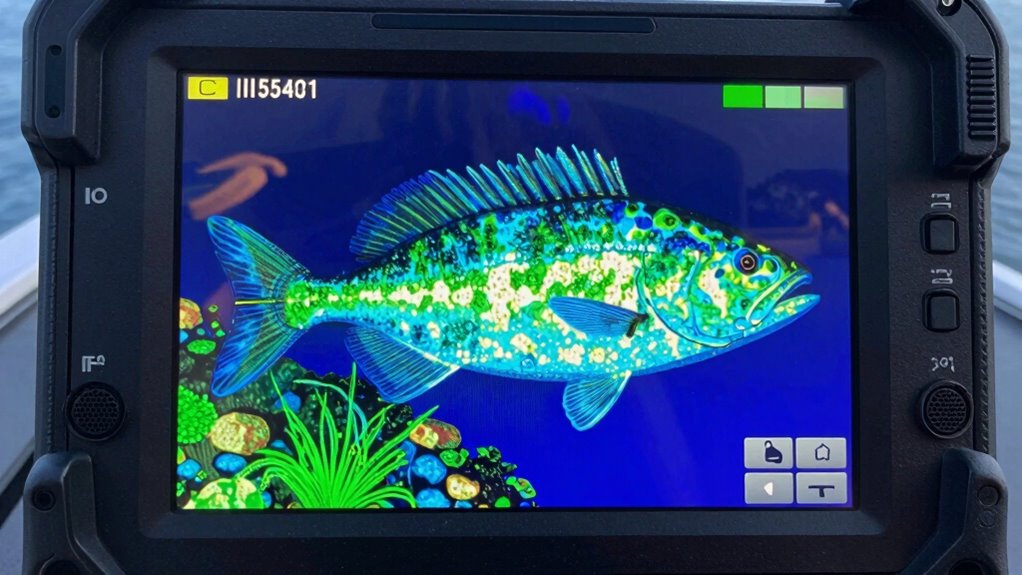

Your fish finder display shows underwater terrain like the lake or ocean floor with contours, structures, and vegetation, helping you spot where fish might hide. Sonar sends sound waves, creating images that distinguish fish—like arches—and the bottom, typically shown as flat lines. Colors and shapes indicate fish size and activity, while adjusting settings sharpens these images. Mastering these features lets you find fish more effectively—keep exploring to uncover even more tips and tricks.

Get everyday essentials delivered free with Prime
- Fast, free delivery on millions of items
- Prime Video, Amazon Music and more included
- Member-only deals all year
Key Takeaways
- Fish finders display underwater terrain, structures, and fish locations using sonar imaging and color-coded signals.
- Solid arches typically represent fish, while flat lines indicate the bottom; colors show signal strength.
- Adjusting sonar settings like gain and sensitivity sharpens images and helps differentiate fish from clutter.
- Recognizing underwater features like drop-offs and structures improves fishing strategy and spot selection.
- Multiple fish arches or clusters suggest active schools, aiding in locating productive fishing areas.
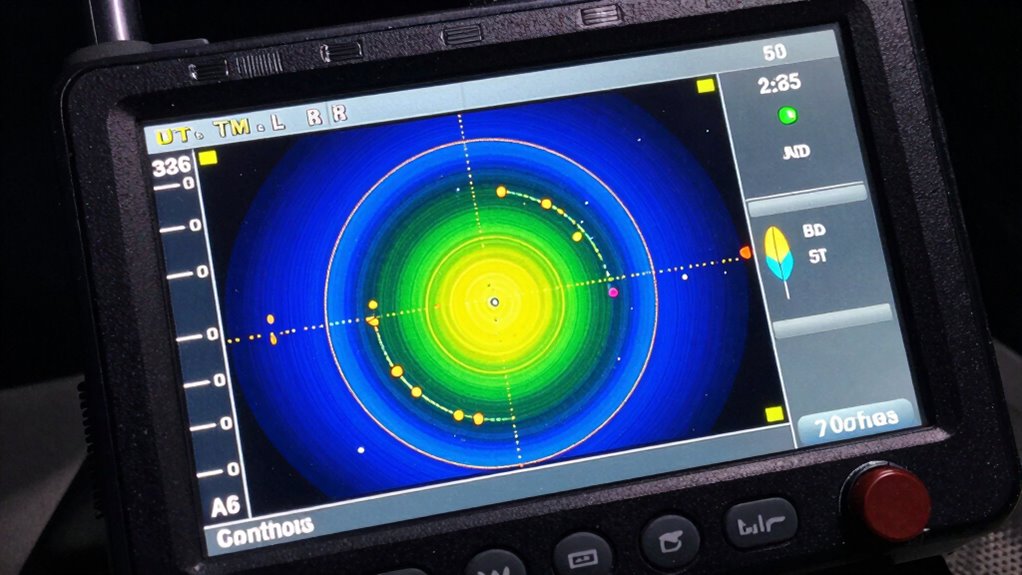
Understanding fish finder screens and sonar terms can feel overwhelming at first, but breaking them down makes it much easier to interpret what you’re seeing. When you look at the screen, you’re fundamentally viewing a detailed map of what’s beneath your boat, created through underwater mapping techniques. This mapping shows the contours of the lake or ocean floor, revealing drop-offs, submerged structures, and vegetation that fish often hide around. As you become more familiar with these visuals, you’ll start to notice patterns and differences, helping you identify promising spots for fishing.
Sonar technology works by sending sound waves into the water. When these waves hit objects like fish or the bottom surface, they bounce back to the transducer and are converted into images on your screen. The key to understanding these images is recognizing what different shapes and colors represent. For example, a solid, arch-shaped target might indicate a fish, while a flat, continuous line often shows the bottom. The colors on your display—ranging from red to green to blue—help you gauge the size and density of what’s below. Red usually indicates stronger signals, which can mean larger fish or denser structures, while blue and green might show weaker returns.
Effective fish behavior interpretation comes with practice. Fish tend to stay near underwater structures, so if you see a cluster of shapes hovering around a particular feature, it’s worth considering that those are active fish. Look for signs of movement or schools of fish, which often appear as multiple arches grouped together. Also, pay attention to the depth readings and the size of the arches. Larger, more defined shapes usually signal bigger fish, while smaller silhouettes might be smaller species or baitfish. Developing an understanding of sonar signals can significantly improve your ability to distinguish between different underwater objects. Additionally, understanding how to read mapping data can help you locate the most productive fishing spots more efficiently. Learning to interpret underwater features can also provide insight into fish habitats and movement patterns. To further enhance your skills, experimenting with different settings and adjustments can reveal new details about what’s beneath the water surface.
As you get more comfortable with your fish finder’s screen, you’ll start to notice how different settings affect the images. Adjusting gain, sensitivity, and frequency can sharpen images and help you distinguish between fish and clutter. Remember, underwater mapping isn’t just about finding fish; it’s about understanding the environment beneath your boat. Utilizing mapping techniques can enhance your ability to identify productive fishing spots and avoid unnecessary guesswork. When combined with fish behavior interpretation, this knowledge allows you to make smarter decisions about where to cast your line and when to move on. Over time, these skills will become second nature, giving you a clear edge on the water. The more you learn to read these signals, the better your chances of a successful catch.
As an affiliate, we earn on qualifying purchases.
Frequently Asked Questions
How Do I Choose the Best Fish Finder for My Boat?
To choose the best fish finder for your boat, consider your boat’s size and your fishing needs. Focus on boat mounting options to guarantee it fits securely and is easy to access. Check the power source compatibility—whether it’s 12V or higher—to ensure reliable operation. Also, think about screen size and sonar features that match your fishing environment, so you get clear images and accurate readings every time.
What Is the Difference Between Traditional and CHIRP Sonar?
Traditional sonar uses a single, fixed sonar frequency, usually around 200 kHz, giving you a clear, detailed image at a specific depth. CHIRP sonar, however, sends a range of frequencies simultaneously, providing more precise data across various depths. This means your transducer depth gets better, and you get less clutter on the screen. CHIRP offers clearer images and detects fish more accurately, especially at different depths, compared to traditional sonar.
How Often Should I Calibrate My Sonar Settings?
You should calibrate your sonar settings regularly, ideally before each fishing trip or every few weeks, to maintain proper calibration frequency. Frequent calibration ensures your sonar remains accurate, helping you detect fish and underwater structures more precisely. If you notice inconsistent readings or reduced sonar accuracy, it’s time to recalibrate. Proper calibration keeps your fish finder performing at its best, maximizing your success on the water.
Can Fish Finders Be Used for Freshwater and Saltwater?
Did you know that over 80% of fish finders work in both freshwater and saltwater? Yes, you can use your fish finder for both water types. Just check your device’s compatibility, as some models are specifically designed for one or the other. Most modern fish finders have adjustable settings to handle the different water conditions, making them versatile tools for all your fishing adventures.
What Maintenance Is Required for Long-Term Sonar Performance?
To guarantee long-term sonar performance, you need to regularly calibrate your sensor and prevent corrosion. Check the sensor calibration periodically to maintain accurate readings, especially after impacts or changes in water conditions. Additionally, clean the transducer and apply corrosion prevention measures, like protective coatings or zinc anodes, to avoid saltwater damage. Proper maintenance keeps your fish finder functioning reliably, providing clear, precise sonar images over time.
As an affiliate, we earn on qualifying purchases.
Conclusion
Now that you’ve unraveled the mysteries behind fish finder screens and sonar terms, you’re ready to navigate the waters with confidence. Think of your sonar as a trusty compass, guiding you through the underwater world like a lighthouse in the night. With this knowledge, you’re not just fishing—you’re mastering the art. So gear up, cast your line, and let your newfound understanding lead you to the big catch waiting beneath the surface.
As an affiliate, we earn on qualifying purchases.
As an affiliate, we earn on qualifying purchases.
Halloween Picks
halloween
As an affiliate, we earn on qualifying purchases.